
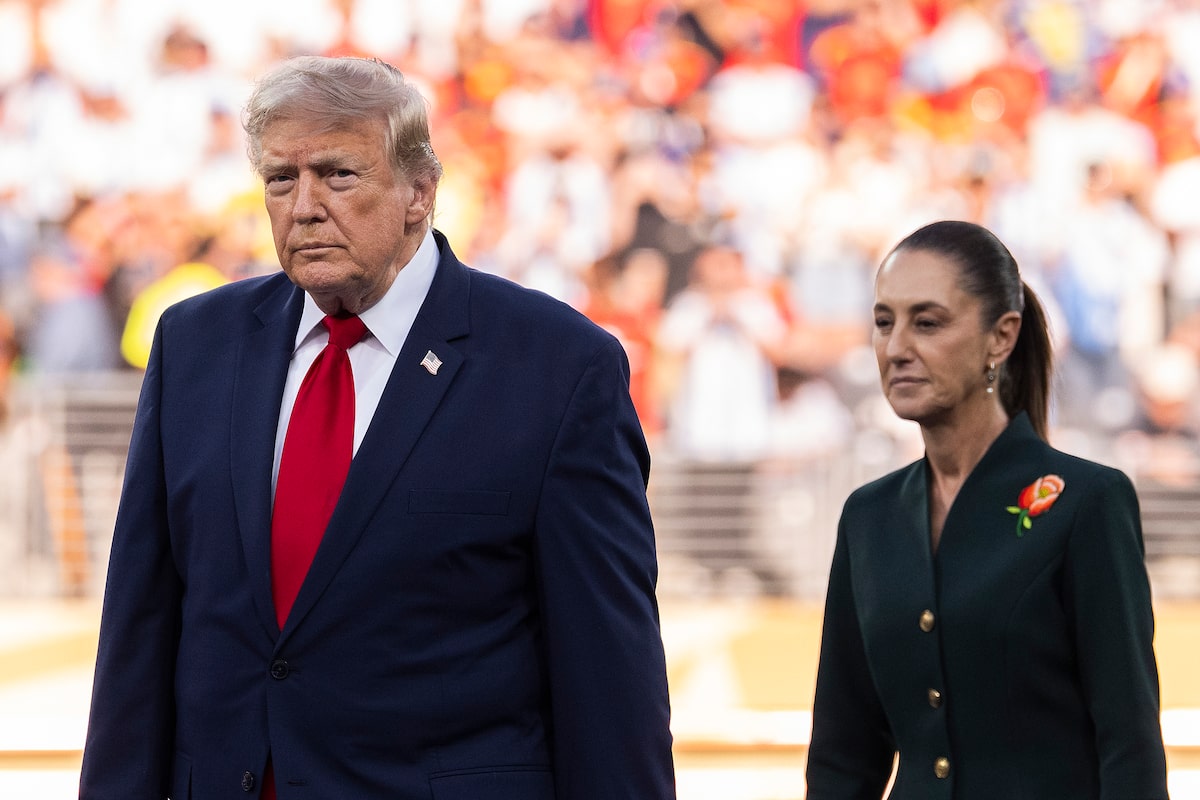
Drama has often characterized the U.S.-Mexico relationship under U.S. President Donald Trump, who has mused about sending U.S. troops into Mexico to combat drug cartels – an idea vehemently opposed by Mexican President Claudia Sheinbaum.David Ramos/Getty Images
The trade talks between Canada and the United States have drawn intense interest from Mexican officials, as the tentative deal between Ottawa and Washington is expected to become the template for Mexico’s negotiations with the Trump administration, according to analysts.
Sources told The Globe and Mail the U.S. wanted to strike a deal with Canada on autos similar to the agreement it is negotiating with Mexico. Mexican Economy Secretary Marcelo Ebrard, the country’s point person on international trade, confirmed shortly after midnight Wednesday that he had met with U.S. Trade Representative Jamieson Greer to discuss tariffs.
Analysts say Mexico watched the Canada-U.S. negotiations with an eye on rules of origin in the automotive sector, which has mushroomed in Mexico over the past 30 years of continental free trade. “Whatever Canada agrees with the U.S. will become the departing point” for Mexico-U.S. talks, said Juan Carlos Baker Pineda, a former Mexican vice-minister of foreign trade and researcher at the Universidad Panamericana in Mexico City.
“We probably have to agree to what we can in order to lower the burden of those tariffs and then live to negotiate another day,” he said of the Mexican negotiating position.
Mexican President Claudia Sheinbaum did not address the Canada-U.S. trade talks during her Wednesday news conference.
Ms. Sheinbaum’s administration has made concessions to the U.S. in a bid to keep the border open to its exports, including cracking down on migrants, and handing over alleged crime bosses, among others.Eduardo Verdugo/The Associated Press
Mexico and the U.S. have already held three rounds of talks to review the U.S.-Mexico-Canada Agreement, with a fourth scheduled for September. Mr. Greer has spoken positively of discussions with Mexico, describing the Mexican side as “pragmatic,” while also observing in July: “They are quite dependent on our market for their growth and for their employment. They know that we know that. That’s why we’re able to proceed in a fairly non-dramatic way with the Mexicans.”
But the U.S. side injected drama into trade talks with Mexico Tuesday, alleging Mexico was dumping strawberries into the U.S. market during the winter months. Mexico’s Economy Secretariat expressed concern over the preliminary decision by the U.S. Department of Commerce, saying it used two “arbitrary concepts,” including a previous decision from the U.S. International Trade Commission that “there was no basis to accept the existence of a product called ‘winter strawberries’ as something different from the product ‘strawberries.’”
Drama has often characterized the U.S.-Mexico relationship under U.S. President Donald Trump, who has often mused about sending U.S. troops into Mexico to combat drug cartels – an idea vehemently opposed by Ms. Sheinbaum.
Mexico has been eager to strike a deal with the U.S. to renew the USMCA, which is critical for its manufacturing-for-export economy. The country sends more than 80 per cent of its exports to America. And, unlike Canada, Mexico has not openly courted other countries as alternate markets or spoken of ruptures with the U.S.
Mexico not looking to cut separate deal with U.S. and leave Canada out, top diplomat says
“Mexico can’t leave the negotiation table without the USMCA,” said Diego Marroquín, a Mexican trade expert at the Washington-based Center for Strategic and International Studies. “The economy will obviously stagnate without it. … There is no way that they can maintain the current social program structure that has made President Sheinbaum so successful electorally.”
While the U.S. has agreed to more talks in September, some observers caution against reading that as a sign that Mexico is pursuing a more sound strategy than Canada.
“Canada is nowhere close to where Mexico is regarding the USMCA review process,” said Arturo Sarukhán, a former Mexican ambassador in Washington. “But at the same time, despite the vindictiveness in the Trump administration and of the President toward Canada, Canada is nowhere as vulnerable politically and diplomatically in terms of hard power than where Mexico is.”
Ms. Sheinbaum has made quiet and frequent concessions to keep the U.S. border open to Mexican exports. Her administration has cracked down on migrants transiting Mexico, handed over 92 alleged crime bosses to U.S. authorities, stopped shipping oil to Cuba at the behest of the Trump administration and settled water debts with the U.S.
But the pressure keeps coming from Washington, especially as the Trump administration targets politicians from the ruling Morena party over accusations of corruption and alleged ties to drug cartels.
“There are three points of leverage: tariffs, military action and Morena politicians,” said Brenda Estefan, a geopolitics professor at the IPADE business school in Mexico City.
Andrew Coyne: There is no appeasing Donald Trump, or deterring him
The U.S. Department of Justice has indicted the Morena governor of Sinaloa state – home to the eponymous drug cartel – on drug charges. Rubén Rocha Moya has taken a leave of absence but denies any wrongdoing and has accused the U.S. of trying to weaken Morena.
Andrés Manuel López Beltrán, the son of former president Andrés Manuel López Obrador, recently revealed in an angry three-page letter to Mr. Trump that he had his U.S. visa revoked – an act he branded “a crude and perverse act of villainy.”
Morena leaders have rallied around Mr. López Beltrán, known as “Andy,” with Ms. Sheinbaum calling the visa revocation “interference in Mexican politics.”
Analysts saw the ruling party protecting itself. “If the Americans later release damaging information or take additional action against Andy or other Morena figures, the base has already been given the interpretation: ‘We told you this was political persecution,’” said Luis Antonio Espino, a Mexican political analyst in Toronto. “Future evidence can then be absorbed as confirmation of the original persecution narrative.”
The U.S. pressure on Mexico has stoked uncertainty. And economic growth remains sluggish. But analysts point to signs of resilience in the Mexican manufacturing sector. The AI boom has sent Mexican exports of computer equipment soaring in 2026, overtaking the automotive sector as Mexico’s leading export category.
“The manufacturing exporting industry in Mexico has been resilient enough, strong enough to find its way around the geopolitical situation and the tariffs,” Mr. Baker Pineda said.