
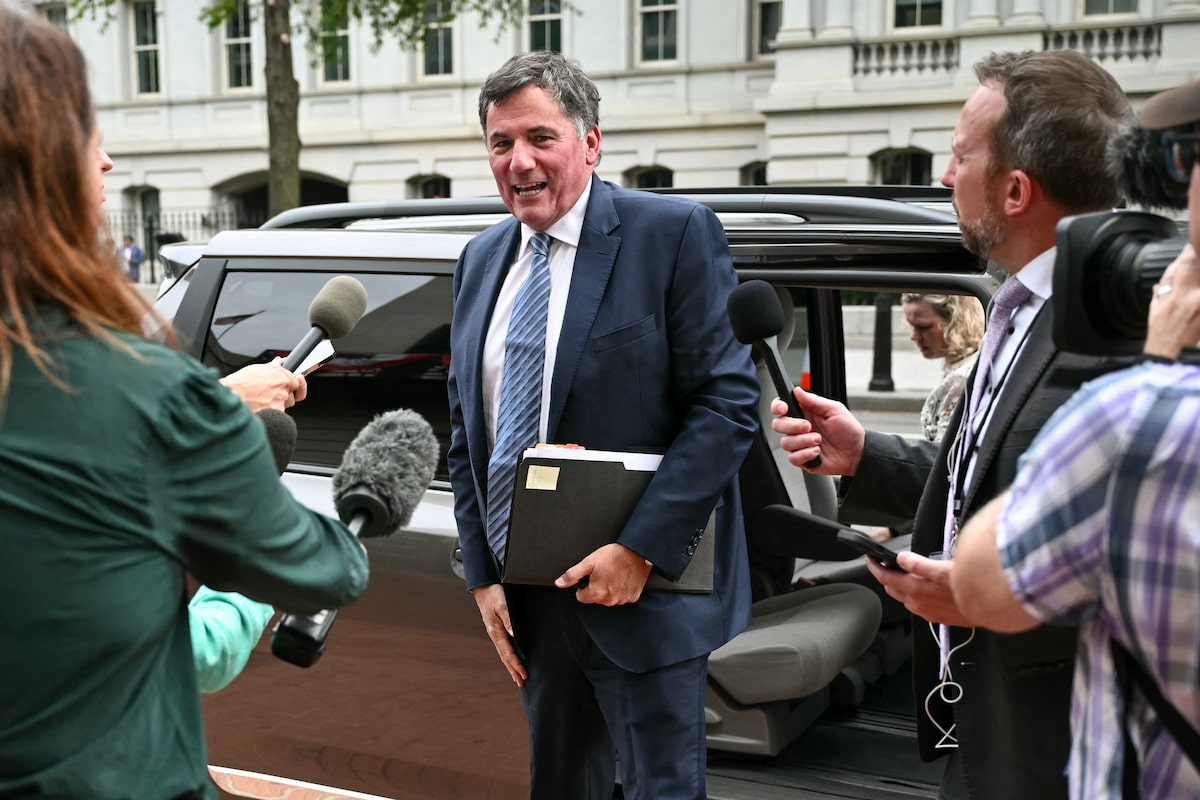
Dominic LeBlanc, the federal minister in charge of U.S.-Canada trade, arrives for a meeting with U.S. Trade Representative Jamieson Greer in Washington on Thursday as trade talks continue.MANDEL NGAN/AFP/Getty Images
Canada’s top trade negotiators are meeting with their U.S. counterpart in Washington on Thursday as the two sides work to close a deal meant to offer some relief to Ottawa from U.S. President Donald Trump’s tariffs in exchange for a suite of Canadian concessions.
Dominic LeBlanc, the Minister responsible for Canada-U.S. trade, and chief negotiator Janice Charette are sitting down with U.S. Trade Representative Jamieson Greer at the latter’s office in the Winder Building near the White House on Thursday afternoon. Mr. LeBlanc had returned from Washington to Ottawa on Wednesday after his last meeting with Mr. Greer. He returned to Washington on Thursday. Ms. Charette has been effectively living in the U.S. capital for the better part of a month as the two sides worked feverishly for a deal.
Mr. LeBlanc and Ms. Charette arrived at Mr. Greer’s office shortly after noon. They were accompanied by Mr. Carney’s chief of staff, Marc-André Blanchard.
“I’m always looking forward to being back at work,” Mr. LeBlanc told reporters on the way in. “We brought some friends from Ottawa.”
The group did not respond to questions about how close a deal is to being closed or if provincial premiers are on side.
Mr. Trump announced that the countries had reached an agreement on Tuesday night, less than two hours before he was set to hammer Canada with 50-per-cent tariffs on US$20-billion worth of goods, under Section 338 of the Smoot-Hawley Tariff Act. But Mr. Carney told provincial premiers on Wednesday that crucial details – such as the amount of tariff relief Canada will receive – are still being haggled over.
Mexico is watching Canada-U.S. trade talks closely
The Globe and Mail has reported that Canada was hoping to trade concessions on a long list of U.S. demands for reduced tariffs under Section 232 of the Trade Expansion Act on autos, steel, aluminum and forestry, which Mr. Trump imposed last year, and for the President not to implement his latest threatened Smoot-Hawley tariffs. Mr. Trump has “paused” those latest tariffs until 12:01 a.m. on Saturday while the two sides try to close a deal.
Canada-U.S. Trade Minister Dominic LeBlanc and U.S. Trade Representative Jamieson Greer speak to reporters on Wednesday.
The Canadian Press
In exchange, the U.S. demanded Canada end provincial bans on U.S. alcohol and Buy Canadian procurement policies, lift retaliatory tariffs on U.S. autos, and change how licences in the dairy supply-management system are allocated.
Washington has also made several defence and security-related demands, including that Canada give the U.S. the right of first refusal on buying critical minerals, complete a deal to buy F-35 fighter jets, buy American military equipment to join the Golden Dome missile defence shield, and export more oil to the U.S.
Foreign Affairs Minister Anita Anand was set on Thursday to meet in Washington with U.S. Secretary of State Marco Rubio “to discuss continental security and other global priorities,” according to her office.
Premiers Scott Moe of Saskatchewan and Tim Houston of Nova Scotia said on Wednesday that Mr. Carney had asked the provinces to put U.S. booze back on shelves as part of a deal. Both premiers indicated that negotiators were still bargaining over Section 232 relief, Canada’s central demand in the deal.
Marsha Lederman: Canada, it may come back to the shelves, but do not buy the U.S. booze
The Prime Minister spoke with Quebec Premier Christine Fréchette on Thursday morning, Mr. Carney’s office said. Ms. Fréchette told reporters that after the call with Mr. Carney, she received many answers but she and her government still need time to review the information on the deal and analyze its impact on the Quebec economy.
In a later scrum with reporters in Roberval, Ms. Fréchette said her team will review all of the details before deciding whether American alcohol will return to the shelves of the province’s Société des alcools du Québec.
“If it’s globally positive, it is possible that we put back the alcohol on the shelves of the SAQ. But we need, first, to have the analysis,” she said.
In addition to his meeting with all of the premiers on Wednesday afternoon, Mr. Carney also spoke one on one with Ontario Premier Doug Ford.
The lone premier to miss the trade debrief with the Prime Minister was British Columbia’s David Eby, a source said.
The Globe is not identifying the source because they were not permitted to disclose details of the meeting.
Editorial: Staying calm in midst of trade uncertainty
On autos, The Globe has reported, a major sticking point is whether only the value of U.S. content in Canadian-made cars will be exempted from Mr. Trump’s tariffs or whether the value of Canadian- and Mexican-made content will be exempted as well.
The U.S. has also sought to exclude forestry entirely from the deal, making it another stumbling block.
Both Mr. Ford and Mr. Eby have been vocal proponents of the alcohol bans, so their co-operation would be needed to seal that aspect of the deal.
Mr. Trump this week has said that, on Canadian tariffs, he would be “reducing it a little bit” and “may bring some of the tariffs down to a level where other countries are.”