
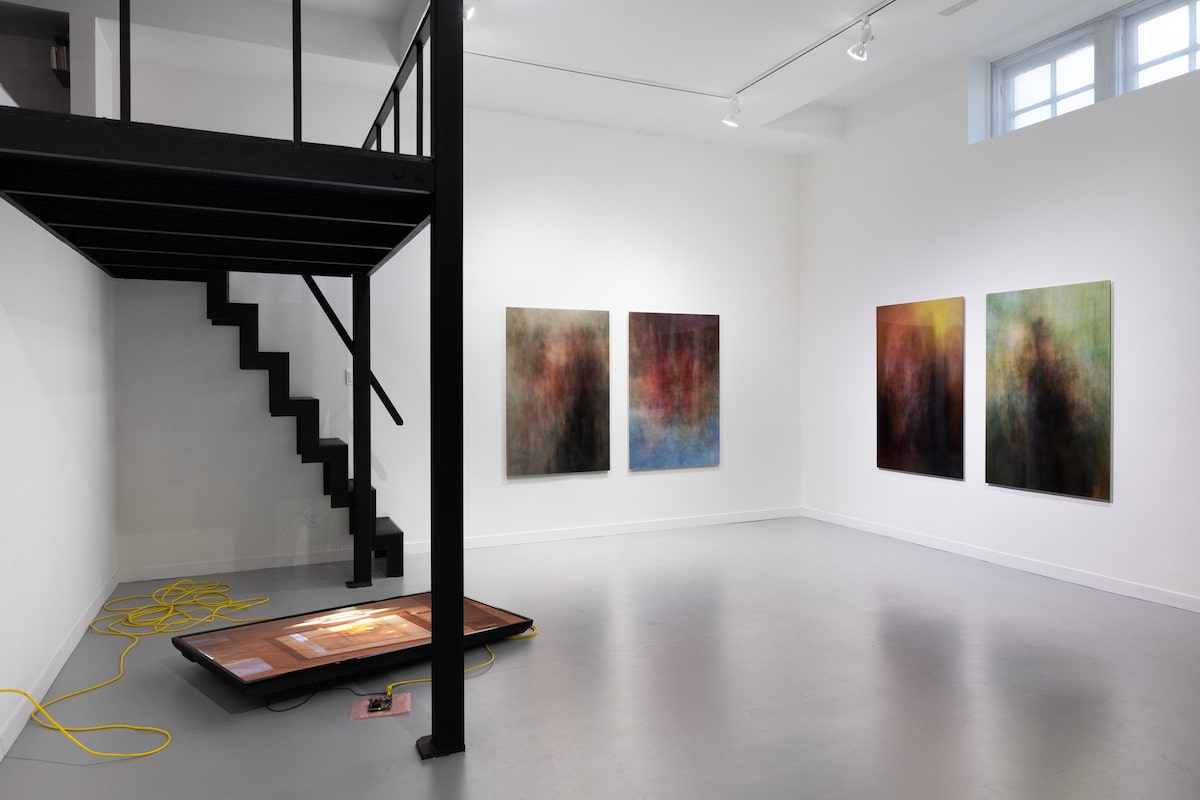
Matt Nish-Lapidus, Remembrance Agent is seen at the SCaM Project Space, a basement gallery in Toronto that gives artists a space to experiment without commercial pressure.Laura Findlay/Supplied
At the artist-run project the Plumb, the ceiling height is roughly 7.5 feet and there are no windows. In certain areas, it’s easy to raise your hands and graze the overhead pipes protruding throughout the space. The gallery, accessed by an alleyway in the west end of Toronto, operates out of a basement.
The Plumb has forgone what most people picture when they think of an art gallery, a room with high ceilings and crisp white walls, in favour of more affordable space and one that some see as more creatively stimulating because it is unexpected.
“The reason this project happens in the basement is that it was affordable,” founding member Daniel Hunt says, adding that artists looking to start a gallery without the deep pockets of a corporation have to think outside of the box – or outside the ground floor.
The ‘Never Enough Night’ exhibition at the Plumb.The Plumb/Supplied
The ‘Shift n’ Wiggle’ exhibition.The Plumb/Supplied
When the members of the Plumb, currently 12 who split the rent and make curatorial decisions, first looked at the subterranean space, even their realtor wondered why they’d want it. “In our first interaction, the question of what exactly we are going to use this space for came up, and then when I said it was an art gallery, they would say: There are no windows,” says Hunt. “Having windows is an immaterial component of what we are looking for. We’re just looking for space.”
A desirable feature in most residential and commercial venues, windows aren’t as important in art contexts. Think about walking through a museum: Typically, there aren’t that many windows. Sunlight is a natural deterrent to light-sensitive artworks, meaning institutions tend to prefer the control of artificial lighting. For this reason, a basement gallery doesn’t affect the art viewing experience.
The Plumb’s space is a sprawling 2,000 square feet. Hunt mentions that this space is ideal for group exhibitions, with many corners “providing natural architectural breaks that allow works to sit and nest together in sequence that in another space would maybe sometimes feel a little too jammed up.”
Tough Guy Mountain, Lost in Internity is seen in the SCaM Project Space in Toronto.Cale Weir/Supplied
Ciar O’Mahony, who is also a member of the Plumb, has her own basement gallery in Toronto called SCaM Project Space, a play on its location within a former church: St. Cyril and Methodius. O’Mahony’s experience running a basement gallery is inherited: Her parents started an art gallery in the same basement in 1998. The family, including O’Mahony, still lives in the converted church. O’Mahony, who runs the gallery with Joshua Rogin, continues the gallery’s legacy, relaunching the project in 2023 to give artists a space to experiment without commercial pressure.
“My mom has worked in the arts my entire life,” says O’Mahony, When she was growing up, her mother, Niamh O’Laoghaire, was the director of the University of Toronto Art Centre; now, she’s the director of Varley Art Gallery. “She was an art history lecturer but wanted to create exhibitions and didn’t have the infrastructure to do so. So why not make your own space in the basement of your house?”
Thrill Seekers by Philip Leonard Ocampo, featuring Hannah Doucet, is seen in the SCaM Project Space.Philip Leonard Ocampo/Supplied
O’Mahony attributes some of the success of below-ground galleries to their hidden nature.
“Maybe there’s just a little bit of excitement or something clandestine, that asks: What are we about to see?” When visitors first enter SCaM Project Space, their reaction is surprise, she says. The basement gallery features 12.5-foot ceilings – a bit taller than a basketball hoop – and is polished with sleek white walls, track lighting and a minimalist black staircase leading to a second level.
The Crawlspace Gallery is located in Inglewood, Calgary, a neighbourhood its members say they typically could not afford.Bella Pesca/Supplied
In Calgary, the aptly named Crawlspace Gallery also makes good use of an underground unit. The gallery is located in Inglewood, a neighbourhood its members say they typically could not afford. “We just found this sketchy Kijiji listing for this basement that had been up for rent for five months and had a million views. We thought, ‘This is definitely not real.’ Then we went to see it, and it was so lovely,” says May Jones, the lead creative director of the artist collective. “It was twice the size of anything else that we were looking at and super cheap because the building was maybe going to be demolished in six months.”
Liminal Sunday by artist Chelsey Rice and curated by Yaiza Lopez Garcia San Roman is seen in the Crawlspace Gallery.Bella Pesca/Supplied
That precarity, along with the perceived notion that a basement is less than ideal, has given the group of nine artists, who graduated from Alberta University of the Arts in 2024, access to lower studio rent, freeing up funds to do other things, such as curate more exhibits. They’ve been in the building for two years but because it’s been slated for demolition, they could be asked to leave at any time.
When that happens, Jones and her co-director know exactly what they’ll look for: their next basement.
“I think people often cite money as an issue, that it’s too expensive to start a space, but we did this for almost no money,” says the Plumb’s Hunt. “We did it because we wanted to do it and we love it and it’s important to have pieces like that in the ecosystem.”