
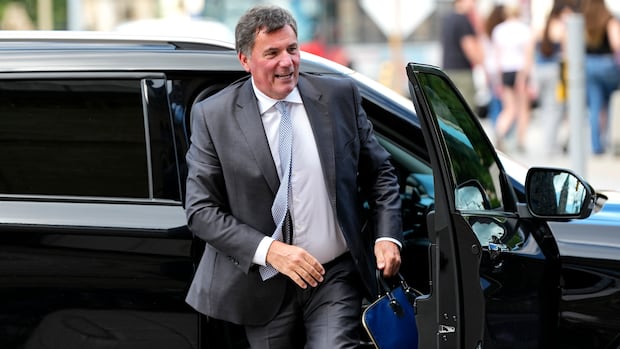
Canada-U.S. Trade Minister Dominic LeBlanc held what is believed to be his longest meeting to date with American officials in Washington as both sides push to finalize a deal that will deliver tariff relief for hard-hit Canadian industries and restore U.S. alcohol sales in province-run liquor stores.
LeBlanc, who has been back and forth between Ottawa and Washington over the last few days to nail down the finer points of what could be a substantive bilateral agreement, was tight-lipped with reporters about what exactly was accomplished behind closed doors with U.S. President Donald Trump’s top trade official, Jamieson Greer. But he said there’s been some positive developments.
“We continue to do the important work Canadians expect us to do. We had a long, detailed meeting with Ambassador Greer and his colleagues,” LeBlanc told reporters after wrapping up the nearly three-hour meeting, which was initially expected to only last about 30 minutes.
“Canadians expect us to get a deal that’s in the economic interest of Canada and Canadian workers. We’re very close and we continue to make progress,” he said.
While none of the details of what’s being considered have been made public, a source with knowledge of the forthcoming agreement said U.S. tariffs on Canadian steel and aluminum are being lowered from 50 per cent to 25 per cent. Discussions regarding derivatives and exemptions are ongoing.
The lower tariff on steel will also include a quota system, allowing only a set volume of imports into the U.S. at the lower rate, the source said.
The deal is expected to cut Trump’s headline tariff rate on Canadian-built cars and trucks from 25 per cent to 15 per cent, a source said. If the tariff applies only to the non-U.S. portion of a vehicle, which is the working assumption, then the effective rate would drop by up to half (7.5 per cent).
CBC News agreed not to name the sources because they were not authorized to speak publicly.
In exchange for slashing those tariffs, the Americans are expecting at least two things in return: an end to the boycott on U.S. alcohol in most provincially owned liquor stores and the lifting of provincial restrictions on American firms competing for government business in this country.
Both actions, launched after Trump initiated a trade war last year with steep tariffs on Canadian industrial products, have been highly effective, decimating American liquor sales in Canada and blocking many U.S. companies from successful procurement bids.
WATCH | LeBlanc says a deal is close: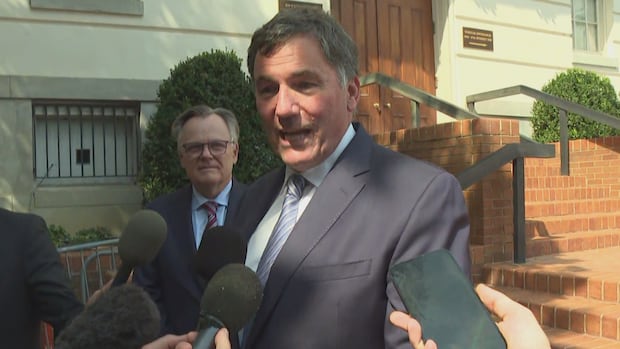
‘We’re very close’ to a deal, says Canada-U.S. trade minister
Canada-U.S. Trade Minister Dominic LeBlanc says negotiators are close to a tariff-relief deal and will stay in Washington to ‘do the work that’s necessary’ to get to an agreement.
While Carney’s plan to broker a deal with Trump to avoid the threatened 50 per cent tariffs and lower existing levies drew praise from some premiers, at least one voiced serious reservations about what Ottawa has in the works.
Manitoba Premier Wab Kinew said that Trump can’t be trusted and he thinks Ottawa should go on the offensive.
“You can’t make a good deal with a bad person,” Kinew told reporters at the Manitoba Legislative Building in Winnipeg.
“I think Donald Trump is weak. America is weaker around the world today than it was a year ago, and he’s about to get slaughtered in the midterms,” Kinew said.
“So, I think we should fight.”
WATCH | Manitoba premier wants Canada to fight back: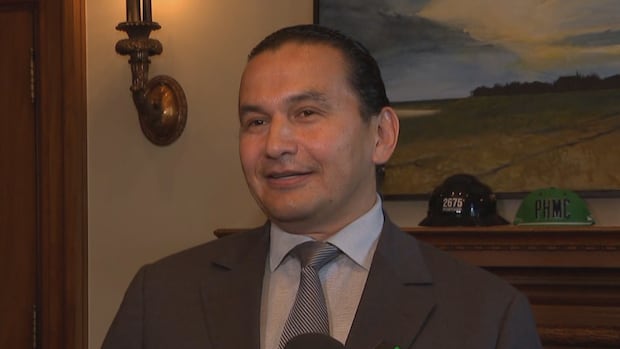
‘We should fight’ U.S. tariffs, says Manitoba premier
Manitoba Premier Wab Kinew says he thinks U.S. President Donald Trump is ‘very weak’ and ‘about to get slaughtered in the midterms,’ and that Canada has the upper hand in trade negotiations.
Still, Kinew said he’s willing to abide Carney’s request that the provinces restore U.S. liquor sales, a key condition of the deal LeBlanc is working through with Greer.
Kinew said Carney was forceful with the premiers when they met on Wednesday evening, insisting that the booze must go back.
“I wouldn’t say he was begging us, but what’s the step before begging?” he said.
Still, Kinew said he respects Carney’s difficult position: trying to deliver help to hard-hit sectors like steel, aluminum, autos and lumber while dealing with a sometimes erratic American counterpart.
“He’s the one who got on the phone with Donald Trump. Somebody has to do it. Thank you, Mark Carney for doing it.”
Nova Scotia Premier Tim Houston, who said he’s “content” with what Carney has presented to the premiers so far, disputed Kinew’s claim that Carney was practically “begging” the premiers to end the liquor boycott, saying he was “surprised” the Manitoban described it that way.
“That’s not even close. I don’t know what meeting that might have taken place in — but it certainly wasn’t one I was in,” Houston said in an interview with CBC’s Power & Politics.
“I would certainly not describe him as begging but I would describe him as being committed to getting the best possible deal for our country and being honest about some of the parts that may be involved,” he said.
Ontario Premier Doug Ford, who, like Kinew, has called for a more adversarial approach, has not said anything publicly about the prospective trade deal.
Quebec Premier Christine Fréchette, meanwhile, had what she described as a long conversation with Carney on Thursday morning after the group call with premiers the evening before.
Fréchette said she had “many questions” for Carney about what’s to come and how it could affect her province, which is one of the world’s leading centres for aluminum.
WATCH | Quebec premier on U.S. booze ban: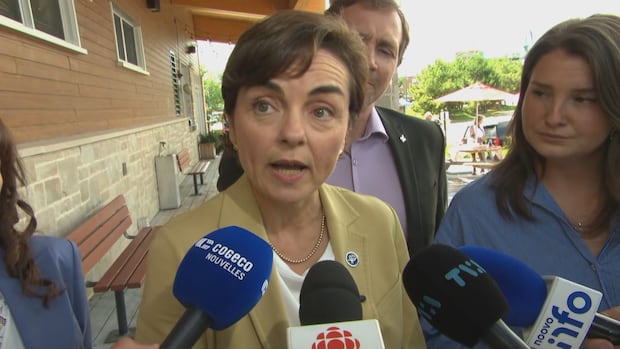
U.S. liquor will go back on shelves if tariff deal is ‘positive’ for Quebec, premier says
Quebec Premier Christine Fréchette says she had a ‘long conversation’ with Prime Minister Mark Carney on Thursday morning during which he answered many of her questions about provisions of a tentative U.S. trade deal. Fréchette says she’s analyzing the information and if it’s positive for Quebec, her government will put U.S. alcohol back on shelves.
“We are now analyzing the answers he gave me because we need to have a global view, a complete view of the impact on Quebec’s economy, and we will decide afterwards what our position is,” Fréchette told reporters in Roberval, Que.
“It is possible that we put back the alcohol on the shelves of the SAQ but we need to have the analysis first.”
B.C. Premier David Eby said a negotiated deal like this won’t deliver everything he or anybody else in this country wants, but he “stands with Team Canada” and thinks the federal government has made “substantial progress across strategic sectors.”
“Given these latest developments we are hopeful about the possibility of an agreement,” he said in a written statement.
Like Carney, who told premiers his commitment to building the Canadian economy and diversifying the country’s partners abroad is unchanged by any U.S. deal, Eby said things “will not go back to the way things were before” this latest tariff fracas.
“We will continue to push forward our work to find new trading partners and secure major projects to build a stronger, more resilient economy that benefits everyone,” he said.