

Historically in this column prior to the start of the season, we have looked at the 4th year breakout candidates, but over the last few seasons we have transitioned to a more games-played approach for breakout thresholds. This idea came from an article posted on June 30th, 2022 and is a good read so definitely go check it out. The brief summary is that there tends to be a game count by which players start to break out. In this case breakout is defined as a 25 percent year-over-year increase. What they found is that average size forwards need about 200 games, and defencemen plus exceptionally small, or larger forwards need about 400 games. Please go check it out for more details, but one section in particular caught my attention.
“It’s always a great indicator if you see that a player finishes the previous season with 230 or 240 career games, and he just enjoyed a very strong second half. When you see that, then feel confident in a potential breakout for the year ahead.”
That got me excited because here are a couple of variables that we can actively filter and sort for. With the right table or reports we can pull this information together and get a list of players who meet this criteria. According to this research it should be a list of players poised to do good things next year. The article also makes clear that these are all generalities, and there are definitely exceptions, but it made me very interested to see who might be on this list.
So how to pull together this data? Well, we already know that we can run custom reports for the regular season (I am using Big Board), so if we pick a midpoint date (in this case I used Jan 1st) we can get point paces for players prior to and after that date. Looking at the difference there we can get a list of players who had a stronger second half than first half. There isn’t a direct report for career games played, but with a little creative filtering on some longer term reports it can work.
Once I exported the reports with the data I needed, I combined them for a custom table for filtering. After applying the games played and point pace criteria we get a list of seven names.
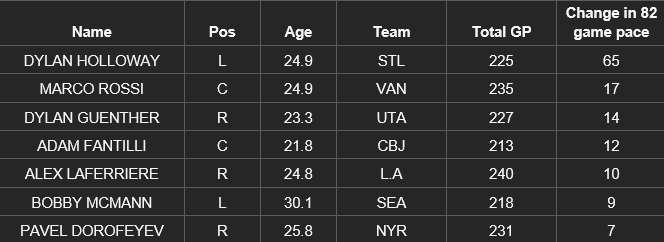
This is certainly an intriguing list. Some of these players already saw quite a bit of success in 25-26 so might not be prime candidates for a second breakout, but we will get to that in a minute.
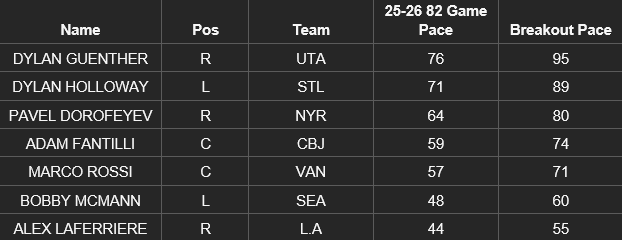
What we really want to know though is what we might be able to expect from these players in the future. If we assume that this list has a higher probability of hitting that breakout status than your typical player that means we are thinking these players will be more likely to put up at least 25 percent more points in 26-27 than they did in 25-26. That means we need to add some more point pace data to our table.
Let’s dig in.
These breakouts usually happen because of a couple of factors. The first is just player progression. They have had a good run of games in the league, gotten their feet under them, figured out what they need to work on, and improved as players. They also tend to see an increase in deployment; more time on ice, playing in the top six, and/or on the top power-play. These deployment criteria are very much dependent on the coach, but in either case it can be hard to predict from the outside. We are going to do our best though to look at these players and see if they have room for improvements in their game and opportunity.
Dylan Guenther has seen modest increases each of the last two seasons, from a 64-point pace in 2023-24 to a 76-point pace in 2025-26. Each season has seen him increase his time on ice, his shot rates, and his expected goal rates. There seems to be little question that Guenther can repeat his 75-point pace, and it is very likely he can improve upon it, the question is just by how much. He is already seeing over 17 minutes a night on average, shooting three times per game, and getting 70 percent of the team’s power-play time. It seems ultimately unlikely that either new addition in Anders Lee or Vincent Trocheck will push his time on ice or power-play deployment down, but there is a small question mark. There are one or two more given some of the underlying numbers, which might cut into a little of the upside off his projection. Ultimately, he likely needs to get closer to 19 minutes a night and sustain strong underlying numbers to get close to that 90-point projection.
Dylan Holloway is a really interesting one. The big change from his first to second half was his elevation to the top line with Robert Thomas and Jimmy Snuggerud. He started the season with 9 points in his first 21 games. He finished with 34 over his last 26, a 107-point pace. The real question is what is that breakout upside. 2025-26 represents his second straight 70-point season. If he stays on the top line, and gets top power-play time (which he saw over 60 percent consistently at the end of the season) repeating should be easy, but will he be able to reach all the way to 90?
Pavel Dorofeyev was a power-play merchant in Las Vegas. He is now a Ranger though and it remains to be seen exactly how he is deployed. Given the contract they offered him it seems very likely he will be in the top six and on the top power play. Like with Guenther in Utah, Dorofeyev was already doing that in Vegas with over 17 minutes a night, 75 percent of the power-play time, and shooting three times per night. Given he is on a new team there is a bigger question mark than with Guenther (plus some of the same underlying minor question marks). Ultimately, he is being brought in to play an important role so it is likely a question of how close he can get to that breakout potential, not if he is going to be able to repeat his 64-point pace.
Adam Fantilli also saw some top six and top power-play deployment, but there is some clear room for his growth here. He added time during the second half of the season, has only seen about 65 percent of the team’s power-play time, and has only been shooting about 2.5 times per game, and his shooting percentage was average, but on the low side. He was seeing almost 20 minutes per night by the second half of the season, so if he sustains that and can increase his shot rates, and that shooting percentage rebounds a bit he looks poised to challenge that breakout number.
Marco Rossi is a bit confusing by the numbers. He moved midseason to a completely depleted and dysfunctional Vancouver squad. He improved during the second half, but basically by every metric he did worse than in 2024-25. He now has two 60ish point pace seasons under his belt, but can he make the jump? He was playing less than 17 minutes a night by the end in Vancouver, was barely shooting more than once per night, but did see a lot of power-play time down the stretch. Vancouver should be embracing the rebuild and the youth so best case that means great deployment for Rossi, but it also might mean no one to play with. Given all of the question marks, hoping for a repeat rather than a breakout might be more reasonable.
Bobby McMann makes the list because of a rather insane goal scoring run once he reached Seattle. He scored eight goals in ten games before cooling off for his final eight games. Still, we are talking about an 18 total game sample in Seattle. He saw 14 points in that time span, and almost 18 minutes of overall ice time, by far the highest of his career. So much about that run was unsustainable, but a 60-point breakout doesn’t seem that unreasonable for a guy who could be on the top line and top power-play for the first extended time in his career. It is something that Jared McCann has essentially been able to do each year in Seattle in that position, though he is the only one. So, the real question is, do McMann and McCann have more in common than the name? Can he be the second consistent 60 point forward in Seattle?
Alex Laferriere is a big question mark. What is LA going to do with the retirement of Anze Kopitar? Is it finally time for Quinton Byfield? The coach did mention using Laferriere more as well, so does he get a bump? The challenge is Laferriere saw over 18 minutes at even strength, and it amounted to his second 45-point pace season. That doesn’t seem like an optimistic indication of a better season. On the other hand, we know he can do 45 points, and 55 doesn’t seem like a huge stretch if he manages any kind of increase to his 37 percent power-play share.
That is all for this week.
Do your part to support organizations working to make hockey for everyone.