
If you could bottle up the benefits of strength training and stock this product on a shelf, it would sell out before you could say “better health and longevity”. As you grow older, the relative benefits only increase.
Yet, despite this activity being free for all to access, relatively few people commit to strength training regularly. Why is that?
“The number one reason why people do not engage in resistance training is because they make the excuse that they don’t have the time,” says Dr Brad Schoenfeld, a professor of exercise science at Lehman College in New York, and one of the world’s leading authorities on muscle growth.
But, he says, you probably don’t need to do as much as you think to make “huge improvements” to your health and fitness: “Just two 20- to 30-minute sessions each week is enough – we’ve done research in our lab which shows this.”
This routine won’t leave you looking like a bodybuilder, Dr Schoenfeld explains. But it will deliver a body that looks good, feels good and handles the rigours of life remarkably well, all in less than one per cent of your week. You will also enjoy better heart health and a significantly reduced risk of a laundry list of chronic diseases. As returns on investment go, it’s largely unmatched.
Below, Dr Schoenfeld reveals how to start strength training at home, and shares the science behind why it is never too late to reap the rewards – even if you are in your 90s.
How to start
For strength training to be effective, there are a few simple criteria you need to meet, according to Dr Schoenfeld.
Firstly, consistency is key. For the minimum effective dose, aim for two weekly workouts on non-consecutive days, every week.
Secondly, once you have fine-tuned your technique using lighter weights, your workouts need to be challenging. If the body is not challenged, it has no reason to change and adapt in the ways we want – more muscle, stronger tissues, myriad better health markers.
“If you’re lifting a weight, and at the end of your set you could do 10 more repetitions with the weight you’re using, you’re not really going to see much in the way of benefits,” says Dr Schoenfeld. “The last few repetitions [of each set] need to be difficult to complete.”
And finally, in each of your sessions, he recommends hitting every major muscle group for a full-body workout. (You can find an example of how to do this with just a pair of dumbbells below.)
If you meet these three conditions, and you give your body the fuel and recovery it needs, “you can produce really large improvements in overall strength, overall health, appearance and other factors too,” Dr Schoenfeld says.
Read more: Scared exercise will injure you? These rules make any routine safe
Why it’s never too late to begin strength training
In 1990, researchers recruited 10 frail residents of a chronic care hospital, each aged 90 or above. They were put through eight weeks of “high-intensity resistance training” – in this case, machine leg extensions.
By the end of the study, two of the 10 subjects no longer used walking sticks to walk, while another regained the ability to rise from his chair without support from his arms. Gait speed, mobility and strength also shot up, while no injuries or adverse impacts on the heart and lungs were reported.
If you start lifting when you’re younger, you can basically maintain your muscle throughout your life
“It’s never too late to start,” says Dr Schoenfeld. “Many people would say the leg extension is one of the least functional exercises – it’s single-joint and uses a machine – but it allowed multiple people to walk without their canes in a very short period of time.”
He caveats this with the message that, the earlier you start strength training, the better.
“This is because there is a progressive loss of muscle over time,” Dr Schoenfeld explains. “Once you get into your thirties and forties, you start to lose about a half per cent of muscle per year if you’re sedentary. This goes up exponentially as you get into your fifties and sixties, and then your seventies and eighties, because you become less and less active.
“But if you start lifting when you’re younger, you can basically maintain your muscle throughout your life.”
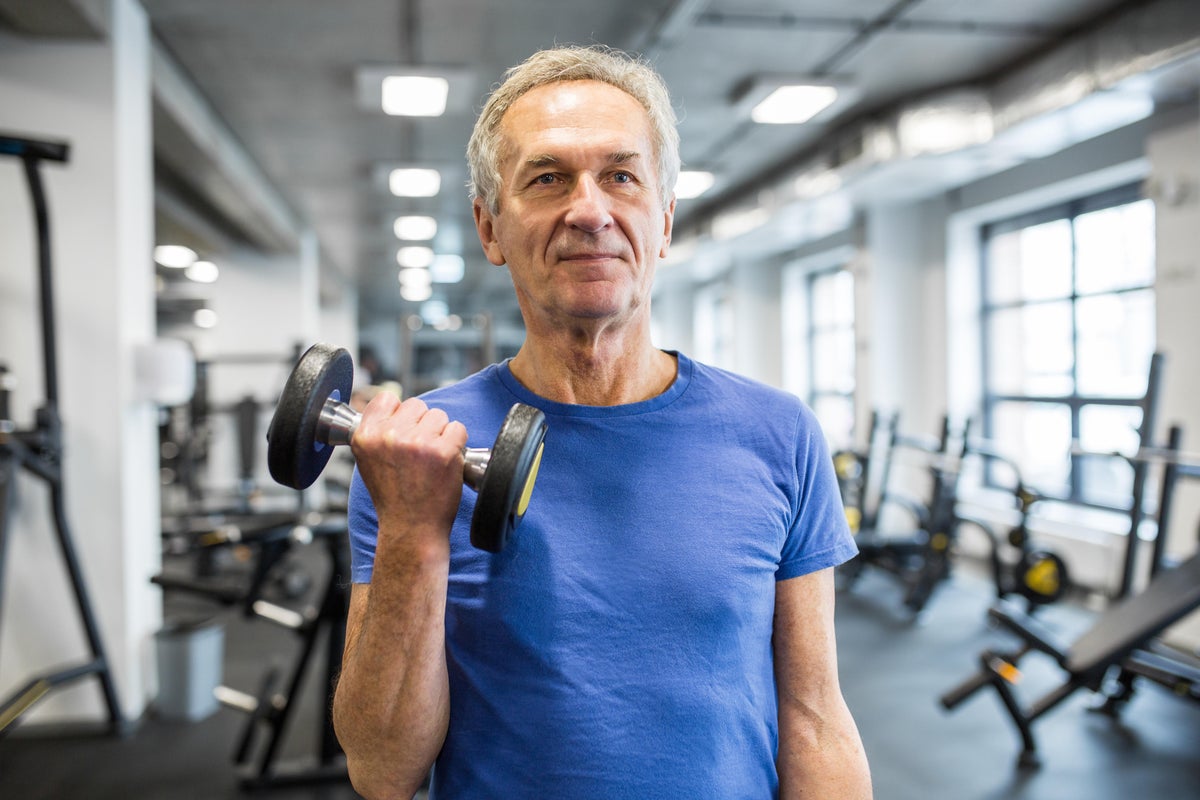
 A couple of 20-minute dumbbell workouts each week can transform your health and fitness, according to muscle expert Dr Brad Schoenfeld (Prostock-studio – stock.adobe.com)
For many reasons, exercise can be easier to pick up when you are younger. And, due to various biological factors, a 20-year-old might have a higher fitness ceiling than someone in their 50s, 60s, 70s and beyond. But a fit and active person in the latter group will likely trounce a sedentary 20-something on many health and fitness fronts.
“We see over and over in studies on the topic that older individuals see these massive benefits from strength training – again, in a very short period of time,” Dr Schoenfeld says. “If you just stick with it, training on a couple of days a week for a couple of months, you’ll see huge benefits.”
His group conducted a meta-analysis into the effects of strength training on people aged 75 and above. They uncovered significant strength and muscle benefits, which naturally carry over to mobility, functionality and independence.
In other words: strength training is not the fountain of youth, but it’s one of the closest things we have, and it’s more accessible than many would have you believe.
Read more: Expert coach shares five kettlebell workouts to get you in ‘the shape of your life’
Feel the fear – but do it anyway
The other major obstacle standing between people and regular strength training is trepidation. They fear injury, or believe they are not flexible enough to perform any of the exercises.
But there is a form of strength training that is suitable for everyone. Take the nonagenarians in the study above. Several could not stand up from their chairs unassisted, so squats were out of the question as a leg-strengthening exercise. Instead, they used a leg extension machine to bolster the leg muscles, and significant benefits soon followed.
If you do not have access to a gym, you could simply sit in a chair then use your hands to support you as you stand up again, and repeat this for several repetitions. If this feels challenging to you, it will have the wanted impact on your fitness levels.
“People think that, when you lift, you have to lift really heavy weights,” Dr Schoenfeld explains. “But in research from our lab we’ve consistently seen that moderate to lighter loads can provide very similar benefits.
“Heavy loads do carry risk, and as people get older they tend to have osteoarthritis and other joint-related issues. But whatever load you’re lifting, if you’re challenging your muscles at the end of the set, you will get very good results.”