
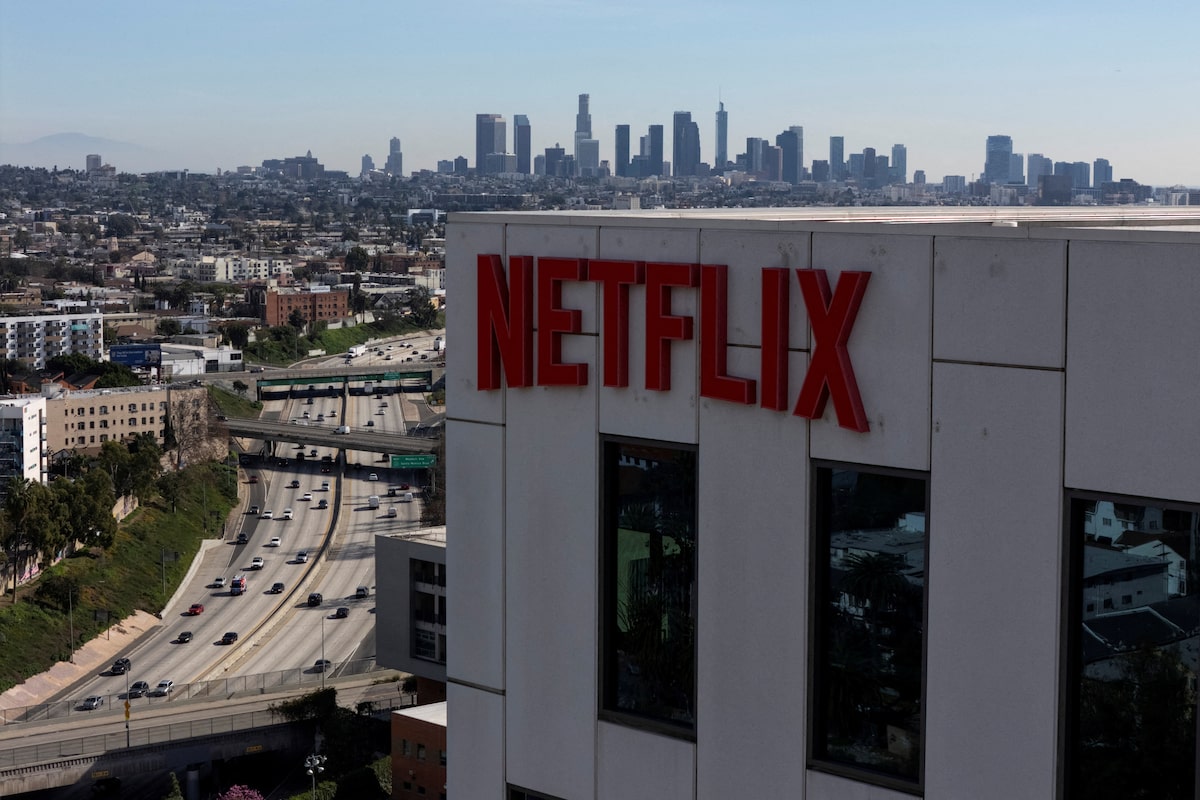
The Online Streaming Act, once it is fully implemented by Canada’s broadcasting regulator, will require foreign streaming companies, such as Netflix, to promote a certain proportion of Canadian content – including French-language and Indigenous content – on their platforms.Daniel Cole/Reuters
Ottawa’s negotiators rejected an 11th-hour demand from the Trump administration to ditch requirements that U.S. streaming platforms, including Netflix and Amazon Prime Video, promote Canadian film, TV and music to their users in Canada.
On Friday evening, the U.S. negotiating team introduced an unexpected demand that Canada provide exemptions to its laws requiring big U.S. streamers to boost the discoverability of Canadian content, including French-language content, in this country, according to a senior government source.
But Canada rejected the demand, made hours before the talks broke down, regarding it as a threat to this country’s culture and sovereignty. It was one of a number of reasons Ottawa’s team walked away from the negotiating table.
The source said during the Friday night talks, the U.S negotiators came with “a new draft” of a prospective trade deal between the two countries, which included demands for concessions on “discoverability” of Canadian content.
Trump revives annexation comments as governors warn tariffs on Canada will harm Americans
Although the Washington negotiators were not specific about which legislative requirements they objected to, the source said, they were insistent that changes be made to Canadian cultural policy in favour of U.S. streaming platforms.
“It was mostly to ensure that there is more content from the U.S. and less Canadian content available on these platforms,” the source said. “This is a red line.”
The Globe and Mail is not naming the source because they are not authorized to discuss the negotiations publicly.
At a press conference on Saturday after the breakdown of the talks the previous evening, Prime Minister Mark Carney said his government had not been prepared to make concessions to Canada’s sovereignty.
He said Canada would not “compromise our sovereignty, protection for French language, or our culture,” adding that these issues had never been up for negotiation during the trade talks.
Premiers present united front behind Carney, but divisions emerge on next steps
The U.S. has taken issue before with two Canadian bills, including one in Quebec, that would require foreign streaming platforms to adapt their algorithms to make it easy to find homegrown content, including in French, in Canada.
U.S. Trade Representative Jamieson Greer has raised concerns about Quebec’s Bill 109, passed in December last year by the province’s National Assembly. It would require streaming services and device manufacturers to promote and prioritize French-language content for Quebec users.
Mr. Greer and his predecessor Katherine Tai also repeatedly identified as a trade irritant the 2023 federal Online Streaming Act. Once it is fully implemented by Canada’s broadcasting regulator, it will require foreign streaming companies to promote a certain proportion of Canadian content – including French-language and Indigenous content – on their platforms.
When the bill was moving through Parliament, foreign streaming platforms argued there should be no such requirement to reconfigure their algorithms to promote Canadian content here. They argued that they already promote Canadian film, TV and music in Canada and worldwide, and bring in huge amounts of revenue for Canadian creators by introducing their work to global audiences.
But supporters of the measures said that Canada is being swamped by American film, TV and music, and foreign streamers need to make Canadian content easier to find here.
Business leaders brace for lengthy trade war after talks break down
Marie-Julie Desrochers, executive director of the Coalition for the Diversity of Cultural Expressions, whose members include a number of Quebec cultural organizations, said “discoverability is really important because it is a way to create a space for our TV shows and movies and music on these platforms.”
Senator Andrew Cardozo, a former CRTC commissioner who sat on the Senate committee that considered the online streaming bill, said he was hoping Canada and the U.S. would reach a trade deal last week, but “there are some red lines we can’t cross and I am proud that government stood firm.”
“This whole deal is about us as a country,” he said. “There are no guardrails in Trump’s world and we have to define and redefine what those guardrails are.”
The Online Streaming Act forces foreign companies that stream audio and video content to not only promote Canadian content, but also to contribute financially to Canada’s cultural industries, as traditional broadcasters have long been made to do.
Earlier this year, the Department of Canadian Heritage responded to concerns from foreign streamers about the amount of money they would have to inject into Canada’s cultural industries under the act.
The department directed the Canadian Radio-television Telecommunications Commission (CRTC) to review its policy requiring streaming giants to triple to 15 per cent the proportion of Canadian revenues they must inject into Canada’s cultural sector under the act.
Campbell Clark: The trade cold war suddenly turns hot again
The department also indicated it planned to direct the broadcasting regulator to scrap its requirements for foreign streaming platforms to fund local news and niche broadcasters in Canada, another sticking point for foreign streamers.
Peter S. Grant, a former member of the Broadcasting and Telecommunications Legislative Review Panel, said “Canada dodged a bullet when it backed away from a trade deal with the U.S. that would have compromised our cultural policy.”
But he questioned why the government had earlier this year declined to stand behind the CRTC’s framework, released in May, requiring the large streamers to spend 15 per cent of their Canadian revenue on Canadian content.
“In Europe, Netflix is required to spend 15 per cent of its revenue on European content. Its global program budget could easily afford to support Canadian content as well,” he said in an e-mail.
Mr. Greer referred last week to “digital trade alignment” between Canada and the U.S. in a social-media post about an impending trade deal.
His remark raised concerns that Ottawa was preparing to trade away some of its ability to make its own digital policies.
Vass Bednar, managing director of The Canadian Shield Institute, said on Sunday that it would be preposterous to hand over sovereignty in the cultural and digital spheres, given the dominance that the U.S. already exerts in these areas.