
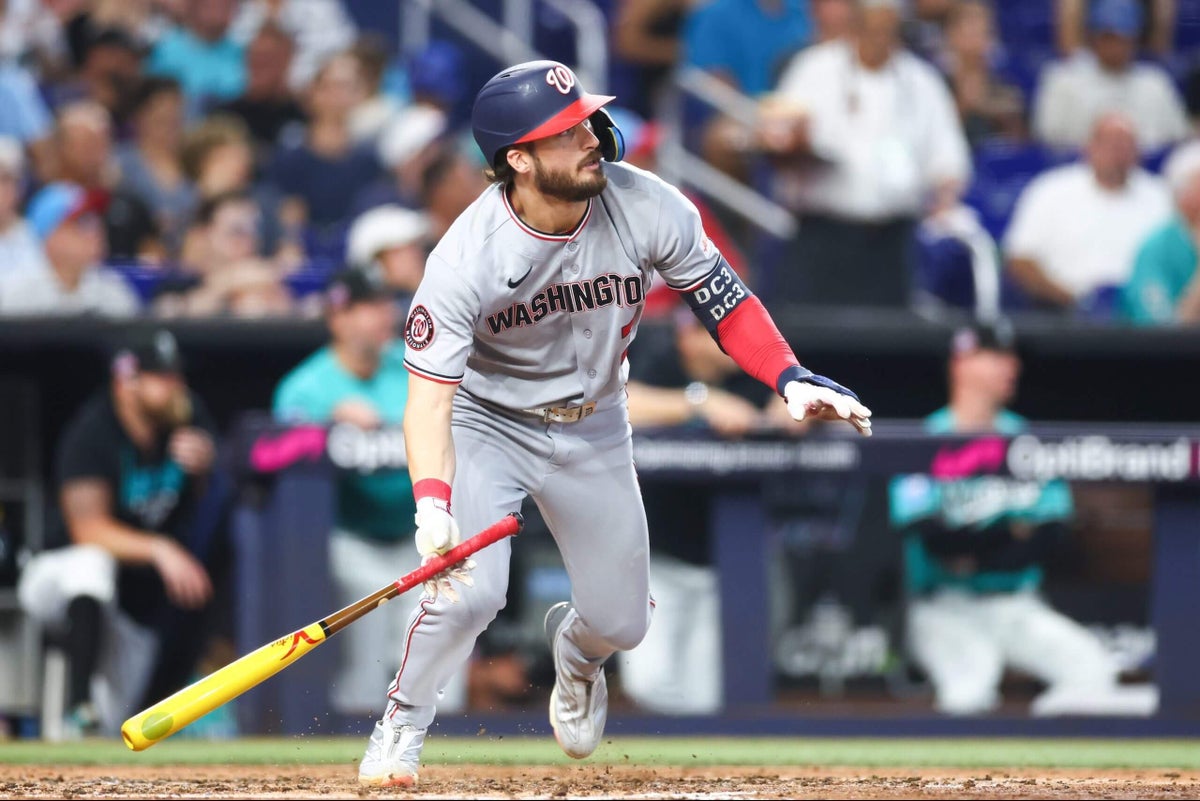
Two Fridays ago, no one inside the visiting manager’s office at Citi Field figured the biggest story from the Washington Nationals’ nine-game road trip would be the collapse of baseball’s best offense.
The Nationals were moving CJ Abrams to second base. That was the story, and it seemed as though it would be for the foreseeable future. Then the Nats scored 20 runs across a 1-8 road trip that officially killed their postseason chances.
This is not the lineup that carried Washington to the highest-scoring offense in MLB — now without James Wood (oblique), Abrams (ankle), Curtis Mead (traded to the Boston Red Sox) and Luis García Jr. (traded to the New York Yankees). But it has many of the components that will make up next year’s roster.
That makes the team’s offensive spiral, punctuated by a sweep by the Miami Marlins this weekend, worth examining.
Move over Shohei Ohtani. Miles Mikolas is the new two-way star.
Spencer Nusbaum
Why haven’t the Nats re-created Wood’s production from the leadoff spot?
Lineup construction is mostly inconsequential when the leadoff hitter is also an MVP candidate, so it stands to reason Wood’s absence wouldn’t go unnoticed. However, that doesn’t excuse the sheer futility with which the Nats have hit atop the order since his departure. The Nats’ approach, in particular, deserves a skeptical eye.
It would be foolish to expect anyone who occupies the top spot to start hitting the ball 115 mph. But Wood had a .390 OBP and reached base 42.1 percent of the time while leading off in the first inning. Entering Sunday, his replacements owned a .256 OBP with just two walks (the fewest in MLB) and 25 strikeouts (the most in MLB).
Since the start of Wood’s IL stint, Washington’s leadoff hitters are swinging at more pitches on the edge of the plate than any other team’s leadoff hitters. These are not bad hacks in a vacuum, but there is value in setting the table, and this suggests they’re failing to shrink the zone.
The repercussions are significant: Wood walked in 16.8 percent of his plate appearances and saw a ton of pitches. Those who have assumed his spot atop the order are walking 2.6 percent of the time, the lowest rate of any team’s leadoff hitters in MLB during this span, and have been more aggressive than patient.
Throughout the season, teammates credited Wood as the straw that stirs the drink. He had papered over his teammates’ slumps, but he and Abrams were also pivotal in that when they returned to the dugout, they explained what they had just seen. It’s up to someone else to start doing the same.
Why are the low-power folks still around?
Harry Ford, Nasim Nuñez and Jorbit Vivas all possess stellar swing decisions but make incredibly light contact compared to their peers.
Here’s where they rank in a crude swing decisions metric (in-zone swing rate minus out-of-zone swing rate) and average exit velocity among the 499 hitters with at least 50 plate appearances:
PlayerExit velocityExit velocity rankSwing decisionsSwing decisions rank
83.4 mph
492nd
52.2%
3rd
82.4 mph
496th
47.9%
12th
85.2 mph
452nd
43.0%
53rd
The Nationals have given these three a ton of runway, indicating each possessed a profile the franchise believes it can develop. There is some logic to it: The Nats have developed power more effectively than any other skill across the major and minor leagues.
Still, their lack of production is one of the major drags on the Nats’ slumping lineup.
A case could be made that Nuñez or Ford would benefit from more development-focused reps in Triple-A Rochester. A case could also be made that the Nats should cut bait with Vivas (who is out of options) since they have plenty of infield depth (albeit right-handed) in the minor leagues that is more likely to factor into the team’s future
So, why keep them around? Though Vivas hasn’t produced, there’s little harm in keeping him on the 40-man roster the rest of the season and seeing if he can add power and bat speed this winter. Nuñez is slighter, so bat speed probably isn’t his path to success, but overcoming issues against heat (.227 slugging percentage against four-seamers and sinkers) is easier to do in the majors. Keeping Ford in the majors allows him to develop even more of a rapport with the pitching staff.
Final: Marlins 6, Nationals 2
The Nats went 1-8 on this road trip and have lost 19 of their last 21 against the NL East. The offense was 1-for-10 with RISP and the middle infield has a .422 OPS this month. Two incredible catches were rendered obsolete.
Record: 61-71
— Spencer Nusbaum (@spencernusbaum_) August 23, 2026
How quickly do you disregard a metric with an ‘x’ in front of it?
Here’s everyone’s favorite: Expected stats.
Entering Sunday’s game, Dylan Crews’ .254 slugging percentage in August ranked 176th out of 187 qualified hitters, and his .401 xSLG ranked 76th. Daylen Lile’s .307 slugging percentage this month ranks 151st, and his .438 xSLG ranked 52nd.
Crews and Lile continue to strike out — and, just as importantly, not draw walks — at a clip that leaves them vulnerable to harsh slumps when they line into hard outs. The organization has started to put together offseason plans for its players, and after helping Crews lift the ball more often in Rochester, the next step is helping him cut down his strikeout rate. For Lile, the focus should be on improving swing decisions. No qualified hitter has seen their chase rate rise more this season.
Throughout August, Nationals manager Blake Butera has insisted his team’s effort hasn’t waned. Effort hasn’t been the issue during this 6-18 stretch, but these final 30 games will require at least more poise from the group.