
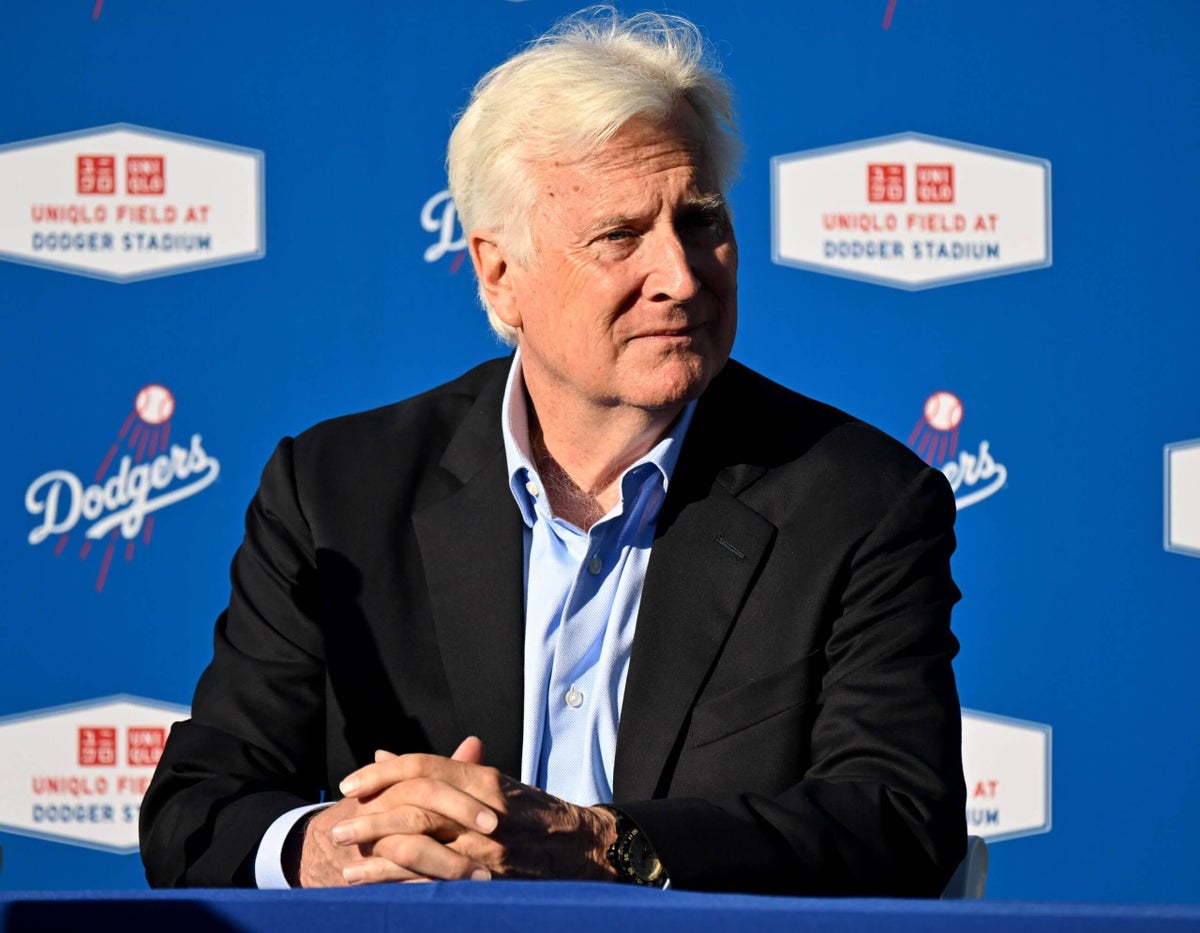
Billionaire Mark Walter spent years quietly building an empire that stretches from insurance and finance to some of the world’s most valuable sports teams. Now, federal investigators are scrutinizing parts of his sprawling business network, and the sale of one marquee franchise — the Los Angeles Lakers — has prompted concern that it’s the first of perhaps several Walter-owned sports dominos to fall.
Walter is CEO of Guggenheim Partners and TWG Global, a holding company with investments that span sports, entertainment, technology and artificial intelligence. He has a personal net worth estimated at $18.3 billion, according to the Bloomberg Billionaires Index.
Walter’s first foray into sports was purchasing MLB’s Los Angeles Dodgers in 2012. Since then, his sports portfolio has grown to include Chelsea FC, the WNBA’s Los Angeles Sparks, the Professional Women’s Hockey League, Cadillac F1 and the Billie Jean King Cup and, until last week, the Lakers.
As the federal probe continues, here are five key questions about the investigation into Walter and the potential ripple effects on the sports and franchises he’s associated with.
1. Why is Mark Walter under investigation?
Two insurance companies owned by Walter — Delaware Life Insurance Company and Clear Spring Life and Annuity — invested money collected from policyholders by lending it to businesses that then were expected to pay it back with interest.
The issue is that some of those loans ultimately financed companies with ties to Walter and were not identified as “affiliated or related-party transactions” as is required. Essentially, investigators are examining whether the transactions amounted to self-dealing.
Life insurers typically invest in relatively safe and low-risk assets to provide predictable returns, and insurers are required to report transactions with affiliated businesses so regulators can ensure the terms are fair, conflicts of interests are evaluated and policyholder money is safeguarded.
Policyholders depend on there being a backstop so that companies can’t stand on both sides of a deal — as both lender and borrower, said Matthew Pace, a New York sports and entertainment lawyer.
Delaware Life and Clear Spring Life received grand jury subpoenas in February as part of an investigation by the U.S. Attorney’s Office for the Southern District of New York. A parallel investigation is underway by the Securities and Exchange Commission. The U.S. Attorney’s Office and SEC declined to comment.
Walter has also declined to comment. Both insurance companies said they are “cooperating fully” with the investigations and acknowledged that they incorrectly labeled billions of dollars worth of loans made to companies with ties to Walter.
For Delaware Life alone, the company reported at the end of last year that its total portfolio of investments made to companies affiliated with Walter was about 3 percent. After subpoenas and an internal investigation, the company revised that number to 42 percent — or nearly $17 billion.
In 2014, Walter’s company, Guggenheim Partners, and three life insurance companies controlled by it were hit with a class-action lawsuit filed by two policyholders who claimed, among other things, that Walter and fellow financier and Dodgers co-owner Todd Boehly used the companies “as a cash machine to buy the most expensive sports franchise in world history, the Dodgers, with over a billion dollars in policyholders’ funds.” The day after the 105-page lawsuit was filed, it was dropped without explanation.
The lead attorney who filed the case, Steve Berman, declined to comment when contacted by The Athletic.
A separate lawsuit by a policyholder with similar claims was dismissed by a Kansas judge in 2019.
2. Why did Walter sell the Los Angeles Lakers?
Walter has not spoken publicly about his motivations, but the move comes as he’s facing a liquidity crunch because he needs to reshuffle billions in affiliated investments off of the insurers’ books by the end of the year.
News that he would sell the Lakers’ was particularly surprising because Walter spent years trying to break into NBA ownership. He attempted to buy the Clippers in 2014 and then, in 2021, bought a minority stake in the Lakers. Last year, he purchased the team at a then-record $10 billion valuation.
Now, he’s found new buyers with familiar names. Former Disney CEO Bob Iger and Thrive Capital founder Joshua Kushner, the younger brother of President Donald Trump’s son-in-law Jared Kushner, agreed to purchase the team for $12.5 billion — $2.5 billion more than when Walter agreed to purchase the team last year.
Andrew Granato, a legal economist and assistant professor at the University of Texas at Austin School of Law, said the speed of the sale — apparently without an open bidding process — suggests Walter needed to raise money quickly.
“There is a hole that needs to be fixed and fixed very quickly,” Granato said.
Walter and Boehly are also in talks to sell their 12.7 percent stake in Chelsea FC, and his Cadillac F1 shares also are rumored to be in play. Walter’s company, TWG Global, has denied that Cadillac F1 is for sale.
But there is pressure on Walter, including from the Delaware Department of Insurance, to reduce the amount of affiliated entanglements on his insurers’ books by the end of the year. The insurance department told The Athletic that state statute bars the agency from releasing details about its remediation plan in ongoing matters.
S&P Global Ratings said if the insurer fails to meet the end of the year deadline or if the government investigations lead to penalties or criminal charges, Delaware Life’s credit rating could be lowered and its reputation damaged.
“The structure of the financial transactions are very technical and very dense and also it’s life insurance. There is a feeling of like ‘Who cares?’” Granato said. “I think that environment has enabled a lot of aggressive financial transactions that are done on the premise that policyholders are not going to notice what’s going on, the regulators are not going to notice what’s going on, the media is not going to notice what’s going on.”
3: Does this affect the Los Angeles Dodgers?
While Dodgers president and CEO Stan Kasten told reporters the Lakers sale “really has nothing to do with the Dodgers,” and reiterated Friday that the team is “not gonna be sold,” it’s impossible to rule that out until we know the scope and depth of the Walter probe.
What we do know is the Dodgers — back-to-back reigning World Series champions — are Walter’s crown jewel, and many believe selling the team would be a last resort for him. He told the Los Angeles Times in 2012 following the purchase of the Dodgers that he didn’t feel compelled to recoup that investment quickly.
“It’s a multi-generational thing my daughters’ granddaughters will own,” he said at the time.
Walter, who owns a reported 27 percent stake as majority owner of the Dodgers, is reportedly open to cashing in on their adjacent revenue streams. He reportedly approached Charter Communications, which has carried the team-owned SportsNet LA for more than a decade, about a lump-sum payout recently in exchange for letting the cable company out early from its Dodgers and Lakers TV deals.
The Dodgers’ regional broadcast rights deal generates an average revenue of $334 million and runs through 2038. According to Puck’s sports media insider John Ourand, those lump-sum talks went nowhere. On Thursday, Charter announced a $34.5 billion merger with Cox Communications.
Kasten said Friday night that the reports about Charter and Walter exploring a sale of his Chelsea shares have been “mischaracterized.”
“Those things don’t go together for a bunch of reasons I’m not going to get into today,” Kasten told reporters. “All I can tell you is what I said to you a week ago, the Lakers sale had nothing to do with the Dodgers. It has not impacted the Dodgers and is not going to impact the Dodgers.”
Major League Baseball has not commented on the Walter investigation. Typically, when the federal government is involved, any potential probe by the league into alleged impropriety would be on hold until after that concludes. It’s not immediately clear if MLB would conduct its own investigation.
The league has never forced ownership change through other owner votes, though it did exert some pressure on the Dodgers’ previous majority owner, Frank McCourt, by threatening a financial takeover and disciplinary action.
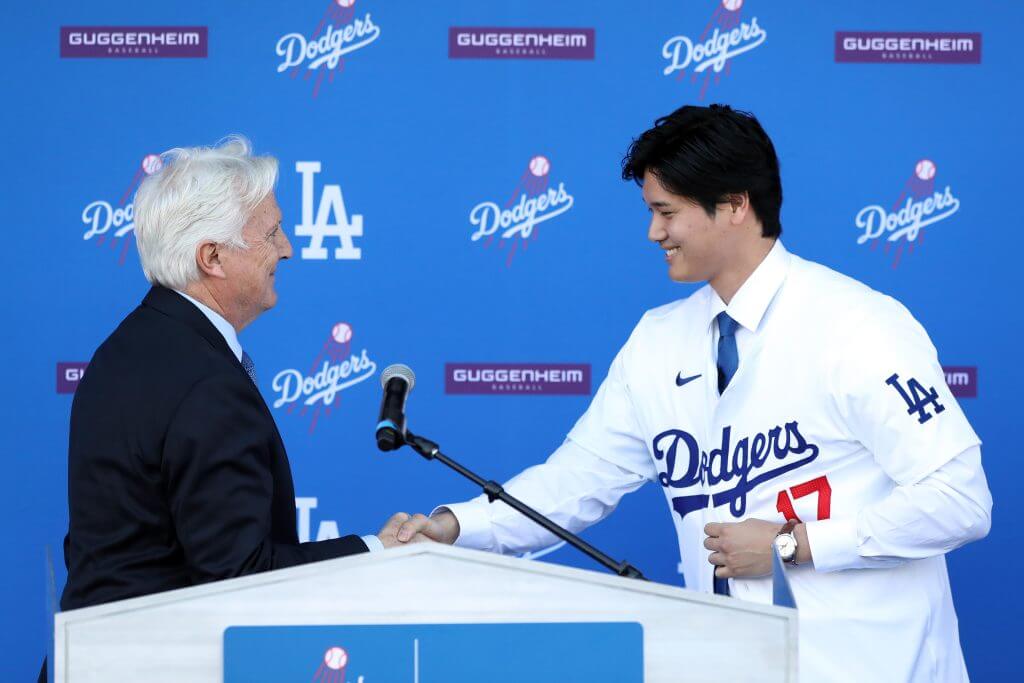
Walter welcomes Shohei Ohtani at Dodger Stadium in 2023, after Ohtani signed an unprecedented contract with the Dodgers. Meg Oliphant / Getty Images
4. What about all the deferred money in Dodger players’ contracts, specifically Shohei Ohtani’s?
The Dodgers usage of deferrals is unprecedented in the sport. They owe more than $1 billion to eight players in payments scheduled to be made from 2028 to ’46. Per baseball’s CBA rules, deferred payments are put into an account roughly two years after they’re agreed upon, which is eight years before they’re due to be paid out. The players union receives updates on those accounts every three months, and there have not been any issues to date with the Dodgers funding those deferrals.
To use Ohtani’s contract as an example, he and the Dodgers agreed to a 10-year deal worth $700 million, $680 million of which would be dispersed in deferred payments from 2034-43. So the $68 million deferred payment owed to Ohtani for the 2024 season, his first with the club, was required to be in a trackable account this summer, to be collected in 2034.
The Dodgers’ deferred payments are in one account, according to industry sources, and while it’s plausible they are in an insurance fund, MLB has rules governing how liquid those accounts must be. Per the CBA: “the amount(s) funded are maintained in the form of unencumbered assets comprising cash or cash equivalents and/or registered and unrestricted readily marketable securities, unless a Club obtains the Parties’ prior written authorization of an alternative form.”
The Dodgers did not request an alternative form for the deferrals in the case of Ohtani or any other current player, people briefed on the details but not authorized to speak publicly about them, told The Athletic.
The Dodgers are the most profitable franchise in baseball, and it’s almost impossible to imagine a scenario in which guaranteed deferred payments are impacted.
“It’s just how you account for it,” Dodgers president of baseball operations Andrew Friedman said at the introductory press conference for pitcher Blake Snell in December 2024. Snell’s deal calls for $66 million in deferred payments. “We’re not going to wake up in 2035 and [say]: ‘Oh my god, that’s right. We have this money due.’ We’ll plan for it along the way.”
Should the Dodgers change majority owners, those deferrals would be passed to the new ownership.
5. How could this all impact the upcoming CBA negotiations?
Not as much as it might appear. To many, the Dodgers have been emblematic of baseball’s uneven playing field by vastly outspending most of their peers. Because of that, the team is the face of the sport’s anticipated labor fight when the current CBA expires in December, which is widely expected to trigger a lockout.
The league contends a salary cap is needed to ensure more competitive balance between the top and the bottom, and can point to the Dodgers’ on-field dominance behind the sport’s second-highest payroll. (The Mets, who have baseball’s top payroll, are currently not in playoff contention.) The players union can argue the Dodgers show that teams willing to spend are generally rewarded with higher attendance and revenue figures. Neither argument seems likely to change regardless of what happens with Walter’s finances.
The Dodgers likely would be in position to be big spenders based on their revenue alone, which Forbes estimated last year was $850 million. They already have surpassed three million in attendance this season, drawing more than 50,000 fans a game, and the ownership group also includes Boehly, who has a 20-percent stake and is worth more than $9 billion.
Kasten, when asked if any of the funds under investigation were related to the Dodgers, said: “Money’s fungible, I guess, but I do know what we have coming in and what we have going out. The Dodgers stand on their own pretty well.”
Even if Walter explores a sale of all or part of his Dodgers shares, baseball’s labor situation shouldn’t be a big factor. For potential buyers, even the short-term loss of revenue that would accompany a lockout involving the loss of games would be more than offset if the owners are successful in instituting any sort of salary cap.
What may change is the future use of deferred payments, which likely will be a contentious issue again. The league has sought to place limits on such contract structures during past CBA negotiations, and the union has always opposed such restrictions, saying it doesn’t want to restrict player earning flexibility.