

Listen to this article
Estimated 4 minutes
The audio version of this article is generated by AI-based technology. Mispronunciations can occur. We are working with our partners to continually review and improve the results.
Terry Michell remembers when the federal government implemented a potato-growing ban in Central Saanich, a community just north of Victoria, it was a hard time.
“The farmers had meetings and there were, you know, 30 or 40 farmers there, just wondering what the heck they were going to do,” said Michell, a longtime farmer, and co-owner of Michell Farms.
It was the 1980s and he was about 20 years old, he said. While his family was able to adapt to the change, not everyone was able to make it happen.
“It forced quite a few other farmers right out of business, actually,” said Michell. “After several years, they just couldn’t make the transition on their land.”
LISTEN: Potatoes are back in Central Saanich after 40+ years — This is Vancouver Island
The federal ban was in response to a devastating pest — the golden nematode, a microscopic invertebrate roundworm.
And the government didn’t just close the lid on potatoes. It also prohibited the growth of nightshades — which include tomatoes and eggplants — in Central Saanich.
However, the Canadian Food Inspection Agency recently found the nematode threat was no longer present in much of the area, and lifted the complete ban in December.
The potato returns
Farmers in the region are now harvesting their first potato crop in decades.
Sol Kinnis is one of them.
“It’s a big favourite,” Kinnis, owner of City’s Edge Farm, told CBC’s On The Island.
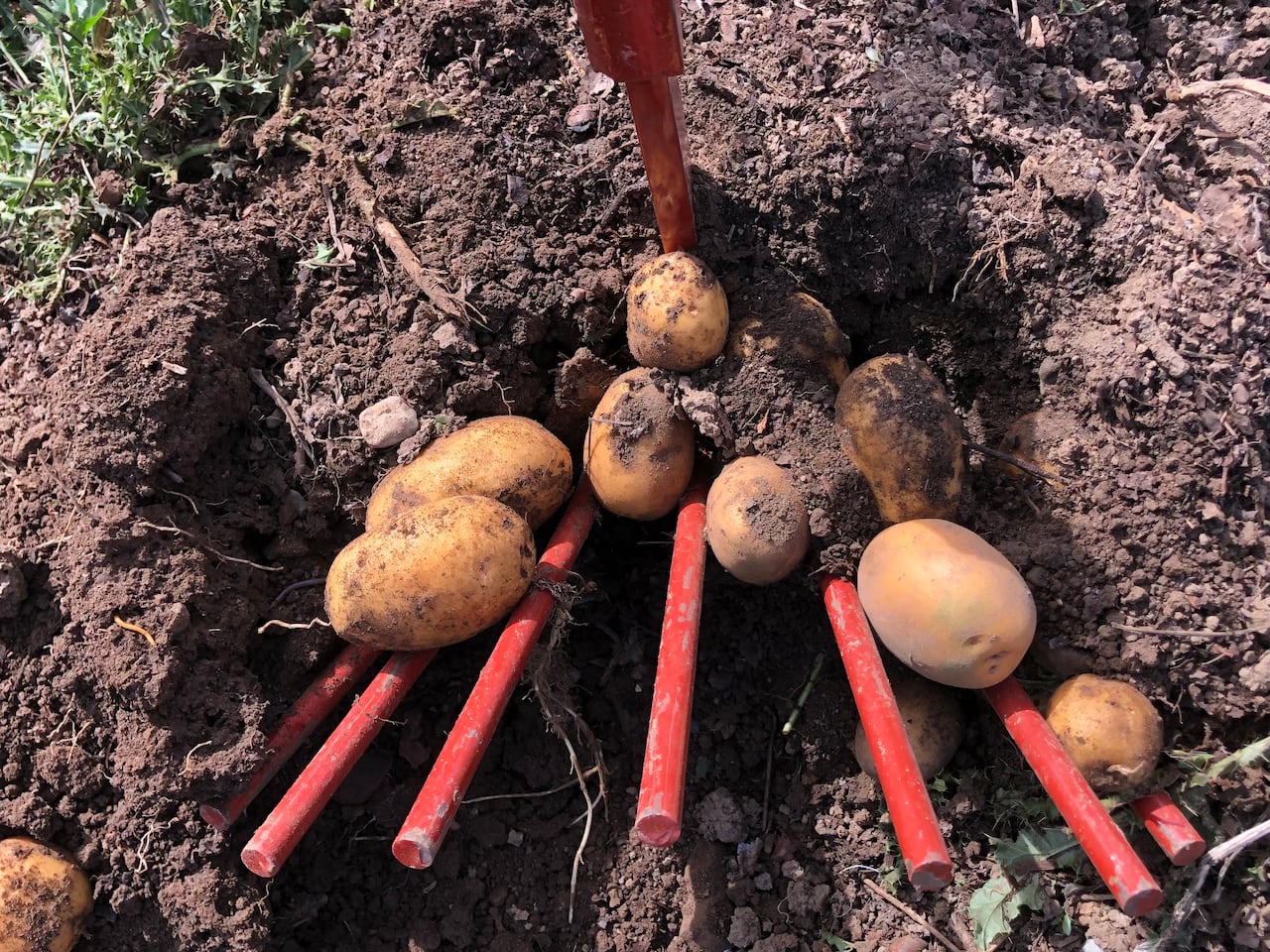 Farmers in Central Saanich are harvesting their first potato crop in decades, following the lift of a ban that dated back to the 1980s. (Submitted by Sol Kinnis)
When she moved to Central Saanich, she had to phase out harvesting spuds, she said.
It was a cause for disappointment among her clients, to whom she sends weekly boxes of produce.
But now that the beloved crop is back, it’s been a homecoming.
“It just makes it more stable,” said Kinnis. “There’s more stuff on the table at the market, and more stuff to offer in people’s boxes.”
A pest-control landmark
For the Canadian Food Inspection Agency, the lifting of the ban represents a milestone.
“It was a great accomplishment, because it’s rare when you can eradicate a quarantine pest,” said Gordon Henry, a national manager with the agency.
Henry said the nematode was designated a quarantine pest because it’s especially hard to eradicate.
Regular potato bugs and disease can be removed with natural cultivation practices and cleanliness, he said.
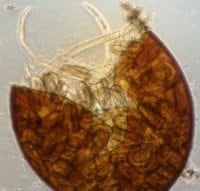 The CFIA designated the golden nematode as a quarantine pest because it’s especially hard to eradicate. (Photo Courtesy of the Nematology Lab, Ontario Plant Laboratories, CFIA)
But the nematode cyst can live dormant without a host for over 20 years in soil, lying in wait for nightshades to be introduced into the ground.
It can move with potato tubers, but it can also hitch a ride on equipment or even the wind, Henry said. So drastic measures had to be taken.
And it seems like it’s paid off.
“What made this work was the fact that in 1982, they actually prohibited the host,” said Henry.
“I think if you allowed potato production to occur in some nature, you would have always allowed the population to multiply a little bit, and it would have been much more difficult.”
An ongoing challenge
However, Central Saanich isn’t completely out of the woods.
There are still roughly 50 hectares of land in Central Saanich where a potato ban remains in effect, Henry said.
“We did find living cysts, or evidence of cysts, that remained a concern to us,” he said.
However, in the meantime, some farmers are cautiously optimistic about the return of the spud.
“It’s another challenge,” said Michell. “We can go on, go after and see if we can grow some nice potatoes in Central Saanich again, which I’m pretty sure we can.”