

Listen to this article
Estimated 4 minutes
The audio version of this article is generated by AI-based technology. Mispronunciations can occur. We are working with our partners to continually review and improve the results.
The story of British Columbia’s complex relationship with our natural environment, our early attempts to control it, and our later attempts to celebrate it can be seen in the places voters have chosen to reach the final four of Search for B.C.’s Roadside Attraction.
“Immersive experiences, esthetic, real esthetic experiences have risen to the top, more so than icons and monuments,” said Emily Carr University design professor Bonne Zabolotney.
“I think the public and tourists have a healthy respect for the ways the built environment meets the natural world, which I might argue is pretty distinctive in British Columbia.”
On Vancouver Island, forestry was the dominant industry for nearly a century, and there was arguably no forestry company more powerful than MacMillan Bloedel.
In 1944, H.R. MacMillan donated the land around Cameron Lake — which was already renowned for its beauty — to the provincial government, preserving a small forest of tall Douglas fir trees that enrapture visitors to this day, made all the more stunning by all the smaller, younger trees that surround it.
In fact, Cathedral Grove in MacMillan Provincial Park is so popular that the local chamber of commerce is leery about a moniker like “B.C.’s Best Roadside Attraction” that could make parking in the notoriously cramped lot even worse.
“It’s very hard to advocate for it,” said Jolleen Dick, CEO of the Alberni Valley Chamber of Commerce.
“It’s not sustainable right now in the high season for summer. We advertise it as an accessible B.C. park, but how accessible really is it if the infrastructure isn’t there?”
WATCH | What makes Cathedral Grove a top roadside attraction?: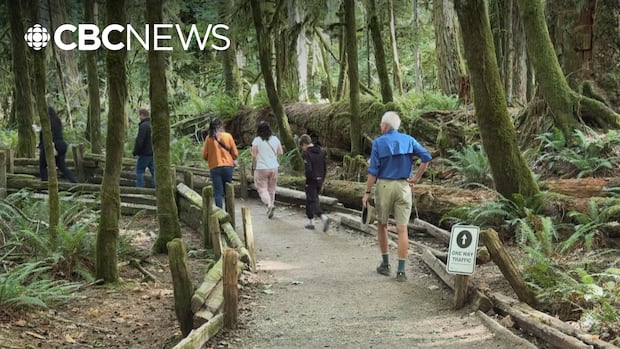
What makes Cathedral Grove B.C.’s top roadside attraction
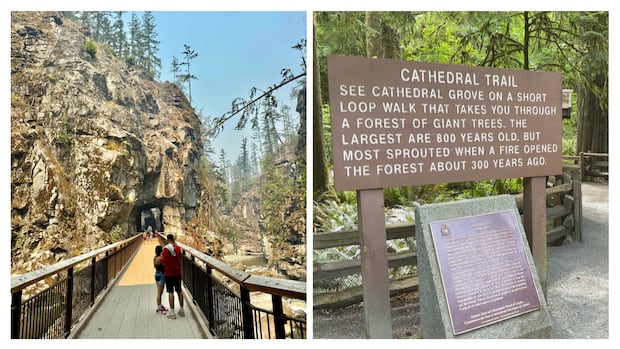
The Othello Tunnels represent the province’s ambition to cut railways through natural barriers, with construction of the Kettle Valley Railway built in the 1910s facing some of its toughest terrain just east of Hope.
“This stretch was the most expensive mile of the railway constructed anywhere in the world at the time,” said Gemma Taylor, an outdoor travel adventure blogger with Off Track Travel.
“They used to blast through the rock and then they would use picks and shovels to excavate the tunnel. So, really hard to build, really hard to upkeep them too, and that’s why the railway abandoned that section in 1961. Luckily for us, it became a recreational area in the 1980s.”
Two different stories of our connection to the land. Two different sites that locals and tourists delight in walking through today.
But which should reach the championship round of the Search for B.C.’s Best Roadside Attraction?
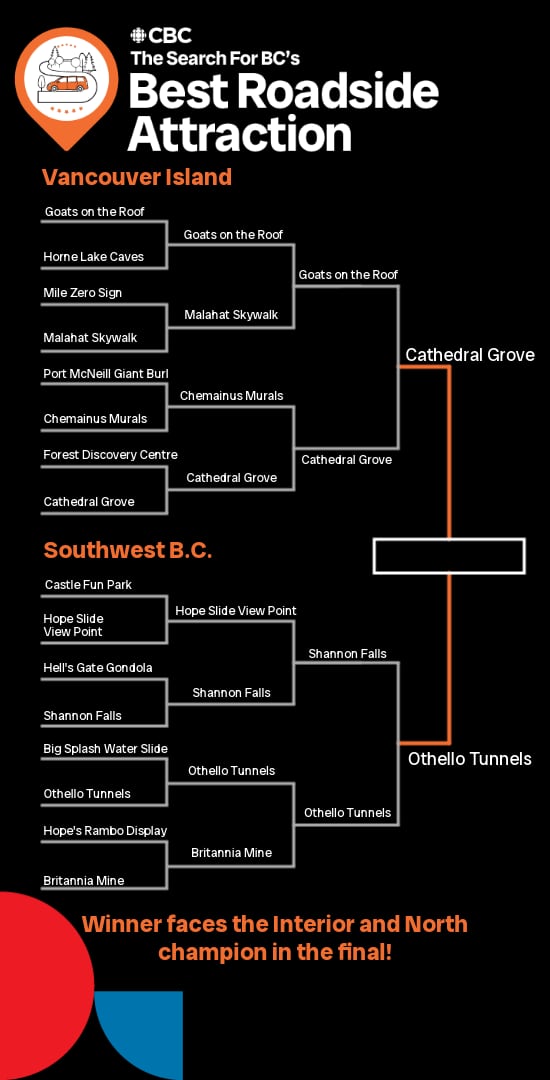 How the Othello Tunnels and Cathedral Grove got to this point in the Search for B.C.’s Best Roadside Attraction (CBC News)It’s bracket time
After determining the best small town, lake and symbol, the Search for B.C.’s Best Roadside Attraction continues our summer tradition of asking CBC British Columbia readers to vote in a bracket and weigh in on an aspect of the province’s identity — and we’ve reached the final four.
Tuesday is the vote between the Vancouver Island champion of Cathedral Grove and the Southwest B.C. champion of Othello Tunnels. Wednesday is the vote between the Interior champion of the Enchanted Forest and the Northern champion of Barkerville. The winners will move on to the final next Monday, before a champion is announced the Friday before Labour Day.
Voting in this matchup is open until 8 p.m. PT on Tuesday.
Good luck — and may the better roadside attraction have a chance to win it all.
(If you’re unable to vote directly on this page, click here)