
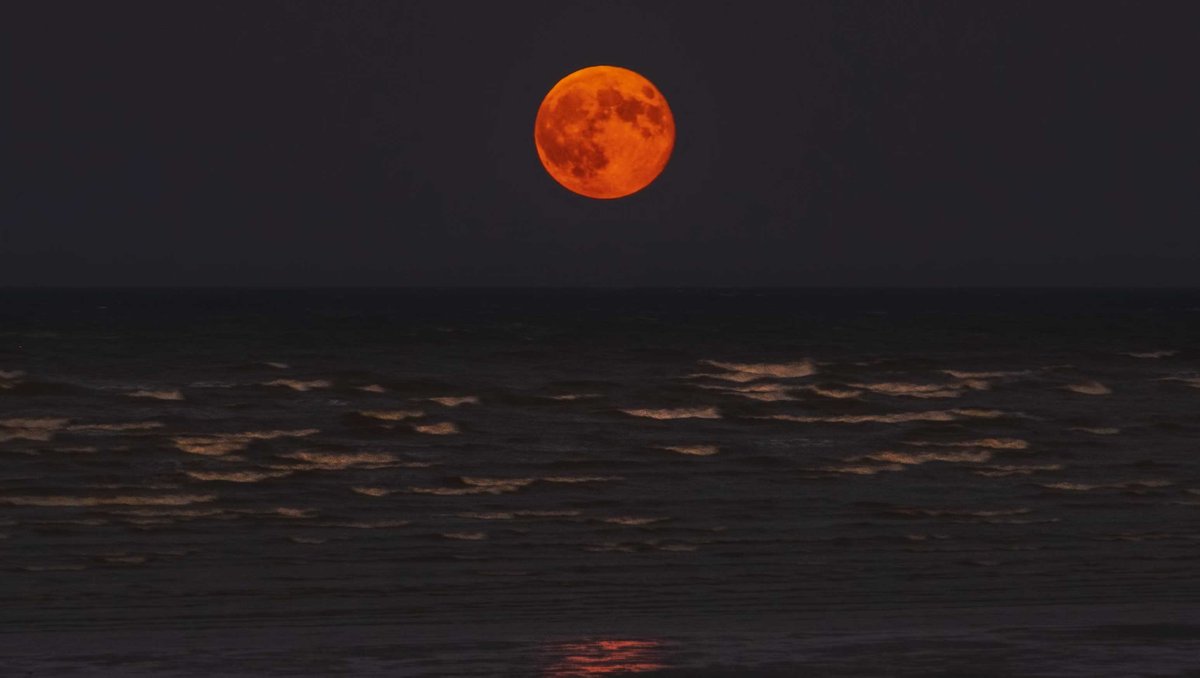
A deep partial lunar eclipse will turn nearly the entire full Moon red Thursday night, Aug. 27.
Skywatchers around Lake Superior have another reason to look up this week.
On the night of Thursday, Aug. 27, into early Friday, Aug. 28, a deep partial lunar eclipse will sweep across North America, putting about 96% of the full Moon into Earth’s shadow at its peak. This eclipse will turn nearly the entire full Moon red Thursday night.
That’s just shy of a total lunar eclipse — the phenomenon commonly called a “Blood Moon” — and should still produce a dramatic sight as most of the Moon takes on shades of copper, orange and deep red.
Around Lake Superior, the best part of the show happens at a fairly friendly hour. Maximum eclipse occurs at about 11:13 p.m. CDT Thursday, when nearly the entire lunar surface will be covered by Earth’s dark inner shadow.
When to Look
The eclipse will unfold gradually over several hours, but you don’t have to stay outside all night to catch the main event.
The Moon begins entering the darker portion of Earth’s shadow at about 9:33 p.m. CDT, when a noticeable dark “bite” will begin creeping across its surface. Over the next hour and a half, that shadow will spread across nearly the entire Moon.
Peak viewing comes around 11:13 p.m. CDT, when approximately 96% of the lunar disc will be eclipsed.
For observers around Lake Superior, look generally toward the southeastern sky during the main portion of the eclipse. A spot with an unobstructed view of the horizon will offer the best chance to follow the event from its early stages.
Why Does the Moon Turn Red?
A lunar eclipse occurs when the Sun, Earth and Moon line up closely enough for the Moon to pass through Earth’s shadow.
But Earth doesn’t block every bit of sunlight from reaching the Moon. Some sunlight passes through our atmosphere, where shorter blue wavelengths are scattered while red and orange wavelengths continue through and are bent toward the lunar surface.
It’s essentially the same reason sunsets look red.
During a total lunar eclipse, that filtered light can turn the entire Moon rusty orange or crimson, earning the event its popular “Blood Moon” nickname. Thursday’s eclipse falls just short of totality, but with 96% coverage, much of the Moon should still take on that distinctive color.
August’s Sturgeon Moon
The eclipse also coincides with August’s full Moon, traditionally known as the Sturgeon Moon.
The name has long been associated with the large freshwater fish that were historically abundant and easier to catch during late summer — making it an especially fitting full Moon for the Great Lakes.
During the eclipse, only a thin sliver of the Sturgeon Moon will remain outside Earth’s deepest shadow.
How and Where to Watch
Unlike a solar eclipse, no special eye protection is needed for a lunar eclipse. It’s completely safe to watch with the naked eye.
Binoculars can make the changing colors and boundary of Earth’s shadow even more striking, while a small telescope will reveal lunar craters and other features disappearing into the shadow.
And while you don’t necessarily need a truly dark sky to see the eclipse, getting away from bright streetlights can make the Moon’s changing colors easier to appreciate.
Around Lake Superior, that leaves no shortage of possibilities—a favorite stretch of shoreline, an overlook, a quiet inland lake or simply a backyard with a good view of the sky. Popular viewing spots include:
Minnesota: Split Rock Lighthouse State Park; Tettegouche State Park
Wisconsin: Meyers Beach; Little Sand Bay
Michigan: Pictured Rocks National Lakeshore; Porcupine Mountains
Ontario: Agawa Bay at Lake Superior Provincial Park; Sleeping Giant Provincial Park
Then, as always with celestial events around the Big Lake, there’s one other ingredient we’ll need:
Clear skies.