
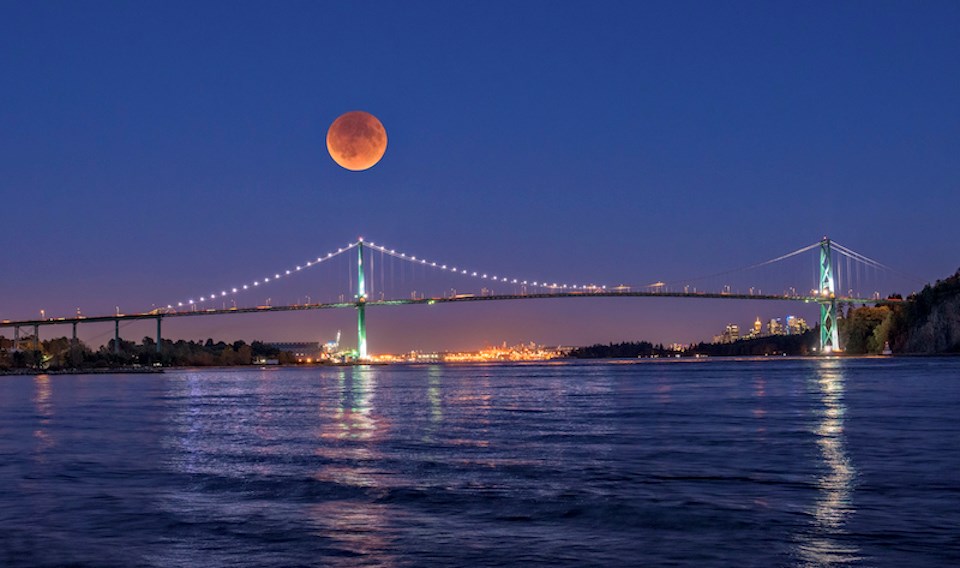
To see or not to see? That is the question.
It might be considered a “partial” lunar eclipse. But it won’t exactly look like only a small slice is covered in Metro Vancouver.
For all intents and purposes, tonight’s partial lunar eclipse might as well be total (see gallery above). I know some people will come for me for saying that, but if you look at how much will be covered, it’s as close as close can get. That means it will look really cool, and the moon could take on that trademark eerie red hue.
Space storms are also expected to intensify the aurora borealis over the next couple of days, making viewing possible locally.
Unfortunately for us, most of it could be obscured from view.
Metro Vancouver weather: Thunderstorms could clear Thursday evening
Thunderstorms are the theme of this week, beginning with a record-setting one on Saturday (the most lightning strikes we’ve ever seen), followed by some sunny days through the start of the week, and back to stormy weather starting Thursday (Aug. 27).
For sky-watchers, this is all bad news. Storms and celestial viewing don’t mix. But we might be spared just enough time, and a fortuitous parting of the clouds, to view the lunar magic, says meteorologist Brian Proctor (in less whimsical terms).
“There’s a possibility [we could see it],” he explains. “It depends on how that cloud settles out from the convection. There’s a possibility, but it’s not high.”
Thunderstorms are expected Thursday afternoon, but the storm is expected to clear heading into the evening and, depending on how the clouds dissipate, viewing may be possible.
Lunar eclipse Vancouver: When can I see the ‘blood moon’ celestial show?
A partial lunar eclipse is expected on Aug. 27. It will begin at 7:56 p.m., reach its maximum fullness at 9:12 p.m. and end just after midnight, according to dateandtime.com. The event will last a total of four hours and five minutes.
Rosanna Tilbrook, an astronomer at the H.R. MacMillan Space Centre, says eclipses occur in interesting “pairs” with the Earth-moon-sun system.
“[They’re] separated by about two weeks (half a lunar cycle),” she says. “During a solar eclipse, the moon appears to block out the sun when viewed from certain places on Earth.”
For anyone checking out the partial lunar eclipse, there’s an explanation for their reddish hue.
“As the Earth moves in between the sun and moon, the scattering of sunlight through Earth’s atmosphere will cause the moon to glow an eerie red, which is the origin of the nickname ‘blood moon,'” Tilbrook explains.
Lunar eclipses can be viewed with the naked eye and don’t require special equipment. Unlike solar eclipses, they aren’t harmful to the eye.
What about the northern lights?
The National Oceanic and Atmospheric Administration’s Space Weather Prediction Center issued a G2 (Moderate) geomagnetic storm watch for Aug. 27 to 29, noting that the “aurora may be visible over some northern and upper Midwest states from New York to Idaho.”
The University of Alaska Fairbanks (UAF) expects “high aurora activity” on Thursday and Friday, with displays possible overhead in areas such as “Inuvik, Yellowknife, Rankin and Iqaluit, to Juneau, Alaska, Edmonton, Winnipeg, Thunder Bay and Sept-Iles,” and visible low on the horizon from Seattle, Des Moines, Chicago, Cleveland, Boston, and Halifax. This includes Vancouver (see gallery above).
The university’s online aurora monitor map shows regions the aurora’s green glow will likely reach, and other areas where it’s less likely. A brief description below the map shows the aurora activity on that particular day.
Skywatchers will have to keep their eyes glued to the Metro Vancouver weather forecast. And another nifty tool could help.
Environment Canada’s online cloud prediction tool for astronomical purposes shows when the sky may clear for ideal sky-viewing conditions.