
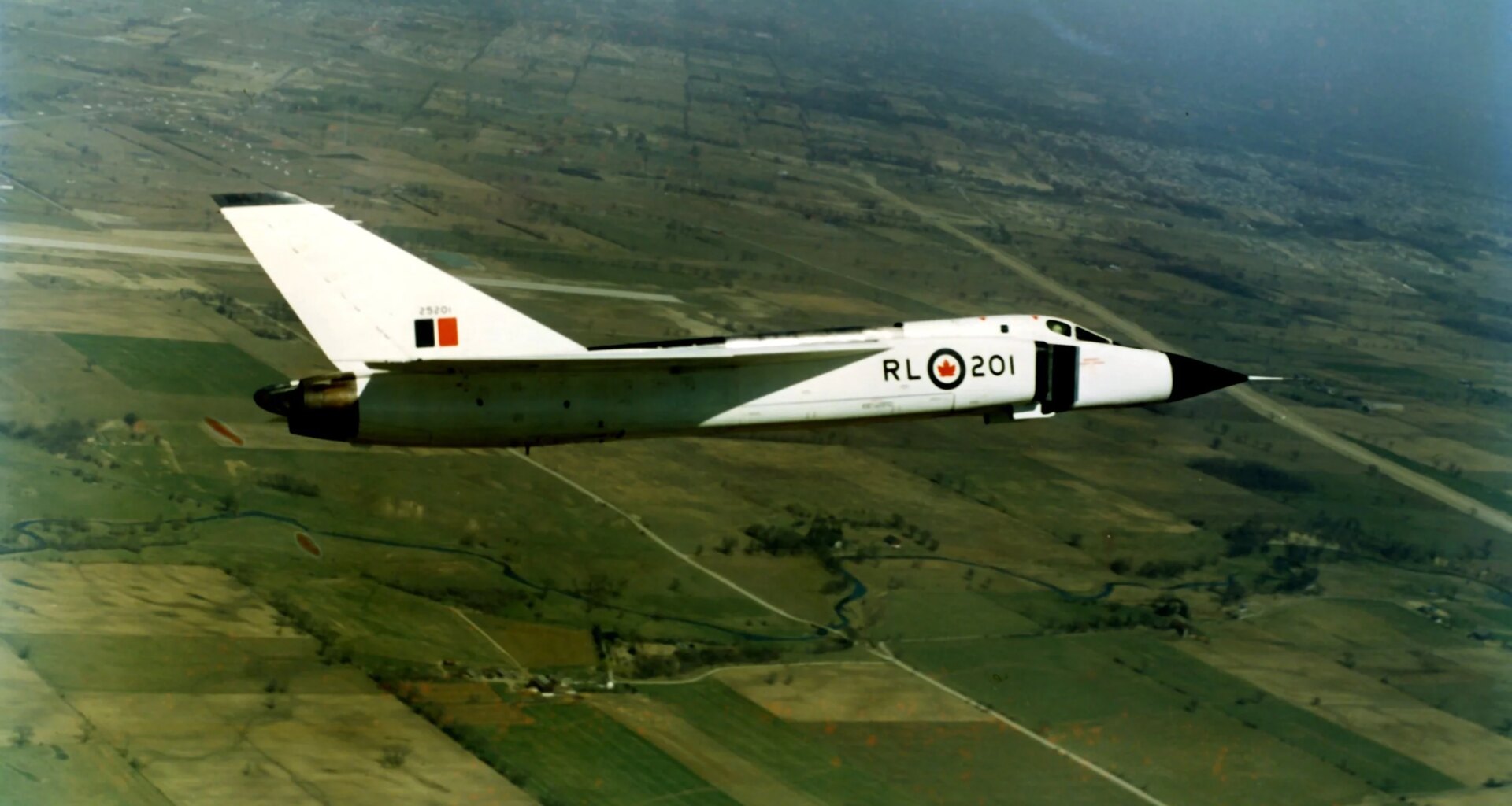
Jack Woodman, the only RCAF pilot to fly the Arrow, reported that the aircraft “was meeting and exceeding all specifications.” The A.V. Roe Canada design team was confident that the Mark II Arrows, starting with RL-206 with the Iroquois engine, would surpass Mach 2 easily, and planned on hitting Mach 3 with future series.
With the ultimate cancellation of the CF-105 program in 1959, we do not know what the Arrow might have achieved. There were five Mark I prototype Arrows that flew, with each being powered by J75 Pratt & Whitney engines. The first Mark II Arrow, RL-206, was nearing completion when the program was cancelled. RL-206 was to have been powered by the Orenda PS-13 “Iroquois” engine and was expected to have set new flight records. Even though only five Mark I Arrows ever flew, they set a new standard for design and flight performance expectations, and set new milestones in terms of “firsts” in the aeronautics industry, made all the more significant when viewed through the lens that it happened here, in Malton (Mississauga), in Canada, and who knows what else the talented brain trust that created the Arrow might have achieved if the program had been allowed to continue.
CF-105 AVRO Arrow “Firsts”:
• The first aircraft designed with digital computers being used for both aerodynamic analysis and designing the structural matrix.
• The first aircraft design to have major components machined by CNC (computer numeric control); i.e., from electronic data that controlled the machine.
• The first aircraft to be developed using an early form of “computational fluid dynamics” with an integrated “lifting body” type of theory rather than the typical (and obsolete) “blade element” theory.
• The first aircraft to have marginal stability designed into the pitch axis for better maneuverability, speed and altitude performance.
• The first aircraft to have negative stability designed into the yaw axis to save weight and cut drag, also boosting performance.
• The first aircraft to fly on an electronic signal from the stick and pedals. (i.e., first fly-by-wire aircraft)
• The first aircraft to be data-link flyable from the ground.
• The first aircraft to be designed with integrated navigation, weapons release, automatic search and track radar, home-on-jamming, infrared detection, electronic countermeasures and counter-countermeasures.
• The first high wing jet fighter that made the entire upper surface a lifting body.
• The first sophisticated bleed-bypass system for both intake and engine/exhaust.
• The first by-pass engine design.
• The first use of titanium for significant portions of the aircraft structure and engine.
• The first use of a drooped leading edge and aerodynamic “twist” on the wing.
• The first use of engines at the rear to allow both a lighter structure and significant payload at the centre of gravity. Many future aircraft designs copied this feature.
• The first use of a long internal weapons bay to allow carriage of specialized, long-range standoff and cruise missiles.
• The first integration of ground-mapping radar and the radar altimeter plus flight control system to allow an interceptor/reconnaissance role.
• The first missile-armed a/c to have a combat weight thrust to weight ratio approaching 1 to 1.
• The first flying 4,000 psi hydraulic system to allow lighter and smaller components.
• The first oxygen-injection re-light system.
• The first engine to have only two main bearing assemblies on a two-shaft design.
• The first aircraft to use a variable stator on a two-shaft engine.
• The first use of a trans-sonic first compressor stage on a turbojet engine.
• The first aircraft engine to use only 10 compressor sections in a two-shaft design.
With information from:
https://canadiansatarms.ca/avro-arrow-list-of-firsts/
https://www.va3kgb.ca/cf105/old%20html%20files/arrow_firsts.htm