

Listen to this article
Estimated 5 minutes
The audio version of this article is generated by AI-based technology. Mispronunciations can occur. We are working with our partners to continually review and improve the results.
Canada-U.S. Trade Minister Dominic LeBlanc says the federal government “welcomes” the United States “withdrawing” its positions on the French language and culture after U.S. Trade Representative Jamieson Greer told CBC News Canada’s streaming laws are not a “red line” for the American side.
“Canada welcomes that the U.S. is now withdrawing its positions on discoverability and labelling and is confirming that measures to promote French language and Canadian culture will not be subject to future U.S. trade actions,” LeBlanc said in a statement posted on X.
“We look forward to further constructive U.S. clarifications on their other positions which would create the possibility of a mutually beneficial trade agreement that respects Canadian sovereignty.”
Last week, Prime Minister Mark Carney told his negotiators to walk away from the table after the Trump administration introduced demands on culture, autos and sovereignty.
WATCH | U.S. trade rep disputes why talks fell apart | Canadian exclusive: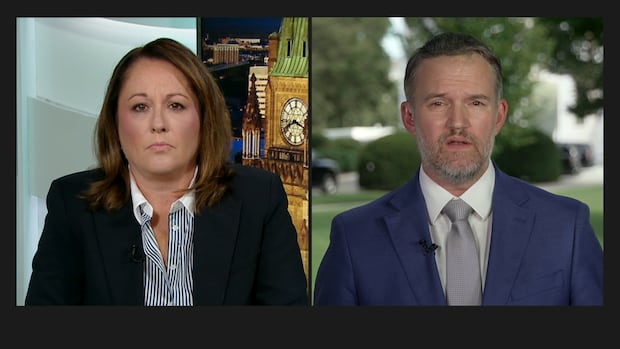
U.S. trade rep disputes why talks fell apart | Canadian exclusive
In a Canadian exclusive interview, U.S. Trade Representative Jamieson Greer disputed Canada’s explanation about why trade talks fell apart, and told CBC News chief political correspondent Rosemary Barton there’s currently no ‘open channels’ to get both sides back to the negotiating table.
The prime minister said the U.S. had issues with Canada’s subsidies for French culture, the prevalence of French-language media online and even the requirement to have bilingual labels on products sold in Canada.
“It was unacceptable right from the start, but the Americans kept trying and trying, and we said no,” Carney said at a news conference on Saturday.
“Ultimately, it’s simple. That was never on the table for Canada and it would not have been acceptable to Canadians.”
Modifying position on culture, language
In an interview with CBC News chief political correspondent Rosemary Barton that aired Wednesday evening, U.S. Trade Representative Jamieson Greer appeared to modify the U.S. position on culture and language.
On the issue of discoverability of French content on streaming services, Greer told Barton it had been “highlighted” by the White House, but not as a dealbreaker.
“President Trump, myself and the U.S. government recognizes the importance and sensitivity of the French language in Canada, in Quebec, in the Maritimes and some [other] areas. We know that this is quite sensitive and quite important,” he said of French-language protections.
“There is no way we would let a good deal go by for something like this. This is not something where we push hard.”
He said that the U.S. view of the issue was “you should let capitalism do its thing,” but added “it’s like the farthest thing from a red line.”
When the talks fell apart, U.S. tariffs of 50 per cent were slapped on a wide range of Canadian products, impacting about $27-billion worth of Canadian goods.
The Americans’ modified position comes two days after Canada announced its own dollar-for-dollar counter-tariffs on more than 700 different U.S. imports.
While the position on language and culture is good news for the prospect of a deal between the two countries, Greer told Barton that as of now, talks had all but broken down.
He said it wasn’t clear when the two countries might return to the negotiation table, confirming he and LeBlanc were not in contact as of Wednesday.
“I would say we don’t have open channels right now,” Greer said. “I have a good relationship with Minister LeBlanc, but right now, I think the Canadian side is talking about their next steps.”
Lutnick says Carney manufactured issue
U.S. Commerce Secretary Howard Lutnick accused Carney of playing politics by walking away from trade negotiations, saying he never mentioned the word “French” or Quebec’s language laws during discussions.
“Do I care about how the Québécois speak?” Lutnick asked. “I mean what could matter less to America. We don’t care.”
That’s why the president posted on social media saying, “it was a complete lie,” Lutnick said.
He said the move was a ploy to prevent the sovereignist Parti Québécois (PQ) from winning the upcoming Quebec election.
When asked about this, PQ Leader Paul St-Pierre Plamondon said if the French language was not actually at stake during negotiations, “that’s a serious issue because it tells you that the government of Canada and Mark Carney said things that are not true.”
But if Lutnick isn’t telling the truth, “it’s telling you what’s the genuine situation of Quebec in that negotiation — namely that we’re not at the table. We’re on the menu,” he said.
Coalition Avénir Québec Leader Christine Fréchette says she believes Carney’s version of events.
“I sense sincerity when we speak with our federal counterparts, at the political level and at the administrative level,” she told reporters in French.
Fréchette, who dissolved Quebec’s National Assembly on Thursday to officially launch the election campaign, said the federal government had provided consistent updates on the state of trade negotiations, especially in the final 24 hours before the deal fell apart.
Do you support Canada’s new retaliatory tariffs on the U.S., set for Sept. 8? Click “Join the Conversation” below. On the app? Tap here.