

Listen to this article
Estimated 4 minutes
The audio version of this article is generated by AI-based technology. Mispronunciations can occur. We are working with our partners to continually review and improve the results.
Rescuers worked through mud and debris Friday in areas devastated by a catastrophic flash flood along the Himalayan border between Nepal and China, continuing the search for hundreds of people still missing as the death toll rose and authorities warned that a newly formed, overflowing lake could trigger further flooding.
Nepalese and Chinese authorities warned of further flooding from a lake that formed upstream after Wednesday’s disaster and was already overflowing. They urged people in potentially affected areas to move to safer ground.
Nepal’s National Disaster Risk Reduction and Management Authority says the death toll has risen to 538, while the number of missing people remained at 977 and 3,742 people have been rescued.
Nepali police later put the death toll at 547. At least three people were killed in Tibet.
The missing include tourists from several countries. Global Affairs Canada has said it was aware of 30 Canadian citizens and permanent residents unaccounted for, though it warned the number could fluctuate in the days ahead given the communication challenges in remote areas.
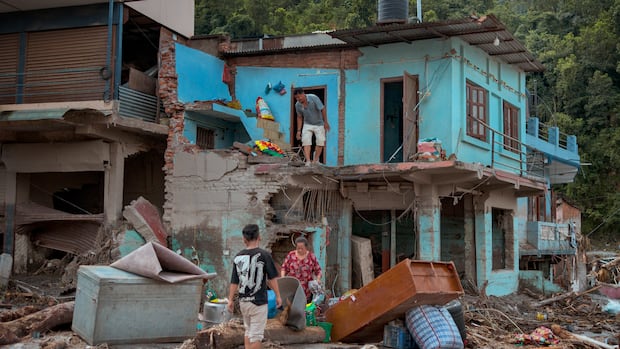
 Residents salvage belongings from their destroyed home following flash floods on Friday in Devighat, Nepal. (Ezra Acayan/Getty Images)
Nepalese army spokesperson Brig. Gen. Raja Ram Basnet told The Associated Press that a team had been deployed Friday to the Upper Trishuli-1 Hydropower Project near the Nepal-China border following reports that people were trapped inside a tunnel.
“It is complicated to find the entry and exit points of the tunnel because everything has been covered by mud,” Basnet said. “Our first priority is rescuing the stranded people.”
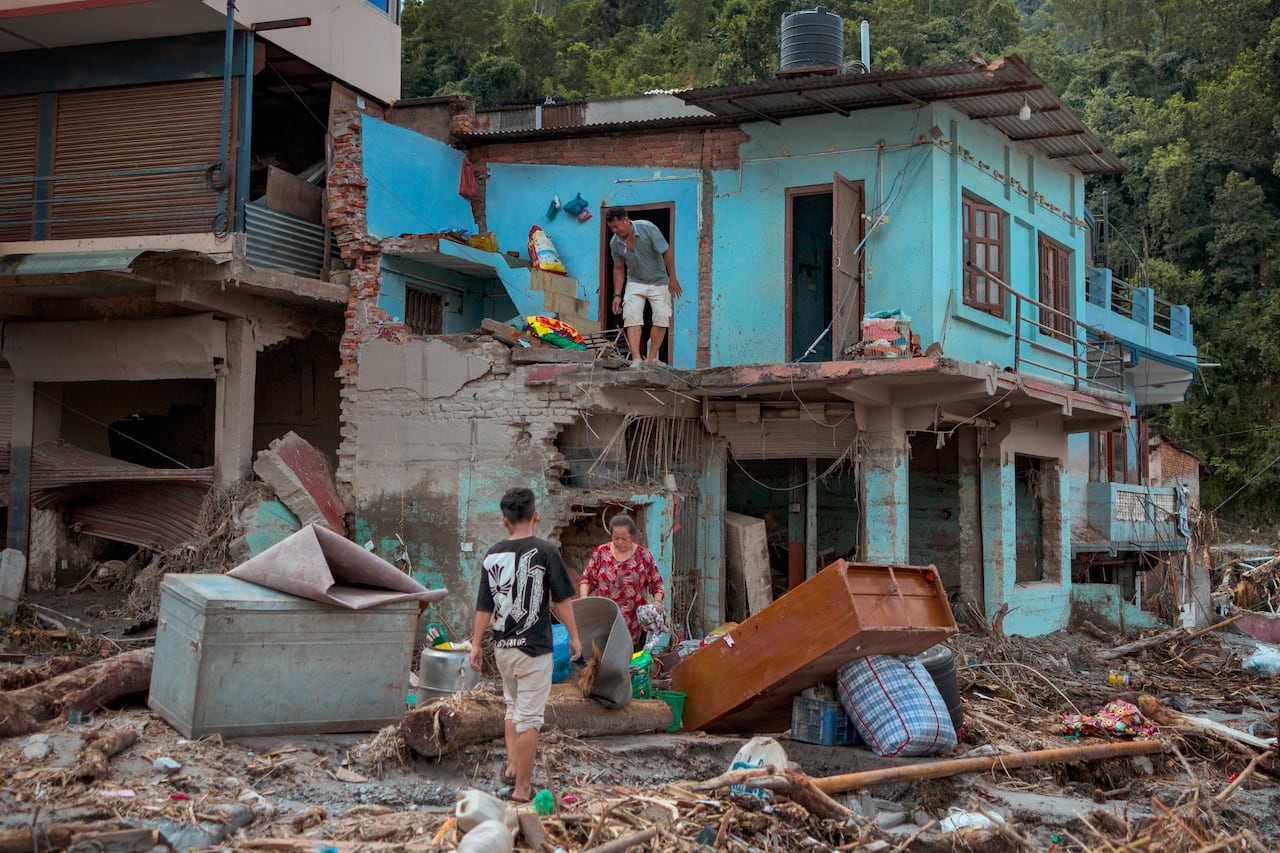
Rescue workers climb through mud to free people trapped in tunnels
Emergency responders rescued 350 people trapped inside a tunnel, shown in video released Nepal’s Prime Minister’s Office on Friday. Efforts are contuining to aid more than 100 people who are still trapped, after Wednesday’s flash flooding that destroyed villages and infrastructure in Nepal.
Red Cross officials, at a news conference in Switzerland, expressed concern about a secondary flood and said that the organization’s rescue operations were temporarily halted after trucks with relief supplies were were blocked by further flooding.
“We believe that at least 93,000 people have been affected and are in great need,” said David Fisher, head of delegation for the International Federation of Red Cross and Red Crescent Societies in Nepal.
Nepal’s Foreign Ministry said on Friday that it appreciated the offers of help from several countries with nationals missing amid the disaster but that it was able to manage the rescue efforts at present.
Flood survivors, including injured people, were taken to Kathmandu and other locations.
The affected areas are popular with hikers and for pilgrimages to religious sites.
Vishnuram Ramaswamy works at a private company in the southern Indian city of Puducherry and said that he last spoke to his mother and two sisters who were on pilgrimage to Mount Kailash on Wednesday morning at 9 a.m.
“This was the first time they had gone on this pilgrimage and it was something my mother always wanted to do,” he said.
Survivor sees ‘black storm’
Customs officer Karbir Gaire is among some of the survivors in Timure, the closest Nepalese village to the border with Tibet.
Gaire reached his office around 8 a.m. on Wednesday and was busy working on his computer when he first felt the ground shake.
“Right after the shake, I noticed a black storm coming towards us,” he recalled from Kathmandu, where he is back with family. “We all immediately started running out, and within a few seconds, we were climbing uphill on the opposite side of our office building. I think those 10 or so seconds saved some of us.”
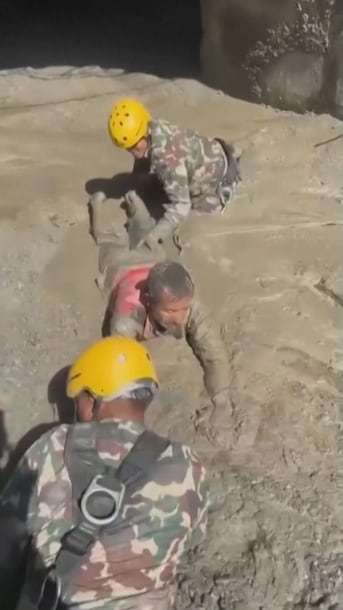
The disaster started with a glacier collapse that sent ice and rock flowing downstream, and which registered as a magnitude-5.2 seismic event at the U.S. Geological Survey.
The science behind Nepal’s catastrophic flash floods
An entire river valley along the Nepal border was wiped out in seconds — but local radar showed no rain, and it wasn’t an earthquake. CBC meteorologist Johanna Wagstaffe breaks down how a massive glacier collapse triggered a violent inland tsunami, and why geologists warn this unfolding climate disaster isn’t over yet.
Gaire doesn’t remember exactly how many people were in the office when the disaster struck, but his 15 colleagues have gone missing.
“It was like a Hollywood movie scene. I don’t call it a flood, it was a tsunami,” he said.
Gaire described Timure as a vibrant place filled with government offices, hotels, cafes, banks, primary schools, tea shops and residential buildings, where more than 1,500 people were living.