

Listen to this article
Estimated 4 minutes
The audio version of this article is generated by AI-based technology. Mispronunciations can occur. We are working with our partners to continually review and improve the results.
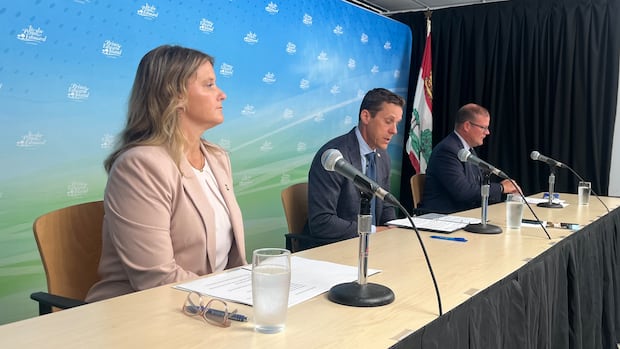
The Prince Edward Island government is rolling out $12.5 million in financial support for businesses facing pressure from newly imposed U.S. tariffs.
Premier Rob Lantz said the breakdown of Canada-U.S. trade talks and the 50 per cent tariffs slapped on billions of dollars in Canadian exports have pushed the province into an uncertain trading environment that it had been bracing for over the past 18 months.
“Canada did not choose this trade war, but we can choose how we respond to it,” Lantz said during a news conference Friday.
“We’ll stand behind Islanders who are affected by this. There will be difficult days ahead.”
Based on government data from January to May, the province estimates about $10 million in P.E.I. exports could be directly hit — including agriculture products such as dairy, as well as refrigeration and freezing equipment, buoys and other floating structures.
Lantz said that figure is an early one and likely to change as more information comes in.
‘Businesses need more flexibility’
To help businesses manage immediate cash-flow pressures, the province is reopening its Tariff Working Capital Assistance Program through Finance P.E.I., making $10 million in working capital financing available to eligible firms.
Economic Development, Trade and Artificial Intelligence Minister Jenn Redmond said the program, first set up in March 2025, has been updated in response to what businesses are now facing.
The maximum loan remains $500,000, but the repayment term has been extended from six to seven years, and the interest-only period has doubled from one year to two years, she said.
“These changes were made because we know businesses need more flexibility,” Redmond said.
“Finance P.E.I. is a patient, understanding lender, and staff are ready to begin administering the program.”
WATCH | What are the P.E.I. government’s plans to counteract Trump’s tariffs?:
What are the P.E.I. government’s plans to counteract Trump’s tariffs?
P.E.I. Premier Rob Lantz says up to $10 million in provincial exports could be affected by the trade war between Canada and the United States. CBC’s Wayne Thibodeau has more on what the province will do to try and offset those impacts.
The province is also launching the P.E.I. Tariff Impact Relief Fund, with $2.5 million available in non-repayable grants of up to $50,000 for eligible businesses.
“These grants can also go towards capital expenses that will help with productivity or pursue different supply chain opportunities. They can also go into market intelligence and trade activity participation,” Redmond said.
She noted that the Atlantic Canada Opportunities Agency is providing $110 million to support small and medium-sized businesses in the region through the Regional Tariff Response Initiative.
“The department has been in regular talks with the Atlantic Canada Opportunity Agency to ensure P.E.I.’s industry needs are heard, represented, and our expectation that we will be supported by the federal government,” Redmond said.
To better track the fallout, the province has launched a tariff impact survey for businesses.
Redmond said the province has received 26 responses so far, but she hopes more businesses will complete the survey so government programs can be adjusted as conditions evolve.
Support for workers
Workforce and Advanced Learning Minister Zack Bell said there is also support available for workers, pointing to the previously announced $3.1-million Canada-P.E.I. workforce tariff response.
He said the fund is intended to help unemployed or laid-off workers gain new skills, allow employers to retrain staff and help currently employed workers strengthen their position in sectors disrupted by tariffs and broader global shifts.
“This is about more than tariffs. It’s about the people behind every job,” Bell said.
He encouraged anyone who expects to be affected to contact Skills P.E.I. for tailored training and employment services.
 ‘A lot of businesses have been … actively looking for other markets outside of the U.S. if they export. Some stopped exporting altogether,’ says Bianca McGregor, CEO of the Greater Charlottetown Area Chamber of Commerce. (Compass)
Bianca McGregor, CEO of the Greater Charlottetown Area Chamber of Commerce, told CBC News: Compass host Steve Bruce that the majority of the chamber’s members employ 10 people or fewer.
“We’re just trying to figure out which businesses are going to be … heavily affected versus which ones aren’t,” she said.
“This has been 18 months in the making, so a lot of businesses have been … actively looking for other markets outside of the U.S. if they export. Some stopped exporting altogether.”
With trade relations between the two countries constantly shifting, McGregor said it has been difficult for businesses to plan appropriately. She called the province’s support “welcome news.”
“That’s the part I think that hurts businesses the most is that inability to be able to manage or to plan appropriately,” she said.
“As a chamber network, stable and fair trade with the United States is first and foremost what we want, but that hasn’t happened.”