
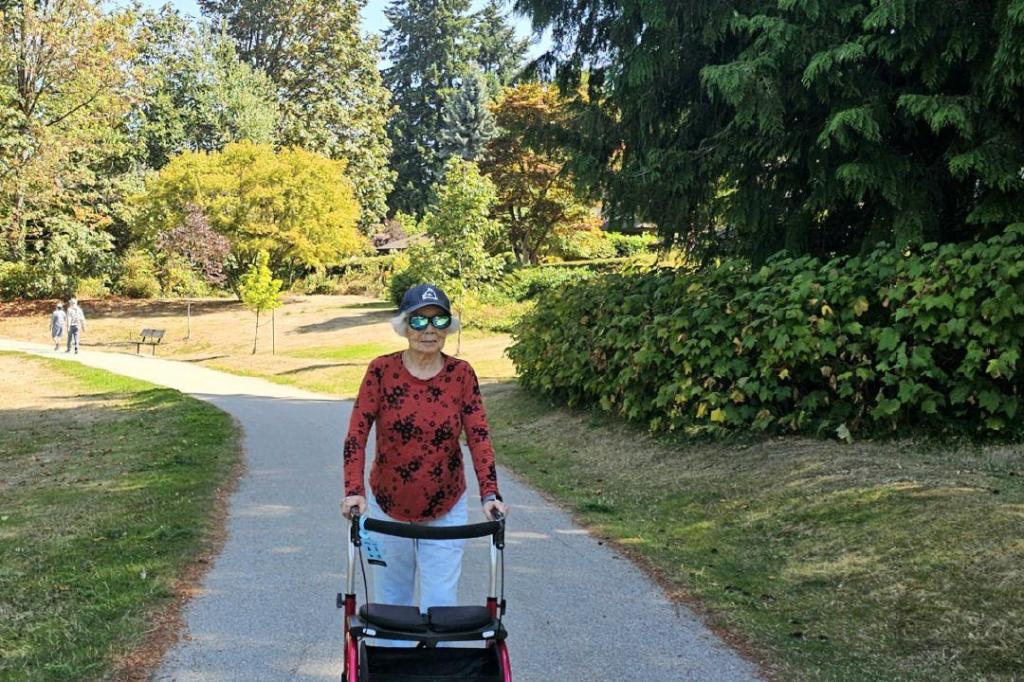
For those fortunate to reach the ripe old age of 99, there may be some things that are no longer possible – driving, rollerskating, climbing trees, tackling the grime on exterior windows, for example.
But under the right conditions, a hip replacement is among things that remain in reach – and can restore a quality of life that may have felt as if it was gone forever.
That’s been the case for South Surrey’s Da Xu, who elected to have a total hip replacement earlier this year after exhausting – over a period of two years – multiple conservative efforts to treat severe arthritic pain in her right hip.
“She was suffering,” her daughter Xiaqing Lu told Peace Arch News, describing “unbearable pain” that prompted a number of visits to Peace Arch Hospital’s ER.
“She ended up in a wheelchair for six months, and couldn’t climb up the stairs to the bedroom… couldn’t walk.”
While treatments including cortisone injections provided some relief, the reprieves felt by her once-active mother were short, said Lu.
Well into her 99th year (she starts her 100th on Oct. 25), Xu was a tad outside the “normal” age range for the procedure – it’s most often performed on those aged 60 to 80 years old.
White Rock orthopedic surgeon Dr. Jeffrey Kwee estimates he performs 60 to 70 joint replacement surgeries annually, on patients who are an average of 70 to 75 years old.
“Certainly, we do have folks who are older, but I think it’s definitely an exception to be well over 90,” he said Thursday (Aug. 27).
Officials with Fraser Health said in the health authority’s last fiscal year (2025-2026), the average age of 472 hip-replacement patients was 70. The oldest was “over 99 years old,” while the youngest was 24.
Lu said her mom initially felt that, given her age, she’d just try to live with the pain. After all, “I don’t have that many years,” she told Lu.
But, after an ER doc recommended she see a surgeon, she started on a new path.
Following the referral, it was around six months before Xu had an appointment. From there, things moved “so quickly,” Lu said.
At the final pre-surgery appointment, the surgeon – whom Lu identified as Kwee – reviewed the potential complications of Xu’s osteoarthritis, COPD and hypertension, as well as “very clearly” explained the risks, which included bone fracture, heart attack and stroke, before looking Xu in the eye and asking, “Do you really want the surgery?”
Both mother and daughter were a bit nervous and scared, Lu recalled.
“I didn’t want my mom to suffer the pain. My mom, she said if her life had no quality, she wouldn’t want to live one day longer,” she said.
Her mom was also at peace with the worst-case scenario – of not waking up from the surgery.
“She said, ‘if I wouldn’t come down from the table, then I would… so peacefully leave,’” she told Lu.
“This is real testament to her, because this is major. She just carried on, as a regular day, so that was amazing.”
Xu, who moved with her daughter to South Surrey five years ago, underwent the hip replacement – coordinated through the Hip and Knee Arthoplasty – Central Intake and Optimization Clinic – at PAH on May 11. She was out of bed the following day starting physiotherapy, and spent a week on the surgical ward before transferring to Fraser Health’s PATH (Patient Assessment and Transition to Home) program, followed by receiving the all-clear to head home on May 29.
Within three weeks of surgery, she was getting around her home with a walker, and on June 16, started venturing outside.
Told to take things slow for three months – to minimize the risk of dislocation – her recovery regime included weekly visits to Grandview Heights Aquatic Centre, physiotherapy, and progress checks every other week, during which Lu said her mom was told she was doing “even better” than some who have undergone a hip replacement at age 60 and even age 80.
They celebrated the three-month post-surgery mark with a paddleboard outing at Buntzen Lake.
Lu described her mom’s hip-replacement journey as “truly inspiring,” and said she hopes “it can inspire others and also show appreciation for the medical team, especially the surgeon’s team, nursing staff, and the PATH program, along with the advanced medical technology that made this possible.”
Kwee confirmed his oldest hip-replacement patient “by far” was 99.
According to Guinness World Records, the oldest person to receive a total hip replacement was U.K resident John Randal, who underwent the surgery in 2011, at 102 years, three months and 30 days old. BBC News reported in 2015 that Isle of Wight resident Gladys Hooper received a hip replacement at age 112. At the time, she was also the U.K.’s oldest woman.
Kwee noted that not everyone hoping to undergo the procedure is eligible, explaining that overall health plays more of a role in the surgical decision than age. Some patients much younger than Xu have not qualified because of other health issues.
“It’s very much based on the individual and how they come to me,” he said.
For those deemed ineligible at the time, all efforts are made to try and improve their situation so that the surgery might be possible down the road.
“We try to optimize (their situation) in every other way we can,” Kwee said.
Kwee said his oldest patient has been “exceptional” in her recovery, and lauded the opportunities medical advancements have provided that make such successes possible.
“We’re fortunate to live in an age where we can do this operation,” he said. “It really does help patients significantly.”