
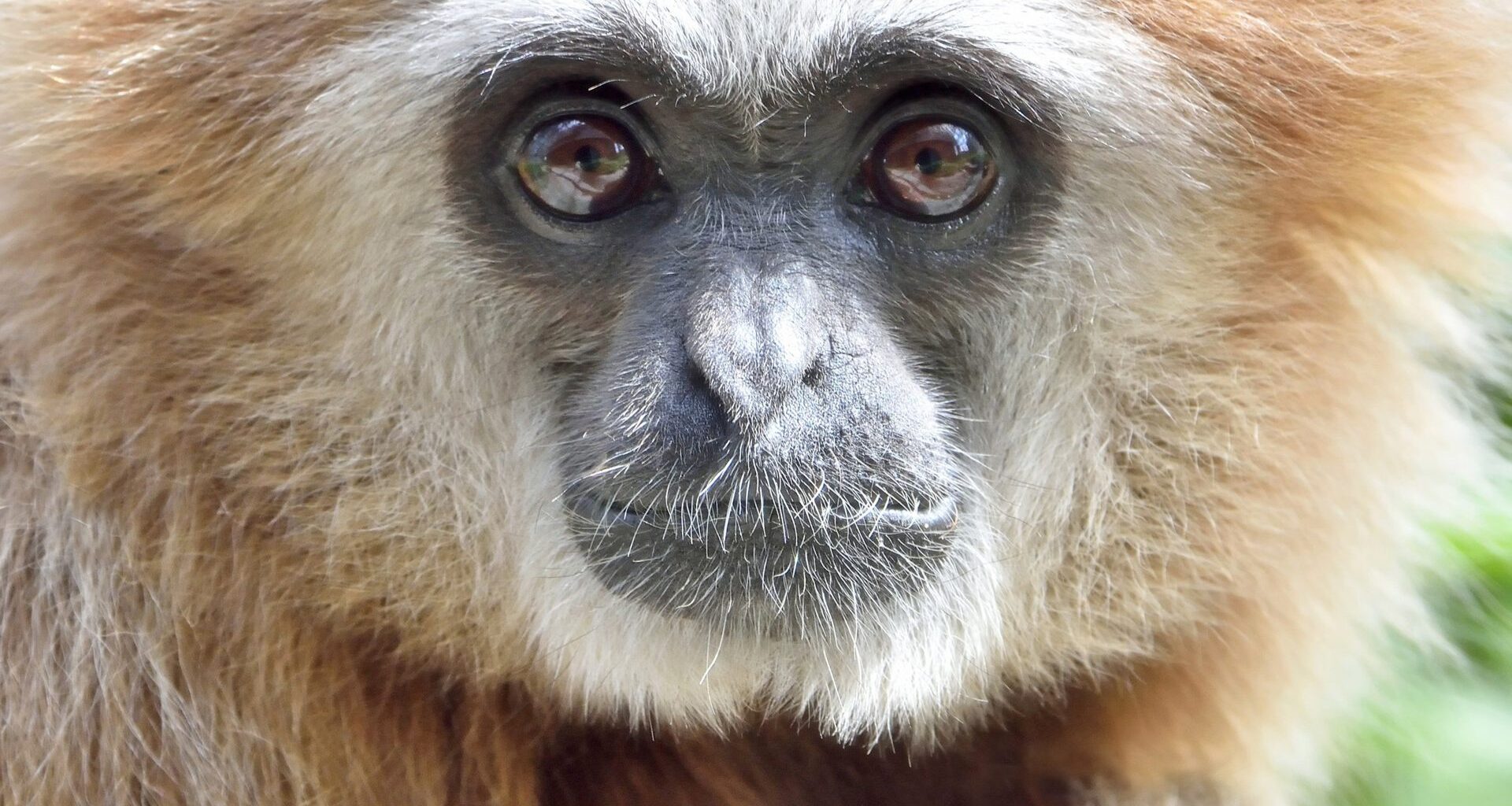
Gibbons focus strongly on eyes, especially other gibbons’ eyes, offering clues about the evolution of primate social attention.
Faces carry a great deal of social information. For primates, a quick look at another face can show who is nearby, where attention is going, and how a social moment may unfold.
Humans often look straight at the eyes. Monkeys and great apes do this too, but much less was known about gibbons.
A team at Kyoto University tested adult gibbons.
The animals spent more time looking at eyes than at any other part of a face, and gibbon eyes held their attention longer than human eyes.
Gibbons help explain social evolution
Gibbons are small apes, not monkeys. They branched away from the line leading to humans and great apes about 17 million years ago.
Most gibbons live in small family groups centered on a long-term pair and their young. This way of living differs from the larger groups found in many other primates.
That difference makes gibbons useful for learning how social life may shape attention to others, yet they have received far less attention than other apes.
First author Makiko Uchikoshi described why this gap matters.
“Understanding the evolutionary origins of the human mind requires comparative studies across the ape lineage,” said Uchikoshi.
“Despite their evolutionary importance, gibbons remain one of the least studied ape groups in cognitive research.”
Gibbons chose to view faces
Three adult male gibbons took part. Tsuyoshi and Raja were 23-year-old brothers, while their father, Mamy, was estimated to be 52.
The team used an eye tracker, a device that records where someone looks on a screen. Nothing was attached to the animals, and the sessions took place in a familiar indoor cage.
Each gibbon sat about 26 inches (65 centimeters) from a 23-inch monitor. Drops of water encouraged him to stay in place, but he could leave and end the session whenever he chose.
The gibbons saw 48 photographs, split evenly between unfamiliar adult gibbons and humans. Every face looked forward with a neutral expression, open eyes, and a closed mouth.
The eyes won attention
Each photograph stayed on the screen for three seconds. The device measured how long the gibbons watched the eyes, nose, mouth, outer face, and background.
When the team combined all the viewing records, the eyes stood out clearly. The gibbons watched them longer than every other area.
The same eye-first pattern appeared in photos of both males and females. However, the team did not directly test whether the animals preferred male or female faces.
Macaque monkeys, great apes, and humans also tend to focus on eyes. The new result suggests that this habit may have deep roots in primate history.
Gibbon eyes held attention longer
The animals did not treat every pair of eyes in the same way. They spent more time watching gibbon eyes than human eyes.
The nose and mouth showed no similar difference. This suggests that eyes are especially important in directing social attention.
This may be an own-species bias, meaning extra attention to members of the same species. All three animals showed the pattern when their results were checked separately.
That result is striking because all three had spent much of their early lives around people and regularly saw both human and gibbon faces.
Even so, the work cannot show whether biology, experience, or both shaped their attention.
Each animal looked differently
The overall result was clear, but the three gibbons did not behave in exactly the same way. Their differences show why larger groups of animals will be needed.
Tsuyoshi showed the strongest focus on eyes. He watched them longer than every other part of the image.
Raja watched the eyes longer than the nose and mouth, but he also spent time on the outer face. Fur patterns and human hairstyles may have caught his attention, although the team did not test that idea.
Mamy showed a clear difference only between the eyes and the background.
He completed half as many image trials because data collection stopped for health reasons, leaving less information about his viewing habits.
What eyes may reveal
Why do eyes attract attention? In many primates, they show where another individual is looking and may carry signals linked to interest, acceptance, desire, or rejection.
Eye contact has been reported during some gibbon mating behavior, but its wider role remains largely unknown. The neutral photos showed where the animals looked, not what they understood, expected, or felt.
Uchikoshi had known the gibbons for nearly three decades before measuring their gaze. The eye tracker turned familiar moments of eye contact into information that could be counted.
“I have known the gibbons that participated in this study for nearly 28 years and have often experienced moments of eye contact, but I had never been able to measure objectively what they were actually looking at,” said Uchikoshi.
“Being able to quantify where they look and for how long felt almost like magic.”
Limitations of the study
Only three gibbons took part, and all were related adult males. They were raised by humans early in life, so they cannot represent every gibbon or every kind of upbringing.
The animals also represented only one branch of the gibbon family. One completed fewer trials, which made his individual result harder to judge.
Still photos with neutral expressions capture only a small part of social life. Moving faces and other social signals could lead to different viewing patterns.
Future work needs females, naturally raised animals living in social groups, more species, and all four main gibbon groups.
Using the same method with several primates would also make comparisons stronger.
A clue to human minds
The value of this work reaches beyond gibbons. Comparing apes can help reveal which parts of human social attention may come from a distant shared past.
The eye-first pattern could be ancient, but this small experiment does not prove when it began. It also does not show that eyes mean the same thing to every primate.
The voluntary method gives researchers a way to include gibbons without restraint. That could lead to clearer tests of how they respond to faces, expressions, and other social signals.
For now, the message is simple: adult gibbons notice the eyes, especially when they belong to another gibbon.
The study is published in the journal Animal Behavior and Cognition.
—–
Like what you read? Subscribe to our newsletter for engaging articles, exclusive content, and the latest updates.
Check us out on EarthSnap, a free app brought to you by Eric Ralls and Earth.com.
—–