
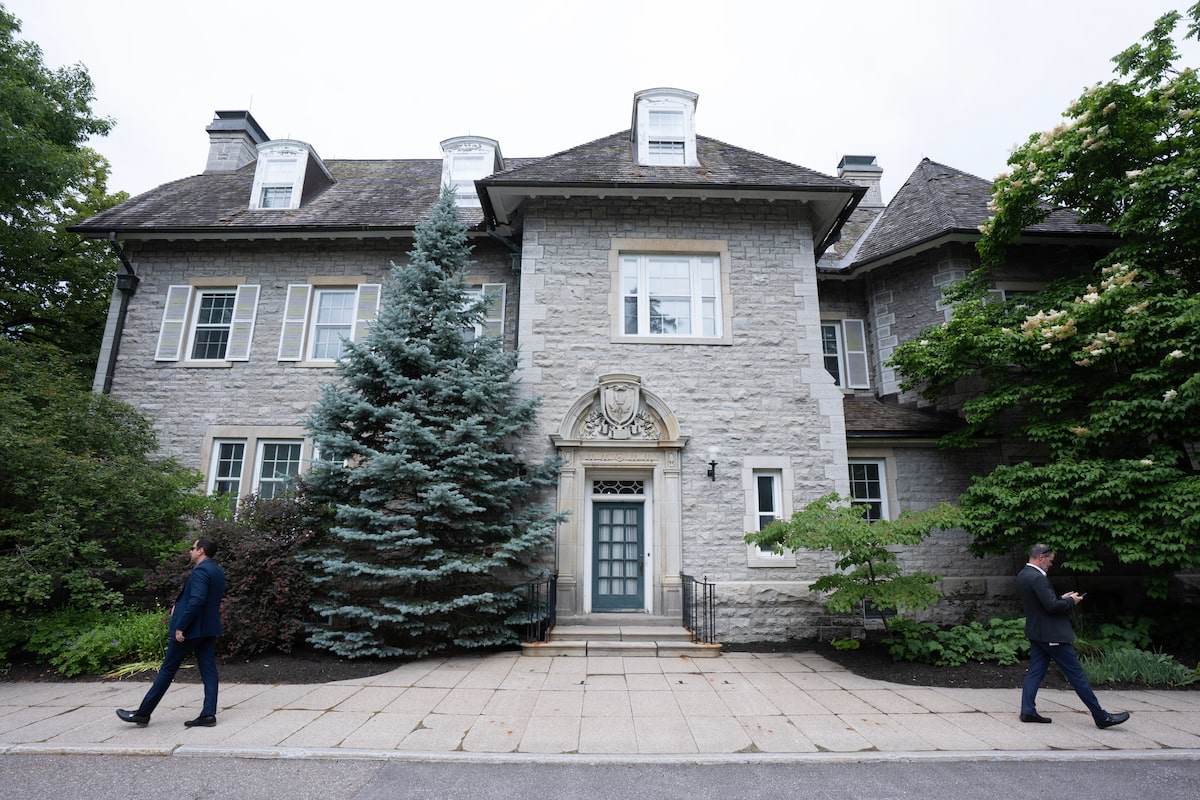
The 24 Sussex renovation is an opportunity to create a flagship of contemporary Canadian design. And that opportunity, so far, is being missed.Adrian Wyld/The Canadian Press
Imagine, a decade from now, the Prime Minister returning home to a great building. The house at 24 Sussex Drive has been renovated and expanded by a team of Canada’s best architects, landscape architects, interior designers and product designers. Photo-ops are framed by windows overlooking the Rideau River, alongside artwork by Christi Belcourt and lighting by Montreal’s Lambert & Fils.
This is what the Prime Minister’s residence should become: a symbol of a country that honours its own creative talent and gives it pride of place. Now that Canada is engaged in a fight for its sovereignty against American overreach, it is crucial for the nation to assert its values and its capabilities. A new 24 Sussex must send a bold message.
Alas, the reality seems likely to be much less inspiring.
This summer, Prime Minister Mark Carney launched a process to “rehabilitate and modernize” the house. It is a welcome effort to bring the building, which has been vacant for a decade, back into shape. But the process has gotten off to a poor start, with no clear vision, too many cooks and an air of bureaucratic meekness.
The 24 Sussex renovation is an opportunity to create a flagship of contemporary Canadian design. And that opportunity, so far, is being missed.
Rather than begin with a bold statement of principles, Mr. Carney announced a so-called “design-and-build competition.”
A design competition, which is a common tool across Europe, aims to select a design on the basis of quality. The point is to find a strong creative vision to drive the project. Ottawa is not doing this at 24 Sussex. Instead, it is inviting designers and contractors to team up. Only a few Canadian contractors could plausibly carry out such a large, sensitive job and so those companies will get their pick of the country’s architecture firms. Designers who are young or lack professional connections – those most likely to bring a novel approach and to advance the art of architecture – are unlikely to be involved.
There’s more. The government has hired an outside group – the advocacy organization Royal Architectural Institute of Canada, based in suburban Manotick, Ont. – to “support” the process. Odd. Why should Public Services and Procurement Canada, which has 19,000 employees, engage consultants to help them engage consultants?
The answer seems clear: Mr. Carney doesn’t want to get bogged down. The prime minister, sensibly, would prefer not to spend his government’s political capital on this highly visible file. Stacking up ranks of consultants insulates the government from criticism.
But it also almost guarantees a bad result. At the moment, 24 Sussex is neither a memorable nor a particularly good building. It has been rebuilt time and again, its front face redesigned in bland, bureaucratic fashion. Its interior is a ruin. If it is a metaphor for the country, and public buildings generally are, it sends a message of neglect, incoherence and dysfunction.
To change this, Mr. Carney must take responsibility, demanding a flagship of innovative, sustainable Canadian design and empowering the civil service to deliver it. Remember, 24 Sussex is where the prime minister hosts the world.
This would be not just a political project but one of economic development. Other countries work to promote their architects and designers. Those nations – such as tiny Denmark, whose architects are designing civic buildings and prominent skyscrapers in Canada – understand that design is a valuable export.
“Unlike many European countries that actively invest in design as both a cultural asset and an economic driver, Canada offers little institutional recognition for the profession,” the Canadian designer Thom Fougere recently wrote for the international publication Dezeen. In that light, he argued, 24 Sussex “presents a precious chance to showcase Canadian design at every level with a nationally significant project.”
Mr. Fougere is correct. Canada lacks a national design policy. Our governments – with few exceptions, including Montreal – simply don’t understand the importance of designing and building great places. Nor do we understand that public projects are of profound importance to the culture and business of design.
We must learn. The house on Sussex Drive is more than a house. It should be a symbol of how Canada thinks about itself, and what it can be.