
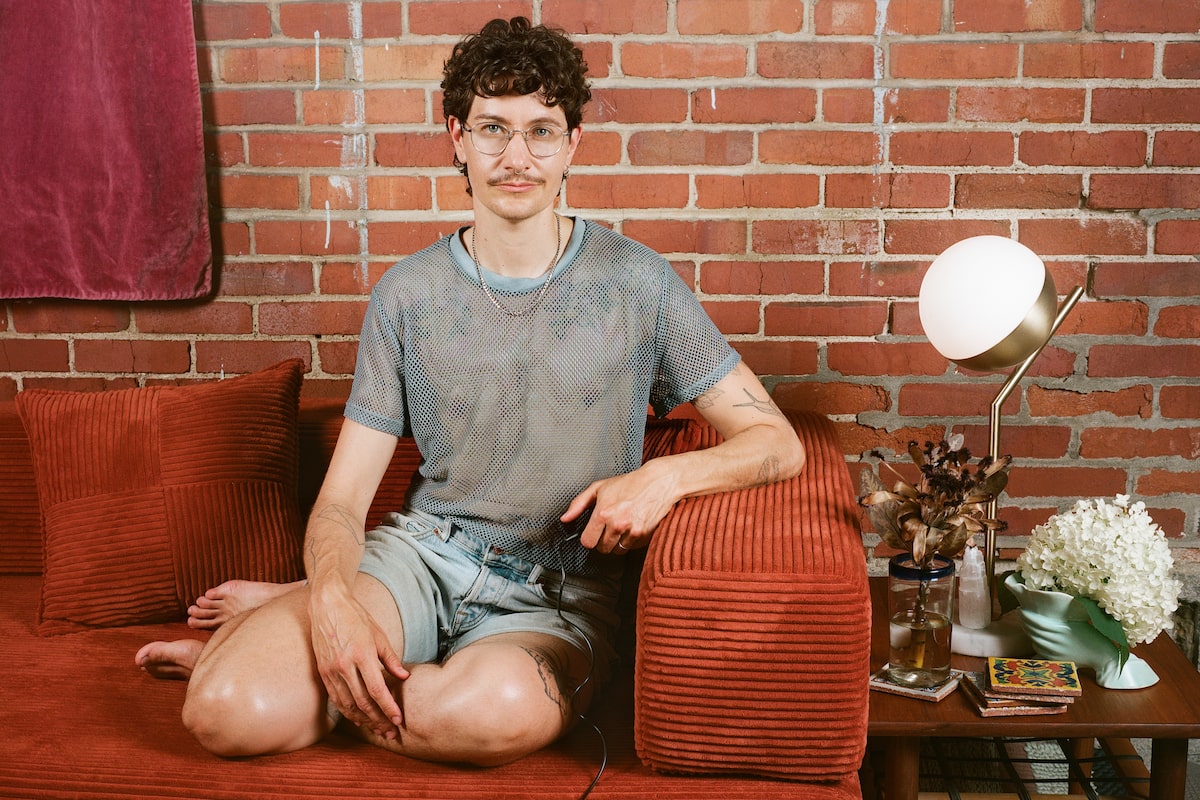
Jesus, Mary, and Joseph: the first queer family?
Such are the questions – transgressive, irreverent, maybe even a little shocking – provoked by the photography of JJ Levine.
The Montreal artist, whose portraiture toys with conventional ideas about gender and sexuality and familial bonds, is having a moment. His pieces have recently been acquired by major institutional collectors in Quebec and English Canada, while the National Gallery will feature his work in an upcoming show. Art fairs in New York and Toronto have been or will be wallpapered with Levines this year.
The artist is trans and his work has a particular relevance at a moment when trans people are under attack, after a period of progress and increased visibility.
But as the Biblical valence of some Levine images suggests, it is their timelessness, as much as their timeliness, that makes them stick in the viewer’s mind.
Far from being mere political statements, his best photographs engage in a deep art-historical conversation going back to medieval Siena and reaching forward to New York’s East Village in the 1980s. Immaculately composed (if not conceived), lushly coloured, and alternating between campy and austere, Levine’s work makes a surprising bid for immortality.
The camera is Levine’s first artistic love and primary implement. A Nan Goldin show at the Musée d’art contemporain was a formative youthful experience. In some ways it’s easiest to slot his work into the history of queer and outsider photography that Goldin represents, along with her contemporary and scene-mate Peter Hujar and later exemplars such as Catherine Opie.
Levine is clearly interested in overturning some of the photographic conventions, from Victorian family groupings to mugshots, that have been used in the past to define in-groups and outsiders. By posing himself and his friends with a classical, or carceral, stiffness, resolutely unsmiling, in temporally ambiguous settings, he places queer and trans subjects back in a tradition they have been excluded from. Looking at his tattooed, non-binary sitters recreating the starch-collared formality of black-and-white grandparents perched on the world’s mantelpieces prompts the question: What if these images were always the norm? And why weren’t they?
This is where Levine does battle with another fraught tradition in photography, the Diane Arbus mode. By shooting drag queens and pairs of male lovers alongside dwarfs, triplets, and other “freaks,” Arbus objectified her queer subjects – or so critics, including Susan Sontag, have argued. Others see deep compassion in her lens, but with Levine there is no question. He can be a tyrant behind the scenes, arranging the sitter’s clothes and limbs and posture just so. But where the viewer enters the equation, the subjects of Levine’s pictures possess undeniable power, gazing back as if to say, “What are you looking at?” These are not portraits for passive consumption, human curiosities to be studied or provide titillation. Levine’s people meet your eye, almost daring you to blink. (If Arbus photographed “them,” Levine photographs “us.”)
The severity of his sitter’s expressions serves a political purpose, returning agency to groups who have been stripped of it in the history of art. But again, the aesthetic echoes are just as interesting.
There is something painterly in Levine, despite his adoration of the camera – a meticulousness about colour and line that brings to mind great painters of the past as much as fellow photographers. The stylized brightness of his palette and starkness of his faces evoke Cézanne’s portraits, improbably.
The two artists also share an intimacy with their sitters that comes through on the canvas, or the print: among Cézanne’s favourite human subjects were his wife and himself, while Levine never photographs someone he doesn’t know, and has made some powerful self-portraits.
Julie Nursing Casper, 2018
Family, both biological and chosen, is Levine’s great theme, which is surely why his work so heavily evokes medieval and Renaissance religious painting. A recent show of his at the downtown Montreal gallery ELLEPHANT stunned me with its similarities to a 2024-2025 retrospective at the Metropolitan Museum in New York about the art of early modern Siena. The two collections could hardly have been more different in medium and historical background, but those 14th-century works in tempera on wood had an uncanny resemblance to Levine’s.
Both the photographer and the painter Duccio, say, depicted small, improbable family groupings who faced persecution and stare out at the viewer with almost eerie intensity, defiantly demanding acceptance or imploring belief.
After all, what is really more improbable: a parent, a sperm donor and their child; or a virgin mother, divine infant and, somewhere off scene, the immaculate donor Himself?
It is questions like these, sacrilegious as they may be, that give Levine’s work some of its charge, and why his photographs will have staying power beyond the urgency of their political moment.