

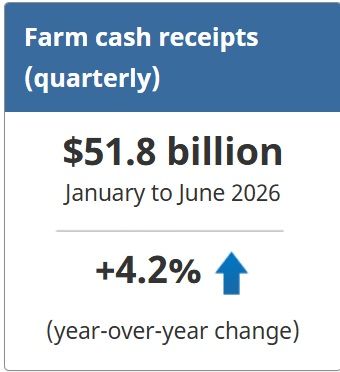
Canadian farmers generated $51.8 billion in farm cash receipts during the first six months of 2026, an increase of 4.2 per cent, or $2.1 billion, from the same period a year earlier, according to Statistics Canada.
The increase was driven by stronger livestock and crop receipts, which more than offset a decline in government program payments.
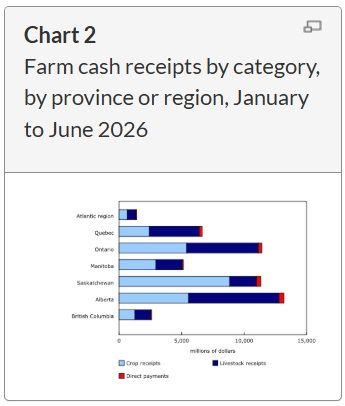
Receipts rose in nearly every province, with Saskatchewan recording the largest gain at $744.5 million, followed by Alberta at $591.2 million.
Cattle Continue to Drive Livestock Revenue
Total livestock receipts climbed 8.7 per cent to $23.2 billion during the first half of the year. Statistics Canada says higher prices for most livestock commodities supported the increase.
Cattle receipts alone were up $1.1 billion compared to the first six months of 2025, accounting for more than 60 per cent of the overall increase in livestock receipts.
Higher cattle prices, up 17.7 per cent year over year, helped offset a 3.8 per cent decline in marketings. Statistics Canada noted cattle receipts have now increased for six consecutive years.
Supply-managed sectors also contributed to the gains. Receipts from supply-managed commodities rose 5.5 per cent to $8.1 billion, with eggs and chicken leading the increase.
Canola Leads Crop Sector Growth
Crop receipts increased 4.1 per cent to $27.1 billion, largely because of stronger marketings across most commodities.
Canola was the standout performer. Receipts increased by $1.3 billion compared to a year earlier, supported by a 15.6 per cent rise in marketings and a 4.6 per cent increase in prices.
Statistics Canada says canola crush volumes were up 15.1 per cent, while higher demand from China and growing exports helped support prices.
Barley receipts also improved, rising $165.6 million because of stronger marketings. Meanwhile, dry pea and lentil receipts increased as exports surged despite some pressure on prices from ample supplies.
Program Payments Decline
Direct program payments moved lower during the period, falling 35.5 per cent to $1.5 billion.
The decrease was primarily linked to lower crop insurance payments, particularly in Alberta, Saskatchewan and Manitoba. Crop insurance payments accounted for more than 80 per cent of the overall reduction in direct payments.
Despite the decline in program support, stronger commodity receipts helped push overall farm cash receipts higher during the first half of 2026.
**It’s important to note that farm cash receipts measure the gross revenue received by farmers and should not be confused with farm profits, since production expenses, debt payments and depreciation are not included.
Source: Statistics Canada, Farm Cash Receipts, January to June 2026.