
Every wealth manager in India will say that trust sits at the centre of the proposition. Rather fewer will describe, in specific terms, what in their business model actually produces it. As generational transfer accelerates and the children of India’s founding entrepreneurs begin choosing their own advisers, that distinction is becoming commercially material.
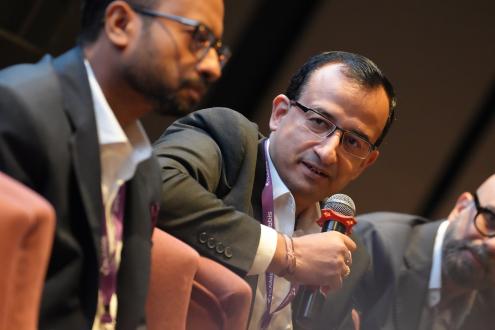
At the Hubbis India Wealth Management Forum 2026 in Mumbai, the opening panel discussion, chaired by Vaanyasri Goel, Chief Investment Strategist at PACE Family Office, asked senior industry leaders to set out their propositions without buzzwords. Munish Randev, Founder and Chief Executive Officer of Cervin Family Office, argued that trust is not a quality an adviser demonstrates through relationship sales skills. It is an outcome of how the firm is built, what it is permitted to earn, and how its own revenue aligns to the key requirements of unconflicted and unbiased Advise.
Key Takeaways
Trust Is Structural, Not Personal: A firm earning revenue only from advisory fees has no alternative route to profit, and the absence of a fallback changes behaviour more reliably than intention does.
Engagement Starts in the Mid Teens: Cervin brings next-generation family members into quarterly meetings from around fifteen and hosts them in the office for few days each year.
Each Generation Is a Separate Relationship: Randev meets generations separately, because a younger family member will say things across the table that they will not say in front of a parent.
Next Generation Is Not a Single Category: Some inheritors are strongly risk oriented and others strongly preservation oriented, and the approach has to differ accordingly. No cookie-cutter here as well
The Family Office Needs Its Own Succession Plan: Families invest heavily in business succession and family constitutions while giving far less thought to the family office itself.
A Single Family Office at a Lower Cost
Asked to describe the firm’s proposition in a sentence or two, Randev was direct about the model and its deliberate limits.
“We are basically your single family office, but at a much lower cost, and an ensured long term continuity plan” he said. Four of the firm’s five founding team members come from hardcore investment management backgrounds, and the mandate covers the full life cycle of a family office, from blueprinting and structuring through governance, investment management and risk management.
He added a benefit that families with in-house arrangements will recognise. “It is almost like your single family office, but at much lower cost, and with no worries about your Chief Investment Officer leaving.”
Cervin works only as an adviser, with no internal products and no commission-based revenue. It’s senior team that has worked together for twelve years, worked purely as a multi-family office Advisor without any other business, Randev described it as boutique by design rather than by stage of growth. “We are boutique in nature. We will remain boutique in nature even as we scale towards larger Assets under advisement”
He offered a note of caution about the category, observing that the multi-family office label is now widely used and often misused while relatively few firms hold to a purely advisory version of it. When Goel referred to the firm having advised over 65 family offices, Randev corrected the figure to 125.
Trust as an Outcome of Structure
Between twenty and twenty-five of Cervin’s most recent clients arrived having already been through the wealth cycle, at the point where the next generation was taking over. With no separate sales team, those client approaches came through LinkedIn and referrals.
“We don’t do cold calling, because you can’t sell trust across the table,” Randev said. “I can’t tell somebody, please trust me, and they will listen. Trust has to be structured in your company itself. “Yes, People often make a mistake of trusting a large brandname without realizing that their business model is not conducive to be an Advisor “
The argument he built from there was about incentives. “If you’re structured like a pure advisory firm with only revenues from advisory, there is no other plan B. And when you don’t have a plan B, you start fully concentrating on Plan A without any distractions.”
Families do not always take this at face value. “There are so many families who still ask that there must be some other way you make money!”
Cervin’s response was documentary. Launching during the pandemic, the firm asked one of the Big Four accountancy practices to draft an simple affidavit that any adviser working with a family business could sign, confirming that neither the adviser nor their directors, spouses or families had earned anything directly or indirectly, beyond the advisory fee the firm receives. Randev said the brief document was published on LinkedIn and circulated widely, and that take-up across the industry has so far been limited. “I am yet to receive a confirmation from any investor that their Advisor has signed the same” he smiled.
For Cervin it is a day one offer-to-sign that goes beyond what the regulator asks. As a registered investment adviser, the firm is audited under the Securities and Exchange Board of India IA regulations, and any revenue not backed by a client agreement is queried by its auditor, down to the refund on a cancelled air ticket.
Turning Up Before the Advice Starts
Structure gets a firm to the starting line. What follows is time. Randev described spending the first five months of a new relationship simply meeting the family and attending their functions etc. With the next generation, the commitment is annual and personal: family members between roughly sixteen and twenty spend two to three days with him each year, in Cervin’s office rather than anywhere else.
He was careful about how he characterised those sessions. “I’ll not call it education. They don’t like the word educating,” he said. “The idea is that don’t be a typical & formal mentor, but somebody they can look up to, to ask any questions about their career and goals.”
Asked what firms have built specifically for the children of existing clients, he began by rejecting the premise that the next generation is a single audience. “You may get a next gen which is very risk oriented, and you may get a next gen which is absolutely preservation oriented.”
Engagement begins at fifteen to seventeen, with attendance at one quarterly meeting. The whole balance sheet is not put in front of them, and he was candid that the experience is often unremarkable for a teenager. “They may find it very boring initially, frankly, and many do.”
This is precisely why he meets generations separately. Speaking to each alone produces the honesty a joint meeting suppresses, including the admission that a young family member is in the room at a parent’s insistence rather than out of interest. “They tell you on your face.”
The starting material is deliberately unglamorous. “Whenever a next gen comes in, the first thing I give that next gen is a book on macroeconomics,” he said. “You don’t have to learn equity trading, debt trading and all. You have to understand how economies & markets work.”
He also flagged a gap across the market. Families devote real attention to business succession and family constitutions, while the question of who succeeds within the family office receives comparatively little. He noted that 55 per cent of Cervin’s assets under advice are already led by women, and framed the more important question as whether the next generation is involved at all.
Not a Distributor
Closing the session, Goel asked each panellist what the next generation most often gets wrong about them. Randev returned to the distinction he had been drawing throughout.
“What they get wrong with us usually is by putting us and the wealth distributors and private bankers in the same category,” he said. “It’s only that you have to explain how hugely different we are.”
“The 3 word in our Logo clearly signify what we believe in; We have deep EXPERTISE in the family office investing space, that has been honed over decades of EXPERIENCE, and all is delivered on a platform of absolute INREGRITY without which both Expertise and Experience have no value to clients.” he shared.
For a firm built around removing the ambiguity from that question, the irony is not lost. The work of separating advice from distribution is largely invisible to a client until someone takes the time to explain it and the clients are open to listen and understand it.