
September 01, 2026
2 min read

Add topic to email alerts
Receive an email when new articles are posted on
Please provide your email address to receive an email when new articles are posted on .
“
data-action=”subscribe”>
Subscribe
We were unable to process your request. Please try again later. If you continue to have this issue please contact customerservice@slackinc.com.
Back to Healio
Key takeaways:Four percent of a cohort of patients with rheumatic and autoimmune conditions were reported to have opioid use disorder.Fewer than 15% of patients with opioid use disorder received treatment for that disorder.
Although opioid use disorder is “relatively common” in rheumatology settings, fewer than 15% of patients with this disorder and rheumatic disease receive medications to treat it, according to data published in Arthritis Care & Research.
“Patients with rheumatic conditions are prescribed opioids at higher rates than the general population, but we know very little about opioid use disorder in this group,” Jacob S. Riegler, MD, MBA, MSBE, a rheumatology fellow in the section of clinical sciences and the division of rheumatology, inflammation and immunity at Brigham and Women’s Hospital, told Healio. “Opioid use disorder is a pathologic pattern of use that raises the risk for overdose and death. Although medications for opioid use disorder lower mortality, no previous study had examined if patients with rheumatic diseases are receiving them.”
To examine opioid use disorder and treatment uptake, as well as assess any “potentially addressable gap in care,” Riegler and colleagues analyzed data from 37,282 patients with osteoarthritis, rheumatoid arthritis, systemic lupus erythematosus or spondyloarthritis with one or more diagnostic codes for opioid dependence or abuse. Data were sourced from the NIH All of Us Research Program.
Demographic information underwent analysis, as did psychiatric disorders, prescription medications including opioids, corticosteroids and disease-modifying antirheumatic drugs, comorbidities and acute care use for those with opioid use disorder and those without. Medications for opioid use disorder were defined as prescriptions for methadone, buprenorphine or naltrexone following the first diagnostic code for opioid use disorder.
According to the researchers, 1,502 patients, or 4% of the cohort, demonstrated opioid use disorder.
“Those patients had more psychiatric comorbidities, higher acute care use, higher mortality, more glucocorticoid use and less disease-modifying antirheumatic drug use,” Riegler said. “They were also more likely to have received prior prescription opioids — 75.7% vs. 45.8% — and corticosteroids, but less likely to have used biologic, targeted synthetic, or conventional DMARDs.”
Further results showed that 14.5% of patients with rheumatic diseases and opioid use disorder received medications to treat the opioid disorder, compared to estimates of 25% among the general population, according to Riegler..
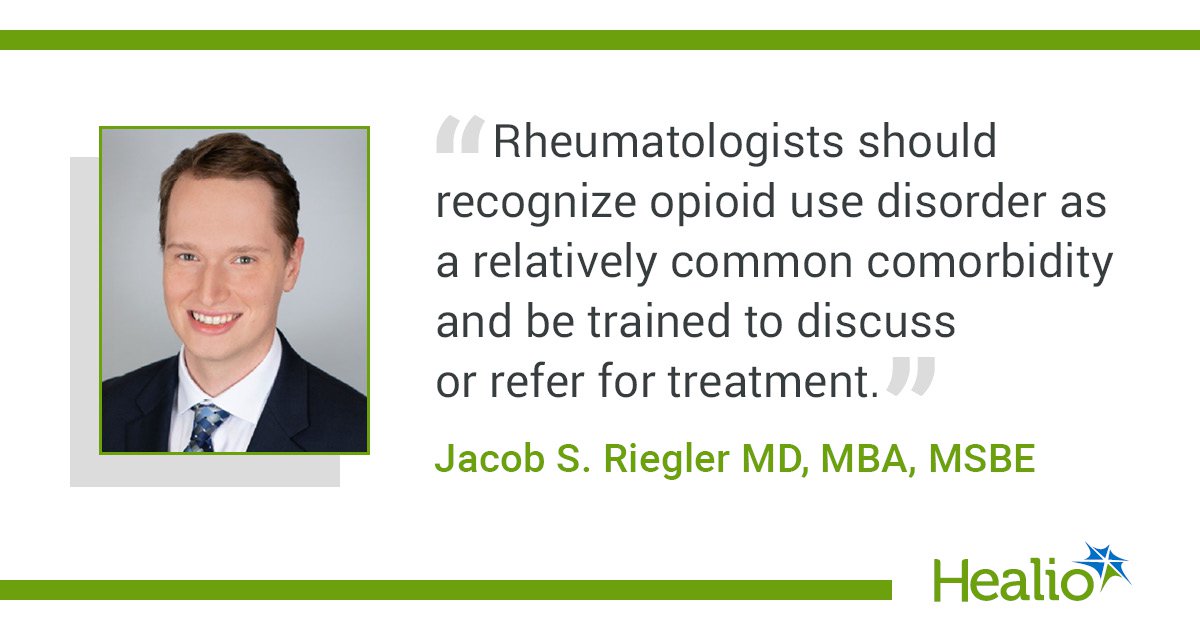
“Rheumatologists should recognize opioid use disorder as a relatively common comorbidity and be trained to discuss or refer for treatment, since starting treatment early is an important step in reducing opioid use disorder-related mortality,” he said.
For more information:
Jacob S. Riegler MD, MBA, MSBE, can be reached at Jriegler@bwh.harvard.edu.
Published by:

Ask a clinical question and tap into Healio AI’s knowledge base.
PubMed, enrolling/recruiting trials, guidelines
Clinical Guidance, Healio CME, FDA news
Healio’s exclusive daily news coverage of clinical data
Learn more
Add topic to email alerts
Receive an email when new articles are posted on
Please provide your email address to receive an email when new articles are posted on .
“
data-action=”subscribe”>
Subscribe
We were unable to process your request. Please try again later. If you continue to have this issue please contact customerservice@slackinc.com.
Back to Healio