
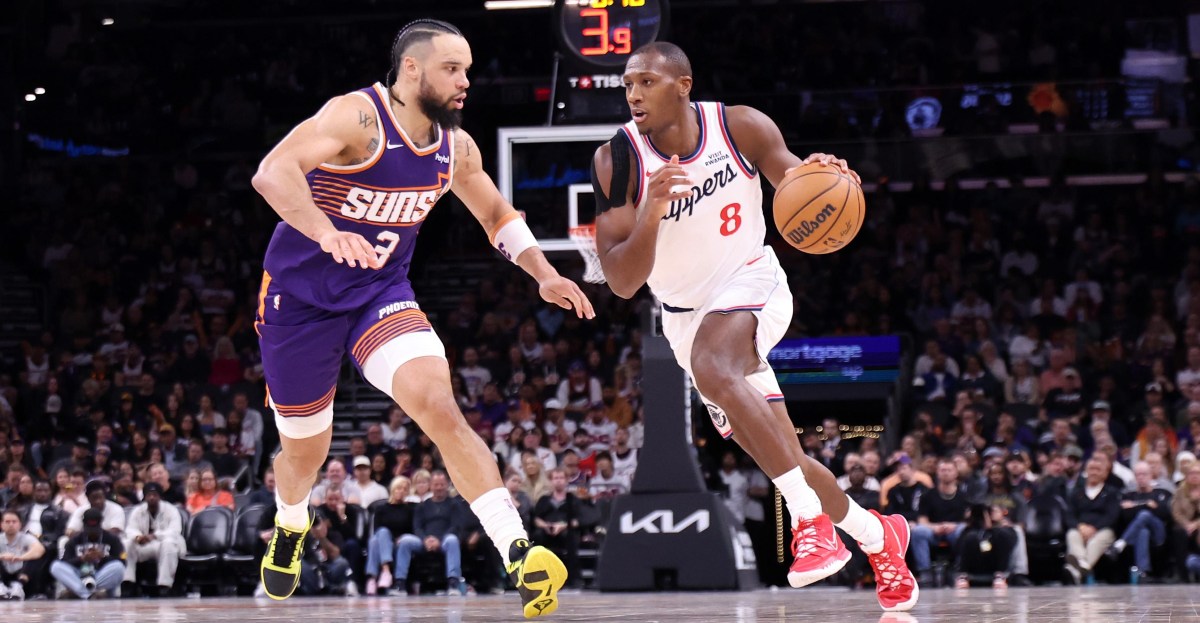
With the Phoenix Suns’ first preseason game a little more than a month away, there hasn’t been much to talk about when it comes to the team lately. And that’s a good thing.
I’m a fan of no drama. I’d much rather operate silently in the background than constantly find myself at the forefront of the conversation. If you gave me the choice between being a ninja, a knight, or a pirate, I’m choosing ninja every time. They’re quiet. They get the job done. They don’t seek fanfare, and half the time you don’t even know they’re there. The Suns have operated more like pirates in the recent past. Loud moves. Swashbuckling around. Stumbling through the season. That’s not the way to be.
There is plenty of drama happening around the NBA, though, and much of it is coming at the expense of the Los Angeles Clippers, who have been penalized for salary cap circumvention. They’ve lost five first-round picks beginning in 2029, which is crippling for any franchise.
And as a Phoenix Suns fan, you can’t help but ask one simple question: Which situation would you rather be in, the Suns or the Clippers? To me, the answer is easy. I’d much rather be in the situation where the organization has a top-20 player, an established culture, draft assets even if they don’t fully control all of them, and plenty of young, exciting talent waiting in the wings
But Sam Quinn of CBS Sports sees it differently.
Some people are contrary simply for the sake of being contrary, and I think this is a horrible take. Saying the Suns are asset-poor in any real capacity feels like being contrarian for the sake of it.
The reason the Clippers are in a far worse position than Phoenix is that they are severely limited in their ability to build. Draft picks provide two different avenues for roster construction. The first is obvious. You use them after a bad season, add young talent, and hope your developmental program can turn those players into meaningful contributors. That’s what the Clippers are hoping for after trading Ivica Zubac to the Indiana Pacers and acquiring the fifth overall pick in last year’s draft. Keaton Wagler represents someone they hope can develop into a star. The problem is that it becomes much harder to build around that kind of player without future draft assets.
That leads to the second function of draft picks. They can be used in trades to add more talent and fortify the roster. We know that all too well in Phoenix, as the Suns gave up numerous picks in deals for Kevin Durant and Bradley Beal. The Clippers no longer have that flexibility because they don’t own first-round picks from 2029 through 2033. Meanwhile, the Suns, even if they don’t fully control all of their own picks in upcoming years, still possess first-round picks. They still have assets that can be included in trades, even if many of them are heavily swapped. There is a massive difference between having compromised draft capital and having none at all.
The Suns also have tradable assets. If they ever decided to move off Devin Booker, they would get a haul in return. Who on the Clippers is going to bring back that kind of value? Darius Garland? Don’t get me wrong, I wouldn’t be opposed to the Suns trading for him, but nobody is giving up four first-round picks for Garland. Booker could absolutely command that kind of return on the open market.
Jalen Green, Dillon Brooks, Miles Bridges? All of those players could most likely bring back some combination of draft compensation or quality players in return. How much do you think the Clippers are getting for Brook Lopez or Derrick Jones Jr.?
The Clippers are trying to build around a young core, but the Suns have one too. The difference is that Phoenix has given itself multiple ways to continue building around that youth, while the Clippers have far fewer options because of the draft capital they no longer possess.
Then there’s the free agency component. You can make the argument that Los Angeles, by itself, is always going to attract talent. I’m not going to argue with you there. There are business opportunities and ventures outside of basketball that make the city appealing, although that kind of arrangement is what got the Clippers in trouble to begin with.
Culturally, though, I think Phoenix is in a far better place. This is an organization that, despite never winning a championship, has an owner who is engaged, inspired, and willing to do what it takes to win while operating within the rules. The Suns have the fifth-best winning percentage in NBA history. The Clippers? They’ve been a black hole since moving from Buffalo to San Diego and then from San Diego to Los Angeles. They’ve never reached the Finals and have historically been one of the league’s punching bags. They have the 28th winning percentage all-time. In short? The Los Angeles Clippers are the Arizona Cardinals of the NBA. So yeah, I think the advantage goes to Phoenix.
It’s silly that I’m even sitting here defending why the Suns are in a better situation than the Clippers. It feels like a ridiculous exercise. But if that’s what Sam Quinn of CBS Sports believes, then feel free to believe it. To me, it puts his take into one of two categories. Either he wrote it to generate clicks, in which case, congratulations, it worked. Or he genuinely believes it. And if he genuinely believes the Clippers are in a better position than the Suns, then I honestly don’t trust his perception of basketball.
Maybe the Suns aren’t sitting on a treasure chest of assets. Nobody is arguing that. But there’s a massive difference between having limitations and having your future confiscated. Phoenix has Booker, tradable contracts, young talent, first-round picks, and an organizational culture that finally appears stable. The Clippers have fewer avenues available to fix whatever comes next. So call me biased. Call me a Suns homer. That’s fine. But if I’m choosing which ship I want to be on moving forward, I’m taking the one that still has a rudder.