
For some Pembina Valley residents, looking through a telescope for the first time can be an experience that sparks a lifelong interest in astronomy.
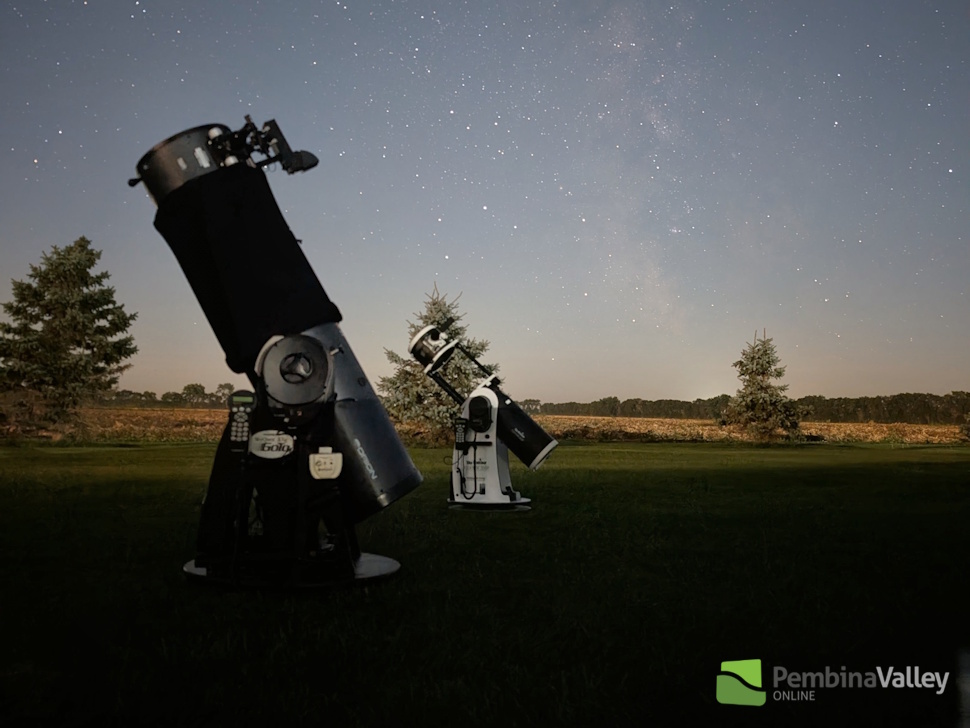
Kenton Dyck, who started and runs the Pembina Valley Astro Club, was in Reinland on Wednesday night with two telescopes, giving residents a chance to explore the night sky.
The club uses two Dobsonian telescopes, including a 12-inch model and an eight-inch model.
Both are go-to telescopes, meaning motors and sensors help track the objects selected by the operator.
Dyck said the equipment makes it easier to introduce people to astronomy during community events.
“Every time we have an event like this, the vast majority of people in this area haven’t had the chance to look through a telescope before,” Dyck said.
He remembers the first time he saw Jupiter and Saturn through a telescope, describing it as a moment when he let out an audible gasp.
“And I hear that reaction like later on when Saturn comes up, you’ll get to hang out here and you will get to hear people have that same reaction,” he said.
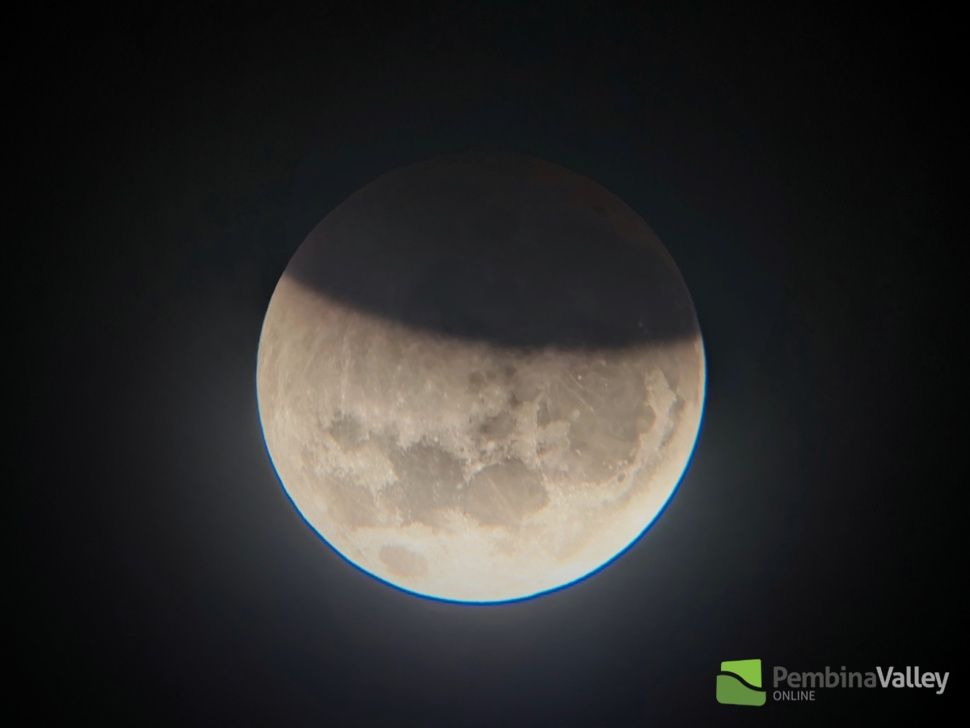 Photo of the moon. Submitted by Kenton Dyck.
Dyck said those first views can become the starting point for a new interest.
“Now I get to be a part of that for a lot of other people,” he said. “And it’s really cool to do that because that’s often the hook for people to get if you see something cool and impactful, something gripping that kind of hooks you and now we have a hopefully a new passion for life.”
The smaller telescope is also more accessible for children and wheelchair users, which Dyck said is an important part of the club’s outreach work.
The telescopes can be moved into position and directed toward selected objects with the push of a button.
A closer look at space
When asked about his favourite star, Dyck chose a particular class of objects instead: pulsars.
Pulsars are neutron stars, which are the dense cores left behind after some stars explode as supernovas.
Dyck said pulsars are several times the mass of the sun compressed into an object about 25 kilometres across.
He compared the process to a figure skater pulling in her arms. As the star shrinks, its rotation speeds up.
Dyck said the fastest pulsars recorded have surfaces travelling at about 25 per cent of the speed of light.
He also recommended The Expanse as one of the more realistic science-fiction productions when it comes to space travel.
Dyck said the series considers the effects of acceleration, inertia and the physical impact of sustained high gravity on the human body.
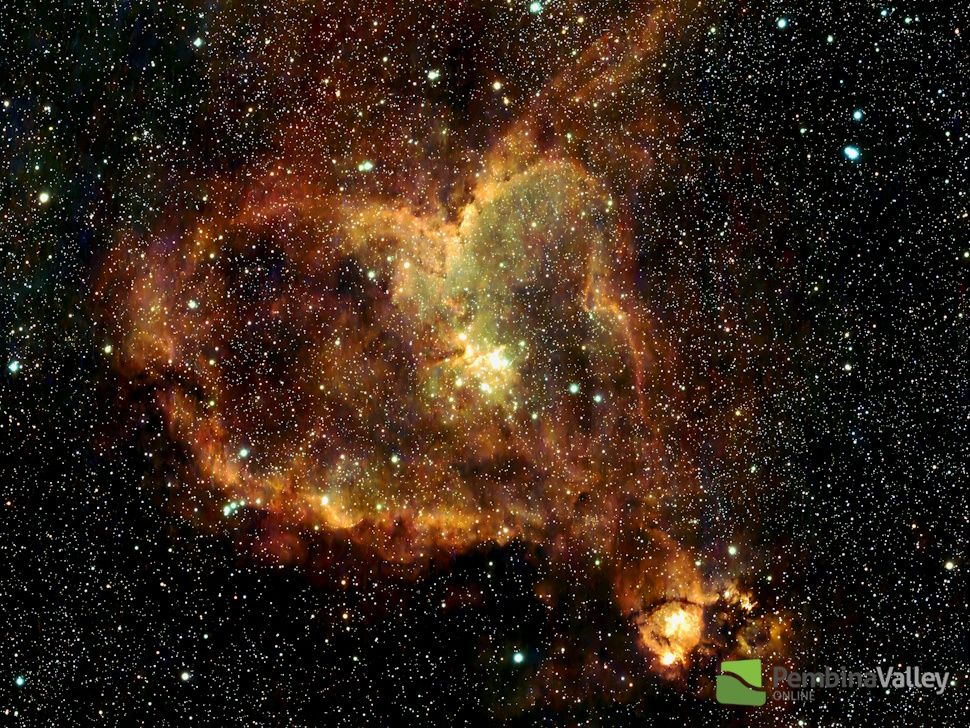 The Heart Nebula (IC 1805) is a vast cloud of glowing hydrogen gas about 7,500 light-years away in the constellation Cassiopeia. Its distinctive heart shape is illuminated by young, hot stars forming deep within the nebula. Submitted by Kenton Dyck.
Upcoming Astro Club events
The Pembina Valley Astro Club has several upcoming events planned in the region.
Dyck said the club will be at the Carman ball diamonds on Sept. 8.
The club will also be at the Dead Horse Cider Apple Jam on Sept. 12, setting up telescopes later in the evening.
Another event is planned for Miami on Sept. 15 at Alexander Ridge Park.
Dyck said the Miami location offers an especially good view because of its position outside town.
“If there is an event that you want to come to and the weather is clear, those two locations are really good,” he said.
For more information about upcoming events, residents can follow the Pembina Valley Astro Club’s facebook page.