
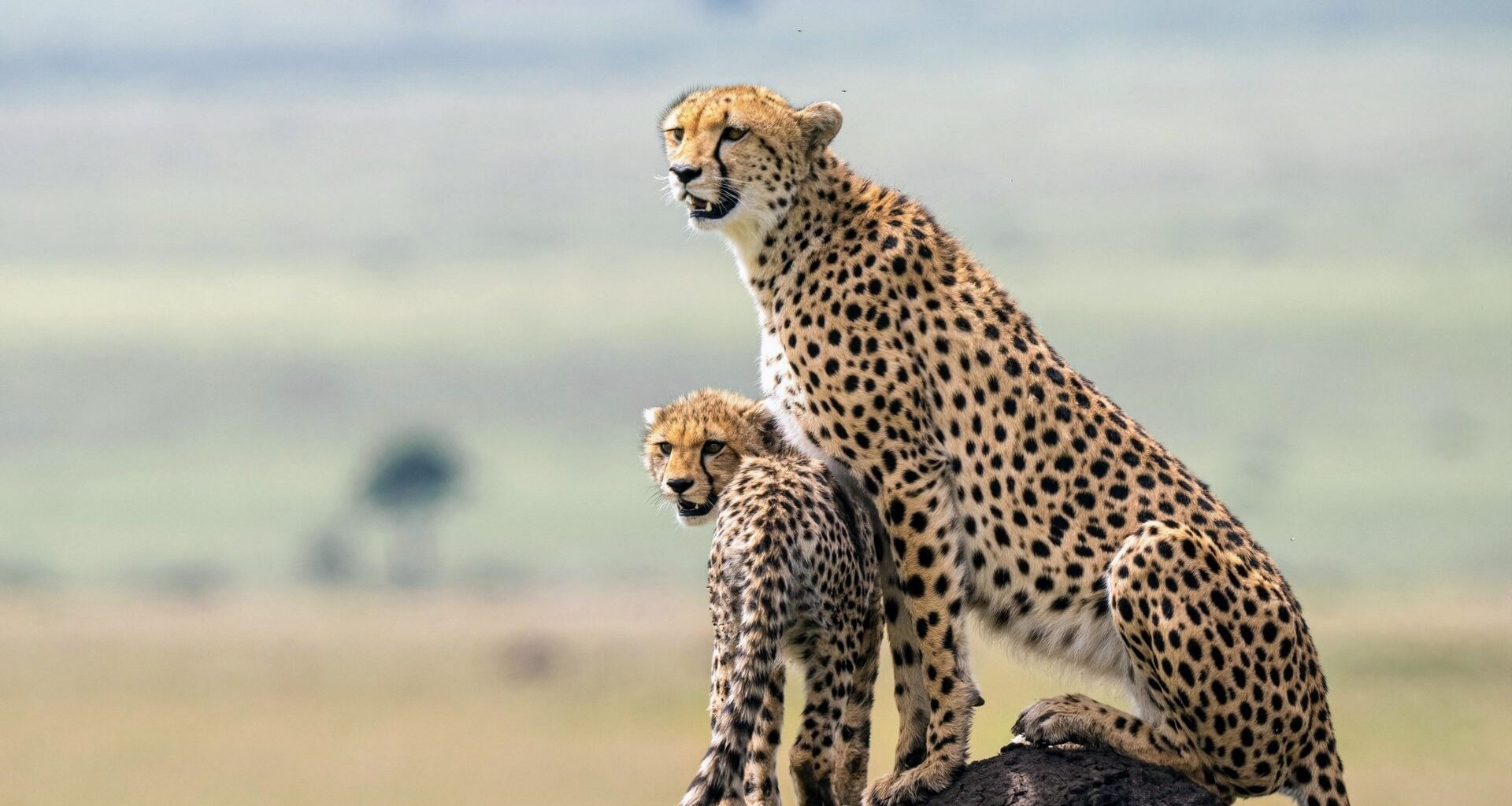
Ancient DNA reveals that the American cheetah was actually closer to pumas, ranged into Arctic Yukon, and may have regularly eaten fish.
For a long time, the extinct animal known as the American cheetah seemed to have a simple story. It had long legs and a light body, much like a modern cheetah.
Because of this, researchers often thought it was a fast-running hunter. They believed it played a similar role in ancient North America.
Fossils do not always tell the full story of an animal. Ancient DNA and chemical clues from the bones now show that Miracinonyx trumani was not a true cheetah.
They also show that it could live in different environments and eat different kinds of food.
This matters because it helps us better understand animals from the past. It also shows that an animal’s appearance does not always tell us how it lived.
America’s cheetah was no cheetah
The cheetah comparison made sense at first because Miracinonyx had a body built for movement across open landscapes.
Yet earlier DNA from mitochondria, small structures inside cells that carry their own DNA, had already suggested that the cat might be closer to pumas.
The new work went further by examining DNA from the cell nucleus, which contains much more genetic information.
The team produced high-quality ancient genomes from a fossil in Natural Trap Cave, Wyoming, and another from Bluefish Caves in Yukon.
The genetic family tree placed Miracinonyx beside the modern puma, Puma concolor, rather than the African cheetah. The Miracinonyx and puma lineages separated around 2.6 million years ago.
Its cheetah-like body evolved on its own. This is called convergent evolution, which happens when unrelated animals develop similar features under similar environmental pressures.
Home range was bigger than expected
Three fossils from Yukon had once been identified as puma-like cats, partly because they were found far north of the accepted Miracinonyx range.
DNA showed that all three were actually Miracinonyx trumani.
The Yukon fossils date to roughly 31,000 to 34,000 years ago.
Their identification pushes the known range of the species more than 20 degrees of latitude farther north, from what is now Florida all the way into Arctic Yukon.
That means this animal lived in very different worlds.
Arctic life changed behavior
Some populations occupied temperate grasslands, while others survived in Arctic steppe-tundra with different prey, colder conditions, and major seasonal changes in daylight.
Molly Cassatt-Johnstone, a Ph.D. candidate at the University of California, Santa Cruz, led the work.
“These cats were remarkably flexible, much like pumas are across their range today. We found loss-of-function mutations in certain genes that regulate circadian rhythms, suggesting they may have adapted to the extreme light cycles of summers and winters in northern latitudes,” Molly Cassatt-Johnstone said.
Yukon cats ate different food
The biggest surprise came from clues inside the fossil bones. These clues can help researchers understand what an animal ate.
The Yukon cats had much higher nitrogen levels than other land animals living in the same area.
The fossils also showed very similar results, even though they came from places nearly 250 miles (400 kilometers) apart and were more than 2,000 years apart in age.
The pattern did not match what researchers would expect from animals eating only land-based prey. So the team looked more closely at parts of the proteins preserved in the bones.
The results suggest that the Yukon cats ate food from higher up the food chain, likely including fish. The Wyoming cats had a different pattern that matched predators mainly eating plant-eating animals on land.
Fish helped northern cats survive
The chemical pattern in Yukon points toward food coming from an aquatic food web, with fish providing the most likely explanation. The fossil evidence does not show exactly how the cats obtained that food.
They may have scavenged dead fish, fed around seasonal spawning areas, or caught fish in shallow water. The chemistry supports regular use of aquatic resources, but it cannot prove one particular hunting behavior.
Professor Matthew Wooller works in the College of Fisheries and Ocean Sciences at the University of Alaska Fairbanks (UAF).
“This species of carnivore has this massive range, all the way from the Arctic to the Lower 48,” Matthew Wooller said.
“They’re demonstrating uber-specialization at two ends of their range, while also feeding on two completely different food sources.”
This difference helps explain why the old image of one specialized “American cheetah” is too narrow. The same species appears to have used very different feeding strategies depending on where it lived.
Genes offer clues
The ancient DNA also gave researchers clues about how these cats may have adjusted to daily light changes. Some genes linked to body clocks did not seem to work normally.
These genes help the body respond to light and keep daily rhythms. That could have been useful in the far north, where summer and winter daylight can be very different.
But the DNA cannot show exactly how the cats slept or behaved.
The team also looked for other genetic changes that may have helped the species over time. They found 23 possible genes worth studying further.
However, those results were not strong enough after stricter testing. So these genes are only possible clues, not proven adaptations.
The population declined over a long time
The DNA suggests that Miracinonyx had low genetic diversity for a long time. The Wyoming cat had slightly less genetic variation than the Yukon cat.
However, neither animal showed signs of severe recent inbreeding.
The researchers also used the DNA to estimate how the population changed over time. Their results suggest the breeding population fell from nearly 100,000 to fewer than 10,000 by about 70,000 years ago.
Extinction cause remains unclear
Professor Beth Shapiro, a senior author at the University of California, Santa Cruz, emphasized that low diversity alone does not show why the species disappeared.
“Miracinonyx persisted for a very long time without the signs of inbreeding we’d expect before a collapse,” Beth Shapiro said.
“The decline was slow, not sudden, and that may be what left it unable to adapt when the climate shifted.”
These population numbers are only estimates, not exact counts. They depend on assumptions about how quickly DNA changes and how long a generation lasted.
The DNA also cannot tell researchers exactly why Miracinonyx became extinct.
Why this cat still matters
The bigger lesson is about how people reconstruct the past.
A familiar body shape can suggest one story, while DNA and chemistry reveal something much more complicated.
Miracinonyx looked like a cheetah but was closely related to pumas. It ranged from temperate regions to Arctic Yukon, and populations in different places appear to have relied on very different foods.
Its story shows how DNA and chemical clues preserved in bones can overturn assumptions based on appearance alone.
The study is published in the journal Current Biology.
—–
Like what you read? Subscribe to our newsletter for engaging articles, exclusive content, and the latest updates.
Check us out on EarthSnap, a free app brought to you by Eric Ralls and Earth.com.
—–