
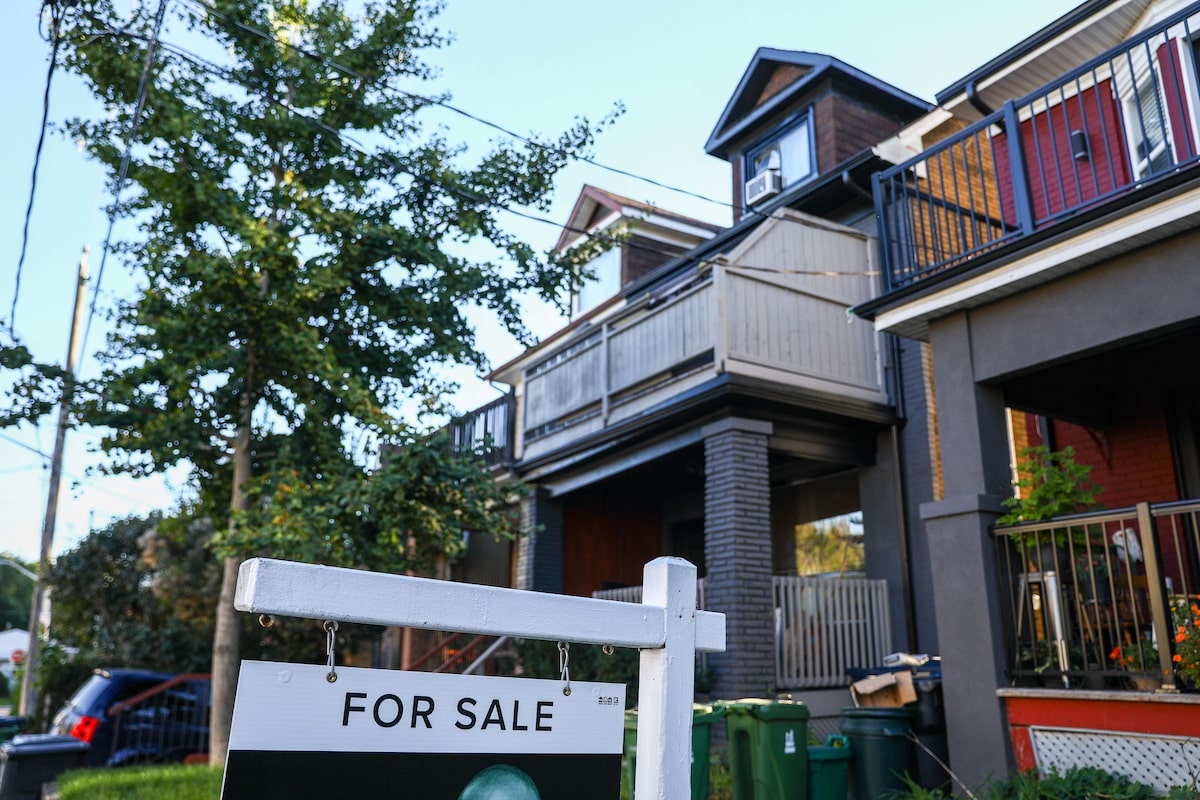
Sales in the GTA dipped 1.3 per cent in August from July on a seasonally adjusted basis, according to the Toronto Regional Real Estate Board.Evan Buhler/The Canadian Press
A lethargic August in the Toronto-area real estate market has some potential sellers wondering whether to push ahead with plans to list their property in the fall while others have already spiked their listings.
Havoc created by the trade war between the United States and Canada only adds to the uncertainty as participants prepare for a fall market that typically kicks off soon after Labour Day.
Nutan Brown, real estate agent with Royal LePage Terrequity Realty, often waits until the second or third week of September so she can gauge the pace of sales.
This year, she is being especially attentive to the mood of buyers in the early going.
“I like to monitor from the sidelines,” Ms. Brown says. “I can tell my clients, ‘here’s the activity level.’”
Business was slow last month in the west end of Toronto, where she does much of her business in areas such as Bloor West Village, Baby Point and Old Mill.
The same trend was apparent throughout the Greater Toronto Area, with a few exceptional sales in desirable pockets.
Sales in the GTA dipped 1.3 per cent in August from July on a seasonally adjusted basis, according to the Toronto Regional Real Estate Board. That result halted a run of improving sales for five months in a row.
New listings surged 5.2 per cent in August from July, notes Daren King, senior economist with National Bank of Canada, who figures some sellers were prompted to list when they saw renewed momentum in the previous months.
Overall, active listings gave buyers lots of choice by historical standards, Mr. King says.
Toronto-area home buyers adjust to the new normal
Sales dropped 2.1 per cent compared with August of last year, while new listings fell 14.1 per cent in the same period.
The average price decreased 2.7 per cent in August compared with August, 2025, to $993,410. That marks the second time this year that the average price in the GTA has come in below $1-million.
Ms. Brown worked with one set of buyers who were keen on a house with an asking price in the $1.6-million range.
That price placed it almost out of reach for the buyers, says Ms. Brown, who decided against submitting an offer.
“We didn’t want to be bold enough to put in a really lowball offer,” she says. “It can annoy the seller and backfire on you.”
Ms. Brown continued to monitor the property for a few weeks until the sellers dropped the asking price by $100,000.
“We went in as quickly as we could,” says Ms. Brown, which gave the homeowners little time to drum up another bid.
The buyers offered about 95 per cent of the new asking price, she says, and the sellers accepted.
“If the right house comes, they’re ready to act, but they can be selective,” she says of many house hunters.
After 399 days on the market, price cuts help find a buyer for lakefront condo in Toronto
In another instance, Ms. Brown worked with one client searching for a two-bedroom waterfront condo in the Humber Bay Shores area.
The downsizing client looked at several units but got cold feet and decided to sell her existing property first.
Ms. Brown says that strategy is wise in an uneven market when homeowners are unsure of how much their house will fetch.
“Sometimes you’ll be pleasantly surprised – sometimes you’d better be careful.”
Some sellers of larger condo units around the Humber Bay area are also putting their listings on hold, says Luke Dalinda, real estate agent with Royal LePage Real Estate Services.
“There is a significant demand for larger suites from empty nesters, except the owners of those suites seem to be waiting out the trade uncertainty,” says Mr. Dalinda.
In an area with many recently built condo towers, Mr. Dalinda notes there were 239 active listings heading into the Labour Day long weekend compared with inventory around 197 in the spring.
Fifty units traded hands in August, he says, and 40 of those sold for less than $800,000. The larger suites often sell for upwards of $1-million.
Mr. Dalinda was optimistic Canada and the United States would have a positive outcome to negotiations for a bilateral trade deal. Instead, talks broke down in late August.
“I was telling clients it would be rocket fuel for the market, and all of a sudden it just went boom,” he says. “It creates a black cloud.”
Mr. Dalinda says the owners of suites with 2,000 square feet of living space or more have seen prices come down over the past few years and they are taking a wait-and-see approach. Some plan to hold off selling for two or three years.
Many of the investors who bought micro “shoebox” condo units can’t afford to wait for a rebound, he says, and they are force to list. He is also seeing a rise in the number of “power of sale” listings as lenders take over.
Mr. Dalinda recently listed an investment property in High Park with three renovated units in a converted red brick house.
The triplex at 137 High Park Ave., with an asking price of $3.98-million, might appeal to an investor or a buyer who wants to live in one unit and rent out the others, says Mr. Dalinda.
This triplex at 137 High Park Ave. in Toronto has an asking price of $3.98-million.Royal LePage Real Estate Services Ltd.
Just before the long weekend, Mr. Dalinda listed a detached house at 87 Riverview Gardens in the Old Mill neighbourhood with an asking price of $1.799-million.
The house with original wood trim and panelled doors likely needs a renovation, he says, but several potential buyers had booked showings in the first two days.
Mr. Dalinda listed in the opening days of September because he believes there is a window of opportunity before consumers feel the impact of countertariffs on U.S. imports.
“October is traditionally a scary time,” he points out, with that month’s reputation for negative surprises that rattle financial markets.
Meanwhile, the “elbows up” rallying cry has galvanized many Canadians.
“People haven’t been affected economically,” he says. “There’s a lot of belief and support and good will.”