
Gazing toward the heavens, our eyes are drawn to mesmerizing galaxies and stars. We wonder where humans fit in the universe. Peering into the endless cosmos, modern telescopes are advanced beyond the imaginations of astronomers from the early 1900s.
Before eastern Ontario’s brilliant astrophotographer Terence Dickinson (1943-2023) was recognized for sharing his amazing starlight images, an earlier local stargazer envisioned the mysteries of deep space. In 1922, mathematician and astronomer Dr. Harold Kingston was instrumental in establishing London, Ontario’s chapter of the Royal Astronomical Society of Canada (RASC).
Harold Reynolds Kingston was born on June 28, 1886 at Picton, Ontario, about 80 kilometres west of Kingston. According to Family Search records, his parents, Joseph J. Kingston (1851-1916) and Annie Elizabeth Reynolds (1858-1943), resided at Hallowell Township with at least three sons. After high school graduation, Harold Kingston was a schoolteacher for several years, then enrolled at Queen’s University in Kingston. Earning a master’s degree in mathematics in 1908, Kingston was hired to teach at a high school in Indianapolis.
Working toward a doctorate degree, Kingston attended University of Chicago, completing his PhD in 1914, “one year after accepting a position in the Department of Mathematics, University of Manitoba,” said RASC’s Encyclopedia Uranica. He was employed as assistant professor and lecturer from 1913 to 1921 at his alma mater. Kingston then moved to London and the University of Western Ontario, where he “had a distinguished career as head of mathematics department.”
A passionate amateur astronomer, Kingston applied his mathematic skills to astronomical observations. He was well-positioned when the math department re-adjusted to the department of mathematics and astronomy. New courses were added in the early 1920s, such as “Descriptive Astronomy and Mathematical Astronomy, as well as a graduate course in Celestial Mechanics,” noted University of Western Ontario. (UWO)
Dr. Kingston’s own career star was shining — he was appointed dean of arts and science and made principal of University College. The educator also received honorary degrees from Queen’s University and UWO in 1953.
Immersed in astronomy, Kingston rose through Winnipeg’s RASC chapter’s volunteer ranks to secretary-treasurer then to president of the organization in 1920. His penchant for stars and planets continued in Ontario, where Kingston “gave some popular lectures in astronomy, which aroused great interest and enthusiasm,” said RASC London Centre. A groundswell of interest led to the founding of London’s RASC centre in February 1922, with Harold Kingston named the first president. He held the position until 1930. Kingston was also elected the society’s national president from 1930-1931 and was honorary president for many years.
Along with lecturing twice in the initial year, Kingston also took time to prepare lists of books at the university library for members, encouraging them to delve into celestial mysteries. Delighting his audience, Kingston’s lectures included “moving pictures” of an eclipse in 1924, and he devised word jumbles of astronomical names to solve.
Kingston “hosted many council meetings at his home,” said RASC London, gave talks on radio, “and prepared a booklet of star maps.” The scientist spoke at events in Toronto and afar. Following Kingston’s lead, members of the London group also organized meetings with “songs, games, contests and debates.” At the close of meetings, members set up telescopes to raptly gaze at the night skies.
Although RASC London membership numbers ranged between 30 to 50 people, astronomy activity enchanted locals. Exceptionally popular for decades, a club viewing night in 1939 “attracted 3,000 people who came to view Mars, Jupiter and the Moon through members’ telescopes,” RASC London reported. Not only was Dr. Kingston adept at attracting crowds, he also had a flair for fundraising for a new telescope at Western’s campus.
Dr. Kingston spoke with Frances Amelia Labatt Cronyn (1868-1941), the widow of politician and lawyer Hume Blake Cronyn, suggesting funding toward an observatory in her husband’s memory. Hume Cronyn (1868-1933) was a Unionist Member of Parliament from 1917-1921 with an interest in science. He had encouraged the federal government to establish what later transformed into the National Research Council. Mrs. Cronyn agreed, gifting the generous amount of $40,000 to establish the Hume Cronyn Memorial Observatory.
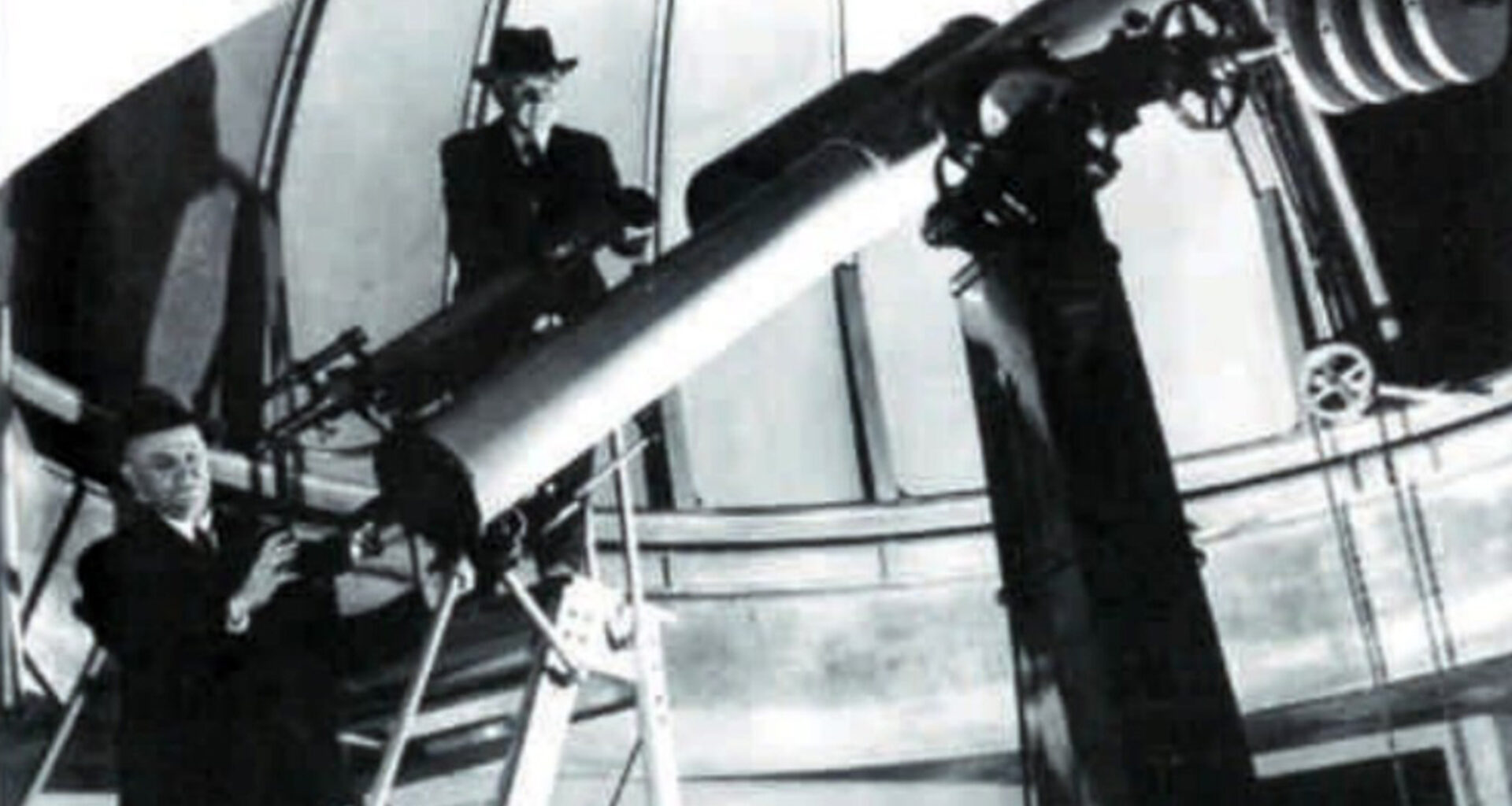
Welcoming students and the public, UWO’s observatory was designed by architect Oliver Roy Moore. The limestone and sandstone observatory’s dome was produced “by Perkin-Elmer Corporation in New York, shipped in pieces and assembled on site,” stated “Cronyn Observatory Highlights,” University of Western Ontario. The building housed a 254 mm brass refractor telescope with “finders, German equatorial mount, and pier” purchased “from Perkin-Elmer of New York for the sum of $7,500 Cdn.”
“The telescope tube is brass, having a focal length of 4386mm, which yields a speed of f/17.2,” described UWO. “The telescope is fitted with 25mm and 90mm finders.” Perhaps related to wartime adjustments — but to the benefit of the astronomy program—the American firm included a 203 mm Schmidt camera at no cost, featuring “a 300 mm diameter spherical mirror (an 8”/12” design).” The Hume Cronyn Memorial Observatory opened on October 25, 1940. Dr. Kingston settled into an office on the observatory’s main floor, with his own 75 mm brass reflecting telescope.
On February 10, 1963, Dr. Harold Kingston died at London. His wife of 48 years was Ethel Maude Holt, born at Hallowell Township in 1884; she died in July 1956. The boy from Picton grew up to teach the beauty of math and then shared the universe through the lens of a grand observatory telescope.
Susanna McLeod is a writer living in Kingston, Ontario.