

Listen to this article
Estimated 3 minutes
The audio version of this article is generated by AI-based technology. Mispronunciations can occur. We are working with our partners to continually review and improve the results.
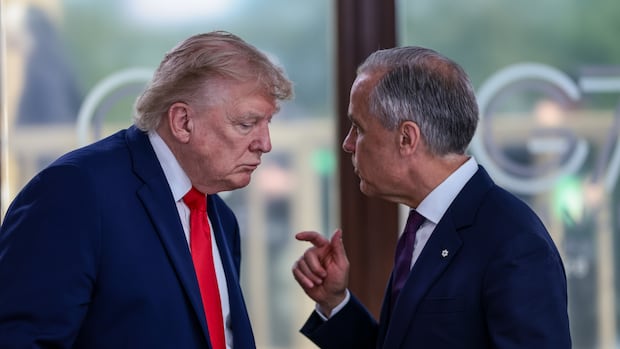
Prime Minister Mark Carney says he’s still in regular contact with U.S. President Donald Trump despite the ongoing trade rift and some unsavoury remarks from administration officials.
The prime minister suggested that his recent conversations with Trump have been focused on global events, including how the wars in Ukraine and Iran are impacting international energy and grain markets.
“In terms of playing that [international] role, we continue to work with the United States. We can compartmentalize,” he said during a news conference alongside Ukrainian President Volodymyr Zelenskyy in Calgary on Thursday.
“I spoke to [Trump] recently in the last few days, a couple of times, related to issues [in Ukraine], related to issues in Iran, other global developments. Because that’s part of our responsibility.”
WATCH | Carney gives examples of topics of discussion with Trump: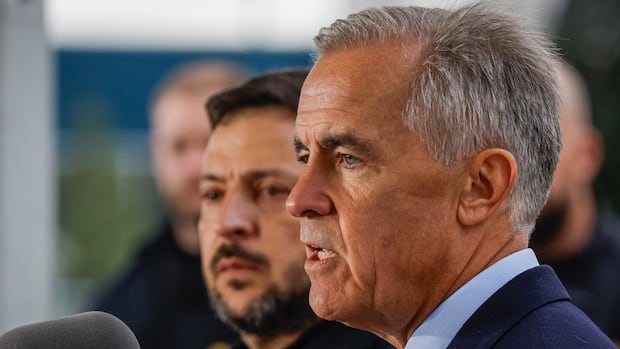
Canada ready to support Russia-Ukraine ceasefire where U.S. can play ‘decisive role’: Carney
Speaking alongside Ukrainian President Volodymyr Zelenskyy on Thursday, Prime Minister Mark Carney said a cessation of hostilities between Russia and Ukraine offers a possible ‘shorter-term solution’ to global issues around access to energy and agricultural goods.
Tariff negotiations between Canada and the U.S. fell apart last month, with both sides hurling blame at the other.
The U.S. immediately slapped 50 per cent levies on hundreds of Canadian goods, and Canada countered with new tariffs on roughly an equivalent value of U.S. imports on Monday. The Trump administration responded on Wednesday by announcing it would place further tariffs on some Canadian imports and outright ban others later this month.
Carney didn’t say whether his government would respond with more counter-tariffs on U.S. goods.
“We’re looking closely at the measures the Americans just recently announced,” he told reporters later on Thursday.
Carney said that even though talks have stalled, he believes there’s still a deal to be had with the U.S.
“Canada’s always ready to strike a fair deal. We believe there’s still a mutually beneficial deal for Canada and the United States,” he said at the news conference with Zelenskyy.
WATCH | Carney says government is reviewing Trump’s latest trade actions: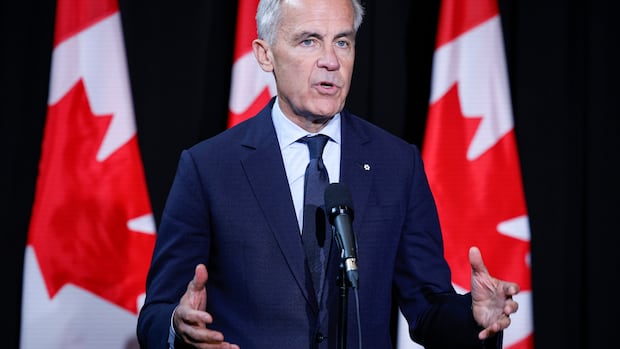
‘We’re looking closely’ at Trump’s import bans and tariffs, Carney says
Prime Minister Mark Carney said on Thursday that the government is looking at U.S. President Donald Trump’s recent measures which include bans on Canadian imports including most alcohol products and new 50 per cent tariffs on a series of other products. ‘We fully recognize that for individual companies and in individual sectors these are significant, and there’s a response there,’ Carney said.
Trump and some of his key cabinet members have disparaged Canada in the media and online in recent weeks.
The president notably decided his government would refer to Lake Ontario as “Lake America.”
U.S. Secretary of War Pete Hegseth and Treasury Secretary Scott Bessent have both derided the Canadian Armed Forces. U.S. Trade Representative Jamieson Greer told the Financial Times that it’s “unhinged” for Canadian leaders to characterize the administration’s tariffs as a trade war.
Carney has pushed back when asked about some of the Trump administration’s more unsavoury remarks, saying they’re “beneath their office.”
WATCH | More about the trade war: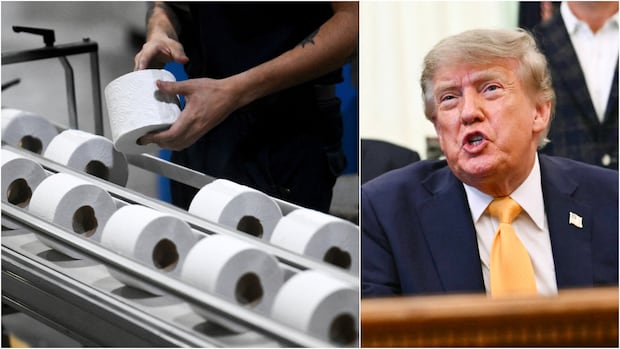
Is toilet paper an unlikely pressure point in the Canada–U.S. trade war?
U.S. President Donald Trump dropped tariffs on certain Canadian products, including toilet paper, cement and salt. In 2024, Canada exported approximately $328 million worth of the product, making it the largest international provider of toilet paper to the U.S.
When asked about why he thinks Trump has continued to disparage Canada since talks fell apart, Carney wouldn’t speculate.
“I can’t look deeply into the souls of other people and see their emotions. This isn’t a question of emotion, it’s a question of sovereignty for Canada,” he said.