
Like U.S. president George W. Bush, Brampton firefighter Neil Kennedy was in a classroom on Sept. 11, 2001, when he learned that a plane had hit the World Trade Center North Tower.
Former president Bush was listening to children read out loud. Kennedy was teaching CPR and first aid to a class of high school students.
Nine hours later, Kennedy and three fellow Brampton firefighters were on their way to New York City, travelling 140 km/h on an empty highway in a Toyota Corolla stuffed with fire helmets, boots, coats and the little bit of luggage they could squeeze in around it.
“Man, we were stuffed, jammed,” said Kennedy, now a retired fire captain living in Victoria. “I mean, you couldn’t see out the window.”
The danger was greater than they knew. Thousands of men and women have since died of complications arising from their work at the site, which was rendered toxic by the fire and collapse of the buildings. The dust in the air contained asbestos, pesticides, plastics and unburned or partially burned jet fuel.
Despite that risk, despite U.S. President Donald Trump and his tariffs and talk about the 51st state, and his renaming Lake Ontario to Lake America, Kennedy says he would do it again in a heartbeat.
“I’d do it today, I’d do it tomorrow.”
Without hesitation, they drove towards a disaster that was still unfolding: 19 hijackers, four planes, nearly 3,000 dead. The World Trade Center towers in New York had been reduced to rubble, a section of the Pentagon was in flames. There was a feeling that anything could happen next.

Retired firefighter Scott Walker is pictured at his home in Cambridge, Ont., on Thursday. Walker was one of four Brampton firefighters who piled into a Toyota Corolla on 9/11 to drive to New York to help look for survivors among the debris that was once the World Trade Center towers.
Laura Proctor for the Toronto Star
Why four Canadian firefighters drove south on 9/11
Kennedy and his colleagues Scott Walker and Rob Morrison said they volunteered because they wanted to help their firefighter brethren, because they had family living in the U.S., or because they had travelled in the States and had always been met with kindness.
“There was none of this animosity that sort of exists right now,” said Morrison, who was 25 the day they drove to New York, and is now three years from retirement.
“All I knew, especially as a young guy, was that these are our neighbours. I’d been there many times, never New York City, but to the U.S., many times. Everybody’s always been awesome, you know?”
On Sept. 11, 2001, the firefighters arrived at the border to find armed guards instead of the generally friendly, lemme-check-your-licence customs officials. Once the border guards learned who they were and where they were headed, they waved them through, telling them to speed up if they needed to.
“There’s not a cop from here to New York City that will pull you over,” the guards told them.
“I said thanks for the tip,” said Kennedy. “So we went about 140.”
Just before entering New York City in the early morning of Sept. 12, they pulled over at a rest stop for a couple of hours of sleep. Two men slept in the front seats of the Corolla. Two slept on picnic tables under the stars.
They woke up and drove towards the black smoke in the sky.
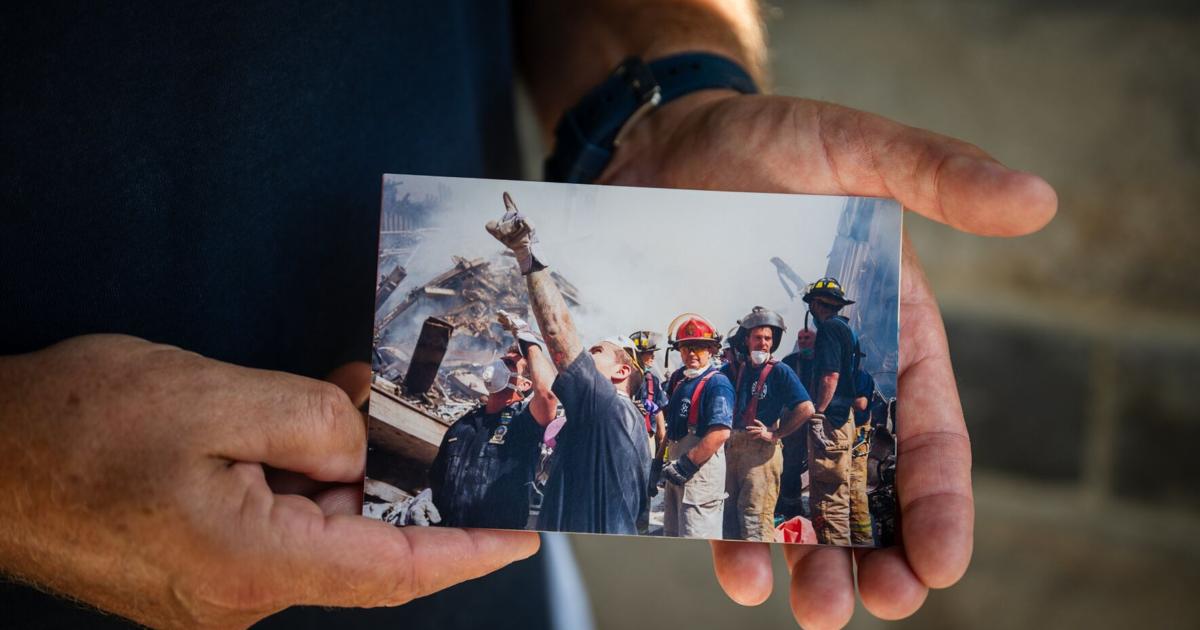
Scott Walker holds a photo he took with then-president George W. Bush at Ground Zero in Manhattan, on Sept. 14, 2001.
Laura Proctor for the Toronto Star
What awaited in New York City
In New York, they somehow ended up with an FBI escort to the Tribeca fire station in Manhattan, less than a mile north of the site.
“We didn’t know if we’d be just staying there cooking for them and helping out there, or if we’d be handing out orange juice 30 blocks from the rubble,” said Walker, who is now retired.
The firefighters there were rough, in mourning. Their lieutenant, Vincent G. Halloran, 43, had been killed leading evacuation efforts in the North Tower the day before.
Their captain told the Brampton firefighters to jump in the back of a pickup truck. They were on their way to the site by 8 a.m. on Sept. 12.
“It was 10 acres of total devastation,” said Kennedy. “The first thing we see is a fire pumper truck upside down, cut in half. There were mountains of debris — metal, concrete, dust, papers. There was a kind of white haze, smoke, that would come and go. There were fires burning way deep underground.”
The Brampton firefighters are pictured upon their return from New York City. From left, Neil Kennedy, Rob Morrison, Brian Gorman and Scott Walker.
Ken Faught/Toronto Star file photo
Kennedy and his colleagues were part of a bucket brigade, moving debris in search of survivors.
“I estimated there were about 2,000 of us in there like little ants among this huge, 10-acre debris field doing that same thing,” said Kennedy.
They wore masks to protect against the smoke.
They worked with firefighters from around the U.S. who had also driven to New York to help — all flights had been grounded. Kennedy, who spent some time living in the U.S. as a child, remembers working with a team from Indiana.
The men remember people waiting outside the roadblocks to the site, carrying pictures of their loved ones, asking firefighters for help.
“Have you seen my son? Look for my brother, look for my wife,” they said.
The men worked among cadaver dogs, whose feet were being cut by the debris. The dogs had to be fitted with booties to keep working.
Walker was part of a team that searched the subway system for a rumoured train full of people, which turned out to be just that, a rumour.
“I will say I have never seen rats that big.”
All three men remember the kindnesses extended by strangers during their time there — the reporter who loaned them a cellphone when theirs wasn’t working; the FBI agents who got them to the firehouse; the Marriott hotel that put them up for free. Their brothers at the station.
None of them have suffered health effects as a result of working on the site. Brian Gorman, the fourth firefighter in the car that night, could not be reached by the Star.
Twenty-five years later, Walker points out how often Canadians routinely pitch in to help Americans. Canadian linesmen travelled south to help restore power after hurricanes and ice storms. Hundreds of firefighters travelled to California in 2020 to help put out wildfires. The residents of Gander opened their homes to more than 6,500 stranded airline passengers whose flights had been diverted to their small Newfoundland town.
“I just kind of wish that they would respect Canada a little bit more,” said Walker. “We’re like a brother and sister.
“Or appreciate that we are here, we’re all human, and Canadians will do it anyway. They’ll still help out because that’s the way Canadians are.”
Kennedy operates on a value system unconnected to what politicians say and what politicians do. To him, there’s them and us: the people at the top, making decisions, and the people at the bottom, who live with the consequences.
He will always act out of the humanity he feels for all the people like him, who live with the consequences, and that will never change, not even in retirement among the palm trees of the B.C. capital.
“Tomorrow, if someone said: ‘We need help in Washington, we got spare bunker gear,’ I wouldn’t hesitate,” said Kennedy.
“I’d be over there in two hours.”
Morrison would do it again, too, despite the political noise.
“I wouldn’t even hesitate. My view on this is your politics is your politics, that has nothing to do with the human aspect of things,” Morrison said.
“I do this because I like to help people. They’re just normal people, just like me. They have kids in university, just like me. They have a wife at home who’s going to be worried about them, just like me. Everybody’s got bills to pay.
“We’re all trying to just get by.”