
A few weeks ago, I came across a Day Runner I carried 25 years ago, and on its cover was the worn and faded decal with the words “Let’s Roll”.
Those were the final words spoken by Todd Beamer to an air phone supervisor before passengers on United Airlines Flight 93 fought hijackers in an effort to regain control of the plane. They decided to fight after learning of the attacks on the Word Trade Center and the Pentagon.
Those brave passengers were killed when their plane crashed in a field near Shanksville, Pennsylvania. They never knew they saved either the US Capitol or the White House.
All commercial and private aircraft were immediately grounded. Only military aircraft was allowed to fly. The rest of the time there was an eerie silence as everyone tried to comprehend what had occurred. The nation was in shock, and for the first time I understood the emotions my parents experienced when they learned Pearl Harbor had been attacked on December 7, 1941.
NASCAR was scheduled to race at New Hampshire the weekend after that deadly Tuesday, but should the event go on?
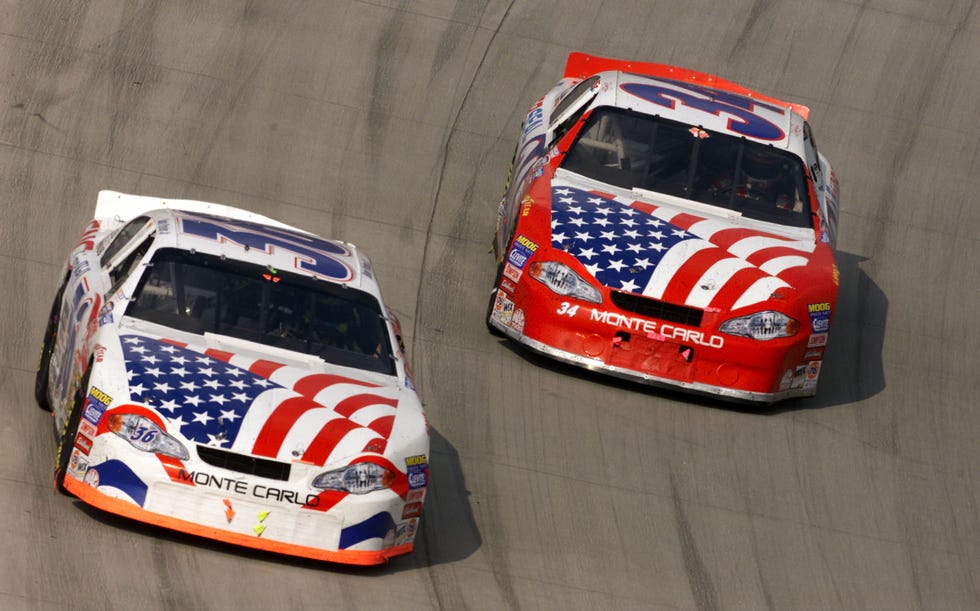 Jamie Squire//Getty Images
Patriotism on display during the Busch series MBNA 200 at Dover Downs International Speedway on September 22, 2001.
NASCAR executives talked to the NFL, the NBA, Major League Baseball, the PGA, the LPGA, the IRL, and the NHRA before making their decision. Then NASCAR Vice President of Corporate Communications Jim Hunter said then NASCAR President Mike Helton kept saying, “Guys, regardless of the economic impact, this is one of those situations where we’ve got to do what’s right. Forget money, forget logistics, everything else. Our country changed Tuesday and the decision we make has got to be the right one. And the right one is not to race this weekend.”
It was definitely the right decision as many people in the racing community were grappling with the loss of family members.
Pat Hawley, who worked in Penske Racing South’s parts department, had a sister who was missing. She worked on the 105th floor of the World Trade Center Tower that was hit by American Airlines Flight 11. Bryan Dilly, a Penske mechanic, had a cousin who was missing.
Harry McMullen, who then was Roush Racing’s general manager, had five family members who worked at the World Trade Center. Three days after the attack, four had been accounted for, but a first cousin who worked on the 102nd floor was still missing.
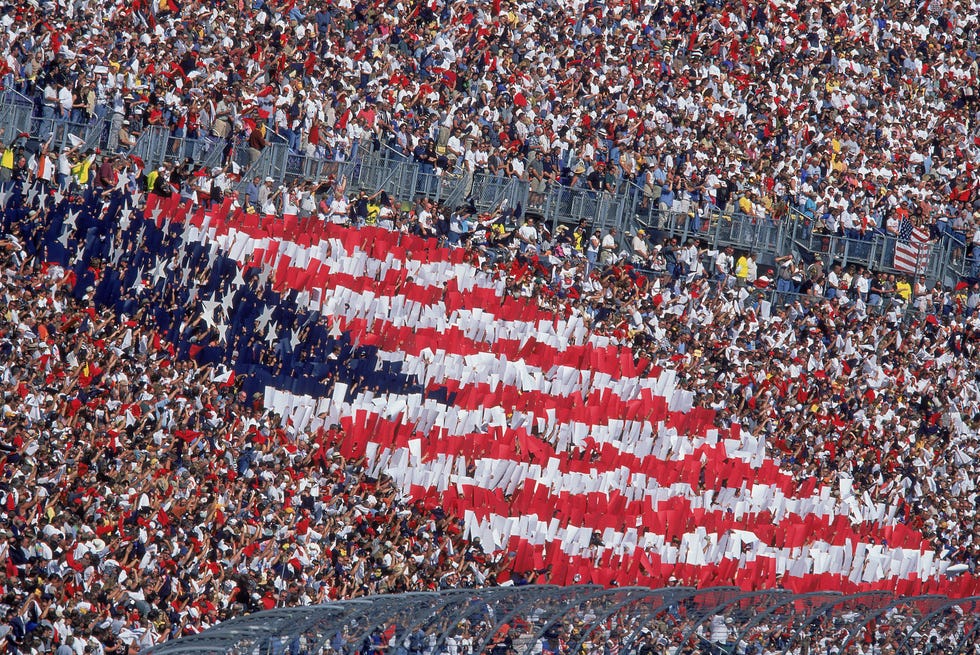 Adam Pretty//Getty Images
The crowd showing their patriotism during the Protection One 400 at the Kansas Speedway on September 30, 2001.
Michele “Shelly” Durkin, the scorer for Jeff Gordon, always stayed at the Marriott that was part of the World Trade Center when she was in New York City on business. Then a vice president in Bank of America’s electronic commerce group, three co-workers in one of the towers were still unaccounted for.
Other members of the racing community had family and friends who survived because they took a different train that morning or they were late.
Several members of the NASCAR community were stranded across the country. Rookie Jason Leffler, Bobby Labonte, Dale Earnhardt Jr., Johnny Benson, Brett Bodine, Dave Blaney, and Joe Nemechek were testing at Kansas Speedway. Those drivers and their teams drove 16 hours to get to North Carolina.
Rusty Wallace was visiting in Los Angeles and found himself stranded on the West Coast for most of the week.
Team owner Rick Hendrick was in Detroit on business. He and his pilots drove back to North Carolina.
Team owner Jack Roush was stranded in Reno, Nevada, while Matt Kenseth was in Wisconsin. Mark Martin had flown from his Daytona Beach home to Concord, North Carolina, and he eventually drove back to Daytona.
Jimmy Spencer was in Houston. He eventually drove a rental car back to North Carolina.
Bobby Hamilton was in Charlotte, North Carolina, being fitted for a seat. He drove back to his Nashville, Tennessee, home.
Mark Cronquist, who was Joe Gibbs Racings’ head engine builder, was in England. He returned to the United States on September 15.
Mourning with family members, spending time with loved ones, making trips to a blood bank, and attending prayer services were more important than building race cars for several days after 9/11. For it was a day in US history that changed all of our lives. It was my generation’s Pearl Harbor.

A North Carolina native, Deb Williams is an award-winning motorsports journalist who is in her fourth decade covering auto racing. In addition to covering the sport for United Press International, she has written motorsports articles for several newspapers, magazines and websites including espnW.com, USA Today, and The Charlotte Observer. Her awards include the American Motorsports Media Award of Excellence, two-time National Motorsports Press Association writer of the year, and two-time recipient of the Russ Catlin award. She also has won an award in the North Carolina Press Association’s sports feature category. During her career, Deb has been managing editor of GT Motorsports magazine and was with Winston Cup Scene and NASCAR Winston Cup Scene for 18 years, serving as the publication’s editor for 10 years. In 2024 she was inducted into the NMPA Hall of Fame.