

When Mark Scheifele and Connor Hellebuyck signed matching $8.5 million contract extensions in 2023, it was meant to signal a new era of Winnipeg Jets competitiveness.
Jets general manager Kevin Cheveldayoff changed the way he approached business, opening up to his star players about how and when Winnipeg could compete for the Stanley Cup — and Scheifele and Hellebuyck bought into his plans. Cheveldayoff characterized their discussions as a “heart-to-heart” conversation, in which the Jets’ front office shared more about Winnipeg’s challenges and ambitions “than we have ever done.” Winnipeg’s franchise cornerstones, satisfied by Cheveldayoff’s plans to build a winner, ended an offseason of doubt by doubling down on Winnipeg — for seven years each.
Three years later, Hellebuyck is adamant that his time in Winnipeg is over. He followed April’s criticism of the Jets’ ability to build a winner with a public trade request in August. He’s not expected to attend training camp, having gone from praising “what (Cheveldayoff) was willing to do to win” to criticizing the team’s complacency. Whatever the impact of Hellebuyck’s gold medal-winning experience with Team USA and return to Winnipeg afterward, it’s clear he doubts the Jets’ ability to win.
Shouldn’t Scheifele, who bought the same sales pitch that Hellebuyck did in 2023, have the same doubts?
“I still believe in this team,” Scheifele said at the NHL media tour in Las Vegas this week.
Then he made his pitch — the same one Josh Morrissey and Adam Lowry made this summer. Scheifele spoke to the quality of Jets teammates such as Morrissey, Kyle Connor and Gabriel Vilardi. He spoke to Winnipeg’s much-needed influx of team speed, citing Mario Ferraro and Stuart Skinner as “some really good pieces” and praised Winnipeg’s top young players, including Viggo Björck, Elias Salomonsson, and Brayden Yager. He said he hopes to help those players “learn the game” at the NHL level, then reiterated his belief in the Jets’ group.
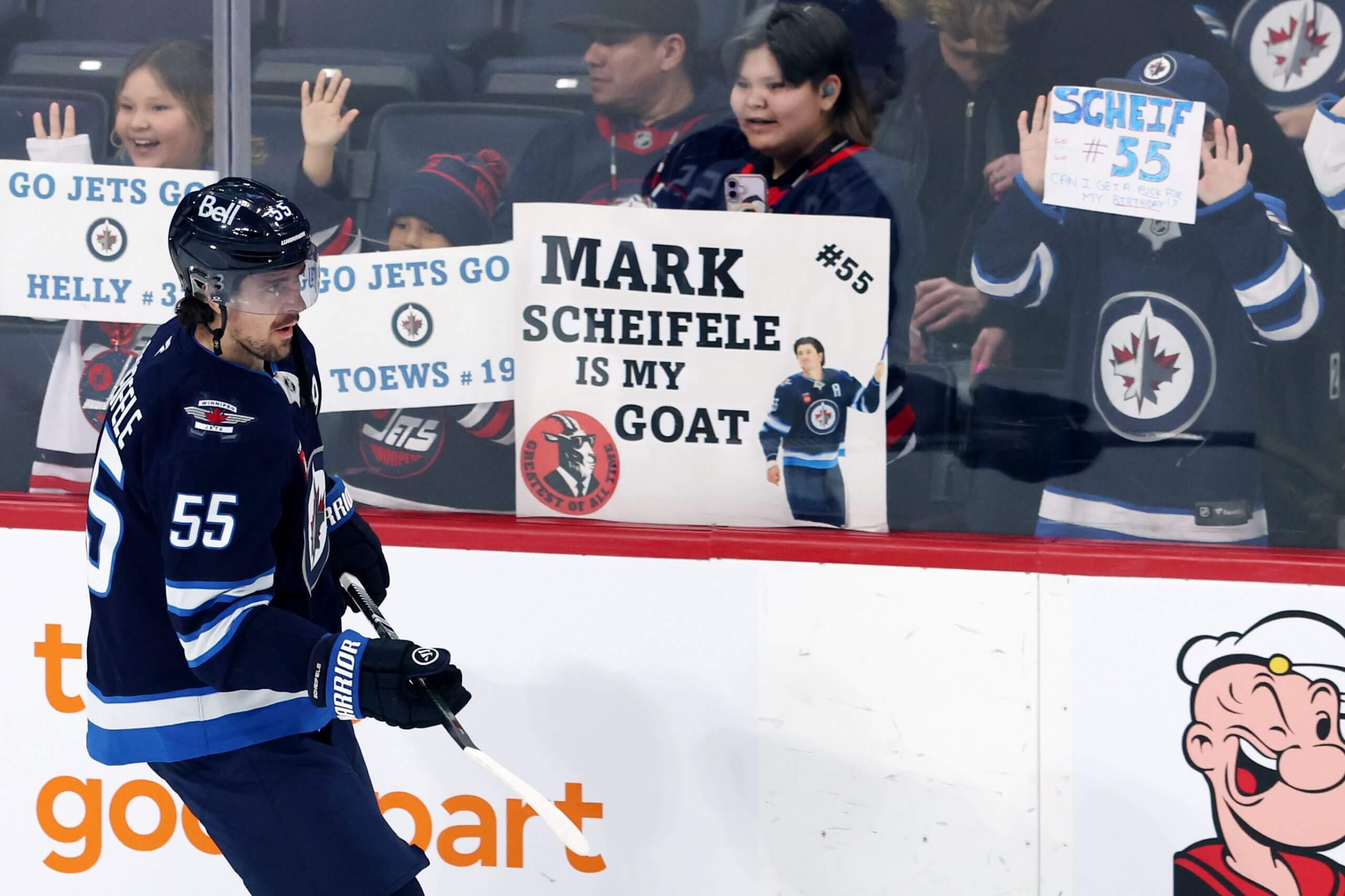
“I’m really excited to see some of the young guys come into their game,” Mark Scheifele said, “and hoping I can be a part of helping them learn the game a little bit, too.” (James Carey Lauder / Imagn Images via Reuters Connect)
It’s exactly the pitch a Jets mainstay would make. It’s the one Scheifele has to make as a leader on a team facing doubt after it missed the playoffs last season. For that reason, it’s easy to dismiss Scheifele’s words as just that: words. Then you talk to Scheifele’s teammates. If Hellebuyck is right and Winnipeg’s Cup odds are low — if what’s left for the Jets players is a fruitless battle against an inevitable rebuild — then there are lessons to be learned from what players are doing.
Before heading to Las Vegas for the media tour, Scheifele skated with current and future Jets teammates in Winnipeg. One of those players was Yager, the 21-year-old prospect centre whom Cheveldayoff cited this summer as a future second-line centre solution. Yager is not a lock for NHL stardom — he scored 30 points in 68 AHL games last season — nor is he guaranteed to make the Jets’ roster out of camp. But Scheifele dedicated time to work with Yager on his game.
Scheifele’s attention to detail struck Yager.
“When you get the chance to skate with him, it’s not just him watching you and then going home. He watches you and tries to help you with your game, which is an even better quality. As a leader, he cares about his future teammates.”
Scheifele, 33, set personal bests with 67 assists and 103 points last season. Yager describes Scheifele’s biggest strengths as his poise and hockey IQ — two seemingly ineffable qualities Yager sees in the way Scheifele protects the puck along the boards. Scheifele’s elite understanding of defensive coverage helps him stay calm with his back to the play, waiting for the right time to centre the puck between sticks and skates into the slot for scoring chances.
“If you were to watch him, you’d think he’s just doing backhand passes and turning,” Yager says. “If you ask him about it, it’s so much more detailed than what it looks like.”
The idea of Scheifele spending time teaching Yager and Winnipeg’s other young players is not new. Scheifele is fond of teaching the subtleties of body position, leverage and ways to gain time and space against defencemen. At past Jets camps, I’ve watched Scheifele and Yager work on skills as specific as how to receive a pass with the heel or toe of the stick depending on how the puck is spinning — the faster a player can kill the spin, Yager said Scheifele taught him, the faster he can make his next play. Yager has also been invited to skate and train with Scheifele in Calgary during the offseason — something he took advantage of before last season’s training camp.
To borrow a euphemism, grass tends to be greener where you water it. Scheifele may have doubts and fears about winning a Stanley Cup in Winnipeg that Hellebuyck does. Scheifele is investing his time into Winnipeg’s future without knowing what comes next. Yager could make the NHL this season. He could emerge as a second- or third-line centre someday. Björck could do the same, perhaps climbing as high as the first line. There’s no guarantee that it happens at all — or that it happens fast enough to align with Scheifele’s peak.
Scheifele is maintaining his optimism, whether or not Winnipeg’s 26th-place finish says that he “should” — and the disposition should help him whether or not that optimism proves to have had merit.
“I’m excited for the future, too,” he said. “We think we got a really good player in Viggo. And at the same time, I was in Winnipeg and skating with Brayden Yager, who looks really good. He looks like he had a great summer of training. Brad Lambert, even Danil Zhilkin, and I skated with him a couple of times in the summer. We got some young guys, Elias Salomonsson, who obviously had surgery in the offseason but showed some real promise last year. I’m really excited to see some of the young guys come into their game and hoping I can be a part of helping them learn the game a little bit, too.”
What if it doesn’t work?
This is Cheveldayoff’s territory. The GM is expected to speak at training camp next week, with Hellebuyck’s trade request — or perhaps even a Hellebuyck trade — likely to take up much of the conversation. If a trade hasn’t been completed, Hellebuyck’s absence could likely be due to a team suspension.
But Winnipeg’s predicament is bigger than the Hellebuyck trade. Its Cup-contending viability is in question — not just in the short term, with Skinner taking over from Hellebuyck, but also for as long as the Central Division remains as star-studded as it is. It was easy to imagine a path into the first round if Hellebuyck returned to his Vezina Trophy-winning form in Winnipeg. But the Colorado Avalanche, Dallas Stars, Minnesota Wild and Utah Mammoth are good reasons to be skeptical of a deep Jets run. Scheifele’s mentorship of Yager and other Jets youth is noble; it’s probably not enough to make them impact players while he’s posting 103-point seasons.
That’s why it’s so important for Cheveldayoff to return to the source of his success. If he has a plan to avoid a rebuild, Jets fans deserve to know how that plan works. Fans need to hear reasons before they can believe them — just like Scheifele and Hellebuyck did when they first signed their extensions.
If he doesn’t, then the market — Jets players included — needs a realistic plan for what appears to be a new chapter in Jets history. Hellebuyck would do well, too, to share his reasoning if his goal is to protect his legacy with the club where he won three Vezina Trophies and one Hart Trophy as league MVP.
In the meantime, there is something heartening about Scheifele’s example as a mentor to Jets youth. Whatever happens next in this difficult moment in Jets history, he’s doing the best he can to help with the skills available to him.