
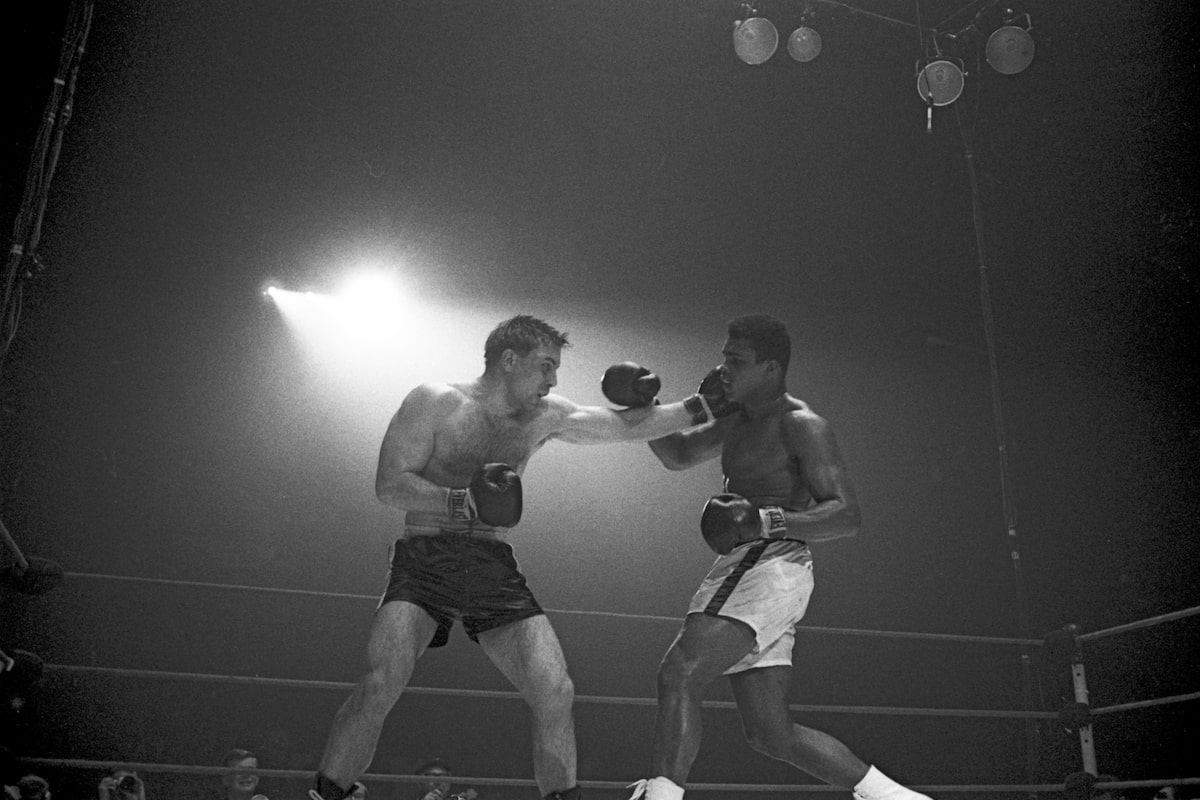
George Chuvalo, the charismatic five-time Canadian heavyweight boxing champion who went the distance with Muhammad Ali twice and who was never knocked off his feet in 93 professional fights, died on Saturday, his 89th birthday.
The beefy, iron-jawed son of Croatian immigrants is generally acknowledged as one of the toughest men to have ever entered the squared circle.
He spent his last years at the Chartwell Grenadier Retirement Residence in Toronto suffering from dementia after a career of head blows absorbed at the hands of some of the sport’s hardest punchers, among them knockout specialist George Foreman and Joe Frazier, who partly dislodged Mr. Chuvalo’s right eyeball from its socket at New York’s Madison Square Garden in 1967.
To the world, Mr. Chuvalo represented the quintessential hard-rock, indefatigable Canadian pugilist.
“You were a tough guy,” said boxing trainer and television personality Russ Anber. “You weren’t necessarily going to win, but you were going to hang in there with anybody in the world and you were going to give fans their money’s worth. George was that fighter.”
The top fights of George Chuvalo’s legendary career
The bull-necked Torontonian inflicted and endured pain inside the ring while experiencing profound tragedy outside it. Once the father of five children, he lost one son and his first wife, Lynne Chuvalo, to suicide. Two more sons died of heroin overdoses.
“It was tough watching him go through those losses,” said Charles (Spider) Jones, a broadcasting partner of Mr. Chuvalo’s and a longtime friend. “He broke down and cried many times. But he just continued on.”
Chuvalo was presented with an honourary ‘People’s Champion’ belt, in March, 2016.Chris Young/The Canadian Press
Mr. Chuvalo was a stout, lionhearted athlete with more boxing skills than his reputation as a brawler would suggest. He was also unjustly but unavoidably defined by his losses. His most memorable prize fight was a valorous 15-round defeat to Mr. Ali for the World Boxing Council’s heavyweight title in his hometown ring at Maple Leaf Gardens on March 29, 1966.
Mr. Ali was young, brash, sublimely talented and one of the planet’s most famous people. He had been scheduled to fight World Boxing Association (WBA) champion Ernie Terrell in Chicago, but after he refused to serve in the U.S. Army at a time when the country was involved in the Vietnam War – “I ain’t got no quarrel with them Vietcong,” Mr. Ali famously declared – the boxing commissions of Illinois and other states refused to sanction the bout.
The match eventually landed at Harold Ballard’s hockey arena. When Mr. Terrell pulled out 17 days before it was scheduled to take place, Mr. Chuvalo stepped in. Because of the political implications, the fight drew worldwide attention. That a white, Canadian underdog from working-class Toronto was competing for the most glorious boxing title in the world made the narrative all the more compelling.
Chuvalo and Ernie Terrell during a heavyweight fight at Maple Leaf Gardens in Toronto, on November 1, 1965.Boris Spremo/The Globe and Mail
Globe and Mail photographer Boris Spremo recalled the fight on its 50th anniversary in 2016: “The whole city was jumping up for George. It was the biggest boxing fight ever in Toronto history. Maple Leaf Gardens was almost full, 14,000 people. It was pandemonium, people yelling and screaming.”
This was a real-life Rocky match, a full decade before Sylvester Stallone’s classic boxing film was made.
“George was a no-hoper, a local hero in as a sacrifice, but he battled nobly,” said sports journalist Stephen Brunt, who wrote the 2003 National Film Board documentary The Last Round: Chuvalo vs. Ali. “Nobody in history would have defeated Muhammad Ali in 1966. I don’t think even Joe Louis would have beaten him. And George didn’t either, but he never backed up.”
The fight was lopsided. For his efforts, Mr. Chuvalo was paid $49,000 but pocketed just $12,500 after the deduction of taxes and management fees. Still, even in defeat, Mr. Chuvalo boosted a nation’s self-esteem.
“In a crazy way, that fight is what defines me for a lot of my fellow Canadians, but it took a long time before I came to appreciate how good it made them feel,” he wrote in his 2013 autobiography Chuvalo: A Fighter’s Life. “It happened almost 50 years ago, but I still hear it all the time, that it made Canadians proud.”
Chuvalo and Cassius Clay (later known as Muhammad Ali) compete in a heavyweight title match at Maple Leaf Gardens in Toronto, on March 29, 1966.Boris Spremo/The Globe and Mail
Mr. Chuvalo was 28 years old and a decade into his prize-fighting career when he fought Mr. Ali at Maple Leaf Gardens. His first professional fights were at the same venue. On April 23, 1956, the handsome 201-pound former Canadian amateur champion handily defeated four opponents to win a heavyweight tournament for novices. Boxing legend Jack Dempsey refereed the final bout.
“There were lots of sportswriters in attendance, and Dempsey said some nice things about me, how he thought I had a big punch and a lot of potential, that kind of thing,” Mr. Chuvalo recalled in his memoir. “It was all pretty exciting stuff for an 18-year-old kid, and the $500 in prize money made me feel like a millionaire.”
Three years later, also in Maple Leaf Gardens, he won the vacant Canadian heavyweight belt by knocking out James J. Parker in the first minutes of a scheduled 12-round fight.
Cassius Clay (Muhammad Ali) and Chuvalo in the title fight at Maple Leaf Gardens, in 1966.Boris Spremo/The Globe and Mail
In 1965, in advance of his important bout with former champion Floyd Patterson in New York’s boxing mecca, Madison Square Garden, Mr. Chuvalo was the subject of a Sports Illustrated cover story which depicted him as well-read fellow who “dabbles in Freud and Confucius and feels he is destined to be heavyweight champion.”
The destiny never materialized. He lost a close decision to Mr. Patterson in what was declared the fight of year by The Ring magazine. Despite the setback, the Canadian fought WBA title holder Mr. Terrell later that same year at Maple Leaf Gardens but lost a 15-round decision. In all, he fought six heavyweights who were world champions at some point in their careers. He lost to each of them, including a second (non-title) defeat to Mr. Ali in Vancouver in 1972.
The fighter’s most notable victory was a knockout of fellow contender Jerry Quarry in 1969.
In 1977, at age 39 and having not fought for more than three years, an overweight Mr. Chuvalo took on an unheralded Bob (Pretty Boy) Felstein at a suburban Toronto hockey arena. Though it was a far cry from his halcyon prime, the fight still meant something to him.
“It will be a reminder of what I did before, that I can still do it,” he told The Globe before the fight. “I’ll still be respectable.”
Chuvalo trains at Bloom’s Gym for his upcoming fight against Britain’s Joe Bygraves at the Royal Albert Hall in London, in November, 1965.Ron Case/Getty Images
He knocked out Mr. Felstein in the ninth round to win the Canadian championship for the fifth and final time. One year later, he defeated George Jerome, a logging-camp cook from Vancouver, to retain the title. It was his last fight. Mr. Chuvalo retired with a record of 73 victories, 18 defeats and two draws. Of the 73 wins, 64 came by knockout.
His pugilistic career behind him, he co-hosted, with Mr. Jones, the boxing program Famous Knockouts. Dabbling in film, he appeared in David Cronenberg’s 1986 science fiction film The Fly, in which the Jeff Goldblum-played protagonist gruesomely broke the arm of Mr. Chuvalo’s character in an arm-wrestling match. The scream from the untrained actor was entirely believable.
Like many ex-boxers, he enjoyed celebrity status, particularly in his hometown. “He liked going into a restaurant and getting a free meal,” Mr. Brunt said. “He loved being the king of Toronto.”
It wasn’t always easy being George Chuvalo. His son Jesse, addicted to heroin, committed suicide in 1985. He was 20. Another son, George Lee was found dead in a hotel room in October, 1993, with a needle stuck in his arm. He was 30. Four days later, Chuvalo’s wife, shattered with grief, took her own life. A third son, Steven, died of a heroin overdose in 1996.
“Today, I’m still damaged goods,” he wrote in his autobiography. “My remaining kids, Mitchell and Vanessa, are damaged goods. You can’t lose a mother and three brothers and not be damaged.”
Following the tragedies, Mr. Chuvalo regularly visited schools, jails and reserves across the country to warn teenagers against drugs. Typically, he collected up to $5,000 per engagement.
He struggled financially at times. At one point in the early 1990s, a credit union foreclosed on his house. Furniture was piled onto the front lawn for the neighbours to see.
Later, he did well in real estate. At one point he managed heavyweight fighter Donovan (Razor) Ruddick, but the two had parted ways by the time the Jamaican-Canadian contender hit the big time in the early 1990s. There was a short-lived nightclub – Toronto’s Caravan Club, with Rocky Marciano as a silent partner – in the late 1960s.
“There were a lot of false starts with George,” Mr. Brunt said. “He was always looking for the big score where he’d make a fortune in one big shot.”
A slugger looks for the knockout punch. In a story for Life magazine in 1971 titled “Ego,” the novelist Norman Mailer described Mr. Chuvalo and fighters like him as “men’s men” whose look and manner were warnings of their courage.
“They have a code – it is to fight until they are licked, and if they have to take a punch for every punch they give, well, they figure they can win,” Mr. Mailer wrote. “They have more guts.”
Chuvalo in Toronto, in December, 1976.James Lewcun/The Globe and Mail
George Louis Chuvalo was born in St. Joseph’s Hospital in Toronto on Sept. 12, 1937. His parents, Stipan (Steve) Chuvalo and Kata Chuvalo (née Kordic), married in Bosnia-Herzegovina in 1926. The father left for Canada months later, but did not send for his wife until 1936.
They raised a family in Toronto’s hard-scrabble Junction neighbourhood. He was a cattle skinner at a Canada Packers slaughterhouse. She was a chicken plucker, earning half a cent per bird at the poultry plant owned by the father of Mr. Chuvalo’s future manager, Irving Ungerman.
As a child, Mr. Chuvalo wandered into Morgan’s Cigar Store for candy but found a copy of The Ring on the magazine rack – “just about eye level for a little guy.” The pictures of muscular men hitting each other convinced him of his future.
His first boxing lessons were learned from cards included in boxes of cereal. A snapshot, taken when he was nine, showed him in trunks, boxing gloves and with a protruding gut. “I used to stick my belly out all the time,” he told Sports Illustrated. “I thought it made me look big.”
By age 15, he was a muscular 198 pounds. He played football and ran track at St. Michael’s College high school, but his passion was punching. On May 7, 1955, he knocked out Peter Piper in Regina to win the Canadian amateur heavyweight championship. By 1956, he was a professional.
He began dating Lynne Sheppard in 1958, when she was 14 years old. Their favourite song was Could This Be Magic, by the Dubs. The song’s question was answered when they married at city hall on March 31, 1959. Four months later, the couple’s first child, Mitchell, was born.
Chuvalo spends Thanksgiving dinner with his wife Lynne and children, in October, 1965.Boris Spremo/The Globe and Mail
The 1965 Sports Illustrated feature presented the husband and wife – “doll,” he called her – as a cheerful pair who engaged in Scrabble and playful banter. The following lighthearted exchange was presented:
“We’ve never had a vacation together,” Ms. Chuvalo said. “The first thing we’ll do when you’re champion, George, is we’ll travel.”
“I’ll take you to Buffalo …,” Mr. Chuvalo quipped.”
“Thanks, George,” his wife interrupted, sarcastically.
“… if you’re a nice girl,” the boxer continued. “The first thing I’ll do when I’m champion is I’ll have a big smile on my face.”
Mr. Chuvalo did take his family to Buffalo, according to his son. “He introduced us to Black American soul food, and the only place you could get it near Toronto was Buffalo,” said Mitchell Chuvalo. “We used to go to a restaurant called Mandy’s and we were treated like royalty when we walked in there.”
Mr. Chuvalo married his second wife, Joanne O’Hara, in 1994. The relationship devolved as the ex-fighter’s cognitive skills declined in the late 2010s. Mr. Chuvalo’s two surviving adult children submitted a divorce application on behalf of their father under power of attorney.
The George Chuvalo Neighbourhood Centre, a facility devoted to community use in Toronto’s west end, opened in 2019. Mr. Chuvalo is a Member of the Order of Canada and an inductee into Canada’s Sports Hall of Fame and Canada’s Walk of Fame.
A sociable public figure, Mr. Chuvalo freely spoke to people on the street or at events such as an 80th-birthday party thrown for him at Toronto’s Cadillac Lounge in 2017. In attendance were fellow national icons Don Cherry, Gordon Lightfoot and Donovan Bailey, along with Marvin (the Weasel) Elkind, known as a chauffeur to mobsters and an enthusiastic police informant.
When anyone ever asked Mr. Chuvalo if he had indeed gone 15 rounds with Muhammad Ali, the tough-as-nails fighter had a stock reply: “No, he went 15 rounds with me.”
You can find more obituaries from The Globe and Mail here.
To submit a memory about someone we have recently profiled on the Obituaries page, e-mail us at obit@globeandmail.com.