

Listen to this article
Estimated 4 minutes
The audio version of this article is generated by AI-based technology. Mispronunciations can occur. We are working with our partners to continually review and improve the results.
An Islander is warning others to be on guard after repeated close encounters with coyotes around her home and dogs.
Sarah Barron, who lives on a farm in New Glasgow and has two dogs, said two coyotes regularly come onto her property.
What troubles her most, she said, is how reluctant the animals seem to be to leave, even when she shouts and makes noise.
She pointed to a recent incident near her barn involving her Jack Russell terrier, Isla.
“I saw her coming towards me with a coyote about… maybe three feet behind her,” Barron told Island Morning host Wayne Thibodeau.
“I ran up to the fence and I was, like, banging on the metal gate, making a huge noise, screaming and yelling.”
Those kinds of close calls are becoming more likely this time of year, wildlife ecologist Maureen Murray said.
Murray said coyotes give birth to pups over the summer and as summer turns to fall, young coyotes begin leaving their parents and looking for territory of their own.
“Some coyotes might not know how to act around people, so you might see coyotes that are coming closer to people than you might expect,” she said.
Barron said the coyote initially moved into the next field after she started making noise, but it did not stay away.
When Barron tried to pick up Isla, the coyote started to come back, and the small dog ran toward it again.
Barron charged at the animal a second time, grabbed Isla and her collie, and put them behind a fenced dog yard at the front of the house.
Even then, the coyote remained nearby.
“That’s what really bothered me: is that you know, I’m screaming, the dogs are barking. It was time for them to kind of say goodbye, and he really wasn’t,” she said.
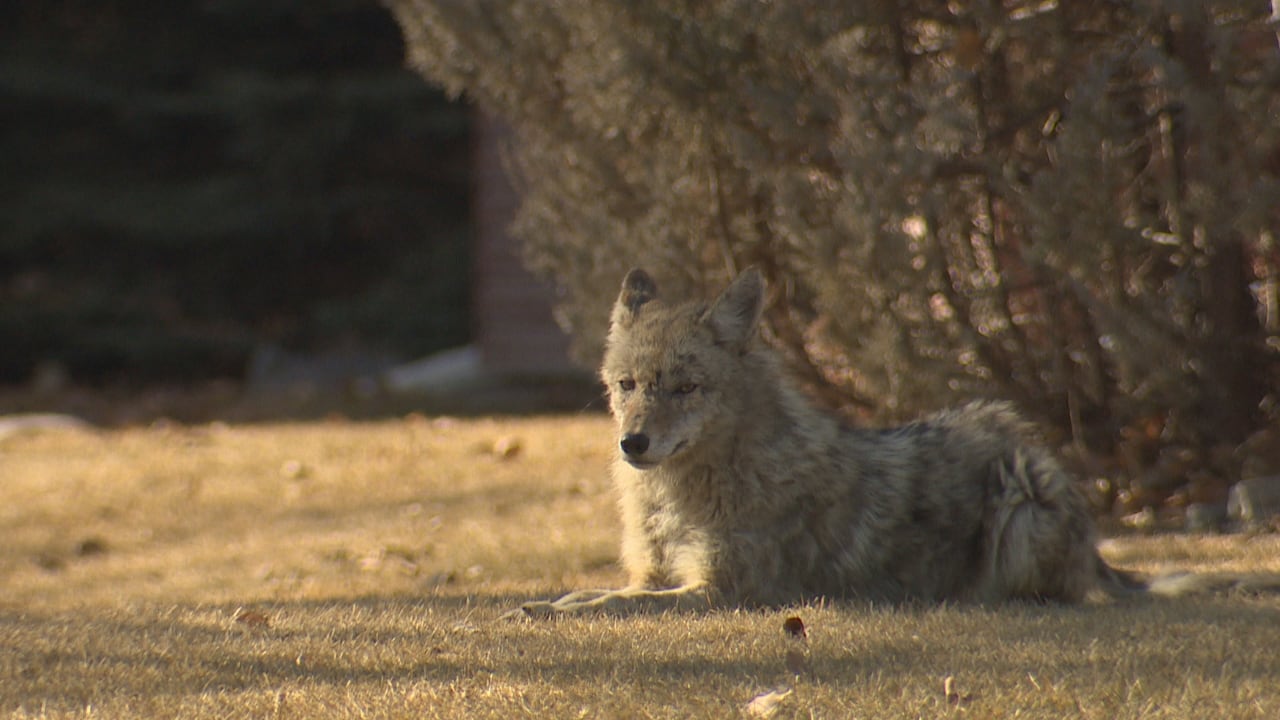 People need to make sure they secure garbage, compost, bird seed, fallen fruit and dog food so coyotes don’t learn that yards and people are places to find food, Murray says. (CBC)
Barron got on her ride‑on lawnmower and drove into the field, yelling as she went. The coyote finally left, but only at a casual pace.
Later, Barron discovered Isla had a puncture wound on her back that hadn’t bled much and was hidden under thick fur.
“I had to take her to the vet, and it was infected, and she had to go on antibiotics and painkillers,” she said. “It was kind of a big deal, and one puncture that had torn muscle.”
She said it was not the first time Isla had been bitten. A previous encounter left bite marks on both sides of the dog’s ribs.
“He had actually had Isla in their mouth, and she managed to get away,” Barron said.
“I like to have wild animals around. Nothing ever has been as confronting and aggressive as these particular coyotes here.”
‘She did a lot of the right things’
Murray said Barron has already taken several important steps to discourage the coyotes from coming onto her property.
“She did a lot of the right things,” Murray said. “I would say all the right things in terms of scaring the coyote away, teaching the coyotes that this is not a space that’s okay to be in.”
Murray noted that it is important to have the fenced dog area Barron uses, and said fences can make yards less attractive to coyotes.
She also said Islanders should remove potential food sources by securing garbage and compost, and cleaning up bird seed, fallen fruit and any dog food left outside.
Murray also pointed to “hazing” techniques, which involve gradually escalating efforts to frighten coyotes and teach them to keep their distance.
“In those situations, it is totally fair to keep escalating, even to the point where maybe you’re throwing tennis balls at them or something like that,” she said.
“You’re just trying to teach them that it is not okay to be near us and our pets.”
The Town of Stratford recently posted tips on social media about what people should do if they encounter coyotes.
Islanders are advised to report any coyote encounter that feels aggressive or threatening to the province’s Fish, Forests and Wildlife Division.