
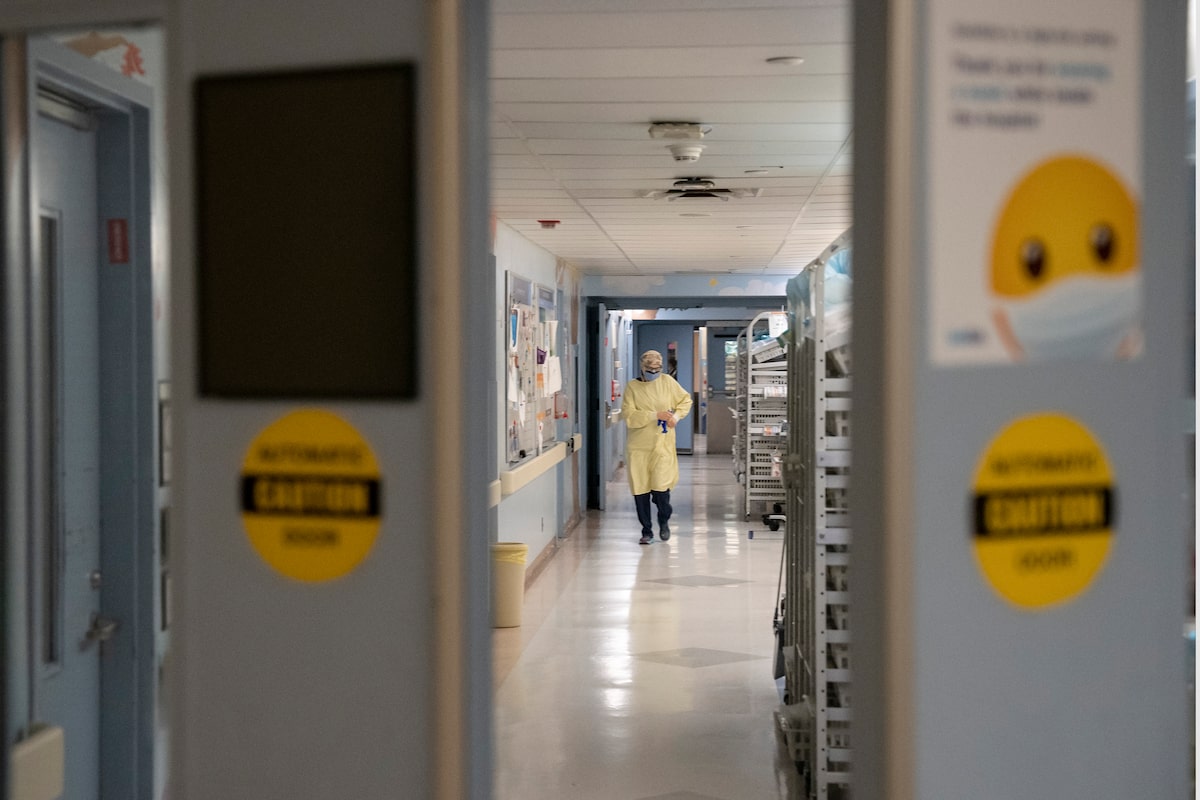
A health-care worker in a Toronto hospital in November, 2022.Chris Young/The Canadian Press
Keith Stewart is the director of Princess Margaret Cancer Centre and the vice-president of cancer and laboratory medicine at Toronto’s University Health Network.
It has never been more urgent to create a world free from the fear of cancer. Cancer rates are steadily rising among younger generations, and global cancer diagnoses are projected to increase dramatically over the next 25 years.
But hope is accelerating as it becomes increasingly feasible to diagnose cancer earlier, leading to better treatment and outcomes – particularly for pancreatic, bladder, kidney and liver cancer, for which there are no population-wide screenings.
The growing availability and popularity of early cancer-detection blood tests are lighting the way forward, offering a new era in cancer care that could be transformative. Such early-detection blood tests can detect fragments of tumour DNA in up to 50 different cancer types circulating in the blood at very low levels.
Identifying cancer before clinical symptoms could shift the paradigm from treating disease once it has taken hold, to preventing it from ever progressing.
Moderna, Merck’s cancer vaccine breakthrough could open new avenue of treatment
While blood tests to detect cancer are already available as self-pay tests, none have yet been approved by the FDA or Health Canada, although several very large clinical trials are under way in Europe and North America.
The advances have been remarkable, but there needs to be further research to establish the true potential – and to examine potential unintended downsides. What if some of the cancers detected would not go on to become life-threatening? What about the psychological distress that can accompany a blood test that claims to have found evidence of cancer? Is there a risk of overtreatment or unwarranted interventions?
It is important to note that blood tests are not a replacement for standard screenings that look for one specific kind of cancer, such as mammographies for breast cancer, colonoscopies for colorectal cancer, or the detection of HPV infection in cervical cells. Many provinces in Canada have lowered the recommended starting age for breast cancer screening to 40 or 45, and this year, Ontario and Prince Edward Island officially lowered their colorectal cancer screening age from 50 to 45 (and to 40 for high-risk individuals).
As research continues to open up new frontiers, it is crucial that Canada be engaged in such studies. Cancer research programs across Canada are already world leaders in developing such testing, and early cancer detection is a significant area of focus for the Canadian Institutes of Health Research. And Princess Margaret Cancer Centre’s Peter Gilgan Centre for Early Cancer Detection Research has launched a large-scale, five-year study that aims to enroll 7,000 cancer patients and use liquid biopsy blood tests to track whether cancer is still present or has recurred following treatment.
Health Canada approves drug to treat hot flashes and night sweats in breast cancer patients
Princess Margaret, along with several leading cancer centres in the U.S., also took part in the PATHFINDER 2 trial, an international landmark study that enrolled 35,000 participants and found that a blood test identified seven times more cancers when used alongside standard screening methods. The blood test, developed by U.S.-based company GRAIL, may identify traces of up to 50 types of cancer, and more than half of the cancers found in this study were early stage-one or -two, where treatment is more effective.
But a second study conducted in Britain differed from PATHFINDER in several key ways. The test, called Galleri, was done in partnership with the National Health Service and enrolled 142,000 asymptomatic participants aged 50 to 77 years. Half the participants received standard-of-care cancer screening, and the other half received standard-of-care screening plus the Galleri test. The study found that the blood test failed to statistically reduce the number of cancers diagnosed at late stage in this age group. Longer follow-up of participants is under way.
On the positive side, the results again showed an increase in the detection of stage-one and -two cancers. About one in 100 participants received a positive cancer signal on the blood test, and roughly half of those were subsequently diagnosed with cancer.
These mixed findings underscore both the promise of early detection and the work that remains to refine optimal deployment of these tools.
In the meantime, while research continues, there are time-tested measures people can take to reduce their risk of cancer. They can stay up-to-date with recommended screening and vaccinations, avoid tobacco, limit alcohol, exercise, and follow a healthy diet.
We are entering a golden era in the early detection of cancer: a point where we can accelerate discovery and redefine what’s possible. It could bring us closer to a future where more cancers are prevented, detected earlier, treated more effectively – and, ultimately, cured.