
Inside the Market’s roundup of some of today’s key analyst actions
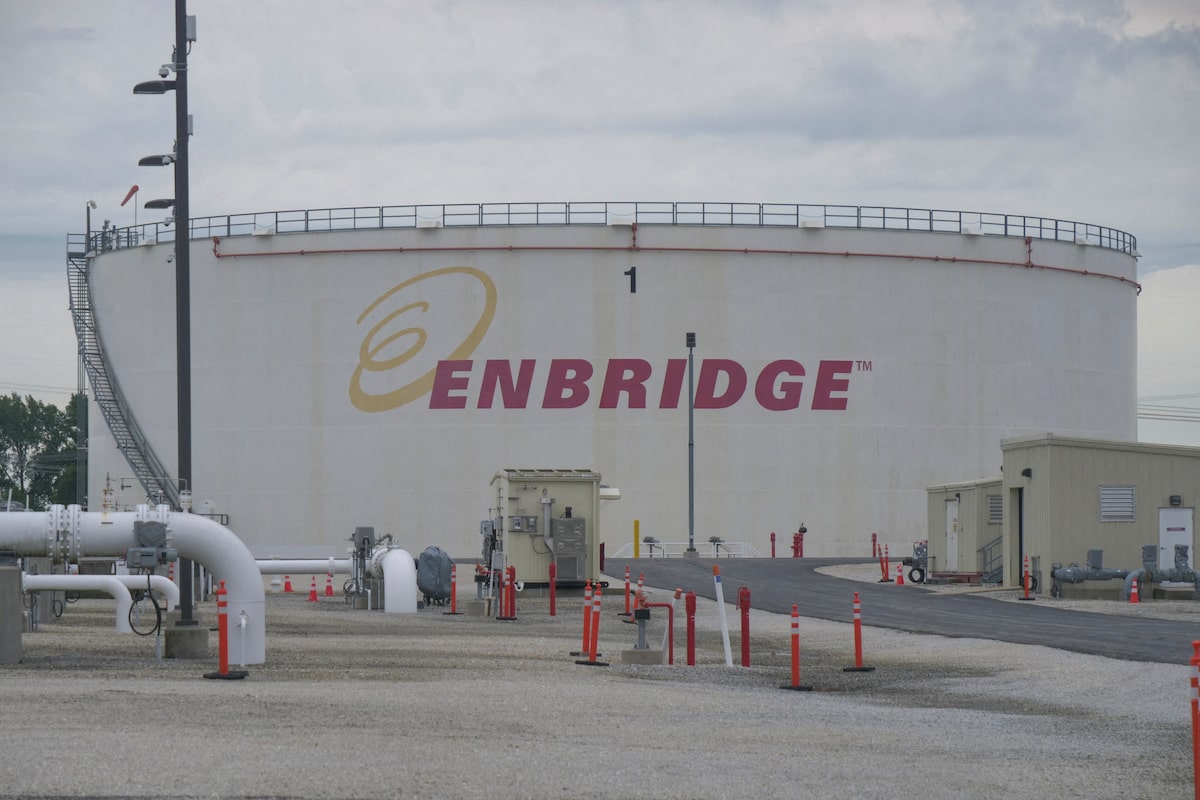
“Expressing faith in North American oil production growth,” National Bank Financial analyst Patrick Kenny upgraded Enbridge Inc. (ENB-T) to “outperform” from “sector perform” after coming off research restriction following its $3.0-billion equity financing, which will partially fund the concurrent US$2.55-billion acquisition of the crude oil business of Tallgrass Energy LP and US$0.6-billion tuck-in of Salt Creek Midstream’s crude oil gathering business.
“The acquisitions further strengthen ENB’s industry-leading North American crude oil super-system, adding highly contracted assets including the 460 mbpd [thousand barrels per day] Pony Express Pipeline (PXP), the 240 mbpd Powder River Gateway, connecting the Bakken, Powder River and Denver-Julesburg basins into Cushing, while extending its Permian wellhead-to-water offering.
“Longer term, we also highlight the optionality for ENB to twin its 310 mbpd Express WCSB egress pipeline system and integrate with an expanded PXP into Cushing and the Gulf Coast via Seaway. Meanwhile, the recent Salt Creek tuck-in adds 420 mbpd of acreage-dedicated Permian gathering capacity with connectivity into ENB’s Gray Oak pipeline and 1.6 mmbpd Ingleside terminal, which currently has 500 mbpd of whitespace.”
In a client note released before the bell, Mr. Kenny said Enbridge’s liquids franchise “remains well positioned to benefit from durable North American crude supply growth, with the company’s transcontinental super-systems currently delivering ~6 mmbpd of crude oil and liquids across the U.S. and Canada.”
“Through 2035, the company expects gross production to increase by more than 1.0 mmbpd [millions of barrels per day] in the WCSB, 0.9 mmbpd in the Permian Basin and 0.2 mmbpd across the Bakken and Rockies,” he added.
“Meanwhile, the Bakken and Rockies stand to benefit from their long-life supply base combined with growing strategic importance in the Denver-Julesburg Basin (DJB) and Powder River Basin (PRB) equipped with advantaged topography and a supportive regulatory backdrop, while Permian growth is supported by improving drilling technologies and ENB’s vertically integrated connection to its Enbridge Ingleside Energy Center (EIEC) for international exports. Meanwhile, ENB’s Mainline continues to provide a critical conduit for U.S.-bound Western Canadian energy, with the potential to facilitate growth beyond the 1.0 mmbpd base case following resolution of the trilateral MOU and long-term commercial visibility supported by 30 years of negotiated tolling agreements.”
Seeing “modest” accretion from the deals to his near-term estimates for the Calgary-based company “while rightsizing 2028 leverage,” Mr. Kenny raised his target for Enbridge shares by $1 to $82. The average target on the Street is $79.26.
“We resume coverage … noting further valuation upside related to more than 1.4 mmbpd of WCSB production growth by the first half of next decade, including sanctioning new regional oil sands pipeline expansions, MLO2, and twinning the Express Pipeline,” he concluded.
“Combined with the stock being down more than 15 per cent since mid-July, now trading less than 12.5 times 2027 estimated EV/EBITDA (long-term average: 13.0 times), and 15 times below our SOTP [sum-of-the-parts] valuation of $77/sh, we resume coverage with an Outperform rating (was SP prior to Restriction) with a 12-month total return opportunity of 28 per cent.”
Elsewhere, others making rating revisions include:
* TD Cowen’s Aaron MacNeil to “buy” from “hold” with an $81 target, down from $82.
“We are resuming coverage and upgrading to BUY, with a view that negative investor sentiment toward Enbridge is overly focused on long-term Mainline concerns that are unlikely to materialize. Our review of historical settlements, top-down/bottom-up fundamental analysis and scenario testing suggest the Mainline is more resilient than sentiment implies,” said Mr. MacNeil.
* BMO’s Ben Pham to “outperform” from “market perform” with a $79.50 target, up from $79.
“In this choppy macro environment, we recommend a focus on quality and visible growth. ENB fits that bill so we are upgrading the shares to Outperform and increasing our target price to $79.50 vs. $79, now offering an attractive 20-per-cent-plus potential total return,” said Mr. Pham.
Analysts making target changes include:
* Raymond James’ Michael Barth to $80 from $79 with a “market perform” rating.
“Despite two accretive acquisitions announced in the last few weeks, the combined purchase price represents just 1.5-2.0 per cent of the company’s current enterprise value, so it’s not particularly material to our thesis (the combined DCF/share accretion is less than 1 per cent on our estimates),” said Mr. Barth. “We do view the risk/reward as getting more attractive at the margin since we downgraded ENB in late-July (the stock is since down 12 per cent vs. the group down just 6 per cent), although we remain concerned about risks that could materialize around the Liquids segment as competing Canadian export pipelines progress. If nothing else, the uncertainty around that range of outcomes gives us pause. As such, we reiterate our Market Perform rating.”
* ATB Cormark’s Nate Heywood to $84 from $83 with an “outperform” rating.
TD Cowen analyst Aaron MacNeil thinks the recent 16-per-cent pullback in the price shares of TC Energy Corp. (TRP-T) has created “an attractive entry point into one of North America’s highest-quality naturalgas midstream companies.”
That led him to raise his rating for its shares to “buy” from “hold” previously, believing the decline “appears tied to three emerging investor concerns that have increased uncertainty around growth and valuation.”
“Opportunity conversion remains the key catalyst, and we view Q3/26 results as a potential inflection point, given the possibility of project sanctions, NGTL updates, and other backlog additions,” he said.
Mr. MacNeil warned the opposition to data centres represents a “notable risk to opportunity conversion,” however he thinks “the broader opportunity profile remains robust.
”Although permitting delays and moratoriums may slow project conversion, we believe the breadth of TC’s opportunity set, utility customer exposure, and continued growth in power demand support long-term opportunity realization,” he said/
“NGTL Growth Remains a Significant Opportunity, but the Economics of Future Expansion Remain the Primary Point of Debate: Although recent reporting has focused on tension between TC, shippers, and policymakers, we believe the key issue is whether a revised framework can provide returns sufficient to attract capital toward roughly 2 Bcf/d of additional growth opportunities beyond the currently approved Multi-Year Growth Plan (MYGP). We remain optimistic that this outcome can be achieved, potentially as early as Q3/26 results.”
He also thinks higher interest rates could be a near-term valuation obstacle, but he sees “much of this risk as manageable.”
“A large portion of TC’s regulated assets ultimately recover financing costs through tolling frameworks, limiting the long-term impact on underlying cash-flow generation,” said Mr. MacNeil.
“Outsized Recent Weakness Suggest a Portion of These Concerns are Likely Priced-in: Importantly, we believe the recent share-price correction already reflects a meaningful portion of these risks, while TC’s premium-quality asset base, visible growth outlook, and industryleading position remain intact. With the shares now trading closer to historical relative valuation levels following the recent pullback, we believe investors are being adequately compensated for the uncertainty surrounding project conversion, NGTL negotiations, and interest rates, supporting our upgrade to BUY.”
He kept a $102 target for TC Energy shares. The average target is $103.03.
National Bank Financial analyst Doug Taylor sees MDA Space Ltd. (MDA-T) “well positioned to benefit from the ongoing structural increase in space investment,” emphasizing its “55+ years of heritage across satellite systems, robotics and Earth observation.”
In a client note titled Entering the Next Stage of the Space Growth Odyssey, he initiated coverage of with an “outperform” rating, seeing the Brampton, Ont.-based set to enter 2027 “with a more diversified revenue and growth profile, a robust balance sheet, and a catalyst-rich pipeline of opportunities” following a series of recent transactions.
In justifying his bullish stance and seeing MDA as a “compelling opportunity” for investors, Mr. Taylor emphasized a trio of factors:
* “MDA pairs deep heritage with increasingly scalable capabilities in a structurally growing space market.”
Analyst: “The global space economy is expected to grow at a 9-per-cent CAGR [compound annual growth rate] through 2035 to US$1.8 trillion, driven by proliferated LEO communications, rising defence-space spending and renewed exploration investment. Against this backdrop, MDA combines established capabilities across communications payloads, space robotics and SAR with expanded manufacturing capacity capable of accommodating significant scale.
* Its backlog “provides visibility, while pipeline conversion creates estimate upside.”
Analyst: “MDA enters H2’26 with $4.4-billion of backlog pro forma the Lightspeed expansion, supporting the revenue outlook through 2027. Its $40-billion five-year organic pipeline includes $10-billion of downselected customer programs/follow-on opportunities, with potential catalysts including ESCPP, new or expanded AURORA constellations and SpaceRAN. Pipeline conversion remains the most visible catalyst for upside to our 2028 estimates.
* Recent M&A activity has expanded its exposure to the U.S. defence industry and a recurring-revenue base.
Analyst: “MDA has announced the acquisitions of BCT and CLS for a combined $2.0-billion (including fees). BCT adds an established U.S. manufacturing footprint, access to classified government programs and $5-billion of incremental pipeline, while CLS adds a scaled recurring EO analytics business and global distribution channel to complement its CHORUS launch. We estimate defense exposure rises from 15–20 per cent in 2025 to over 20-per-cent pro forma, while recurring revenue should represent over one third of the business in 2027.”
Mr. Taylor is now forecasting 15-per-cent organic growth in 2026 followed by 3 per cent and 8 per cent in 2027 and 2028, respectively, which he calls “a conservative baseline while we await further pipeline conversion.”
“The pending acquisitions supplement this growth, driving total revenue to $2.7-billion in 2027 (up 46 per cent) and $3.0 billion in 2028 (up 8 per cent),” he added. “We forecast Adj. EBITDA margins around 19-20 per cent through the period, while FCF should improve materially after 2026 as working-capital pressure normalizes and recent investments mature.”
The analyst set a target of $55 per share. The current average on the Street is $70.54.
“Our $55.00 target applies a 17.5 times NTM+1 EBITDA multiple, a premium to established aerospace and defense peers that we believe is warranted by MDA’s higher growth, pure-play space exposure, growing defence/recurring mix and scarcity value as a scaled, profitable public space company,” he noted. “Our target implies a 37-per-cent one-year return.”
National Bank Financial analyst Mike Stevens thinks Calian Group Ltd.’s (CGY-T) “recent operating momentum and improved execution support the earnings outlook, while its substantial balance sheet capacity and plans to accelerate capital deployment leave M&A as the clearest near-term source of additional upside.”
In a client report released Tuesday titled Powering Defence Readiness, With Bigger Missions Still Ahead, he initiated coverage of the Ottawa-based mission-critical solutions company, which focuses on defence, space, healthcare and other critical infrastructure sectors, with an “outperform” rating, emphasizing its” improved momentum, a cleaner portfolio, favourable growth and low leverage.”
Mr. Stevens said Calian now “spans Canada’s defence-readiness foundations” while its “four operating engines balance visibility and growth torque.”
“More than half of Calian’s revenue is generated in Canada, where recent funding packages supporting a materially stronger defence spending cycle add $81.8-billion of incremental investment over five years to an annual defence base above $50-billion,” he explained. “However, larger budgets create value only when translated into military capability, which we frame across five readiness foundations drawn from Canada’s defence policy: people, training, equipment, infrastructure and sustainment. Calian’s FY26 contract activity supports that alignment with $1 billion of signings spanning all five foundations, while book-to-bill is tracking above 1.0 times and its largely defence-related backlog stands at $1.6 billion, reinforcing its right-to-win.”
“We group roughly 85 per cent of pro forma revenue into four operating engines: Healthcare, Training, Space and Nuclear. Healthcare and Training provide capacity-led scale, duration and incumbency, while Space and Nuclear offer exposure to technology adoption, resilient connectivity and infrastructure modernization. The mix balances large service platforms, often underpinned by multi-year defence contracts, with higher growth and higher margins but more variable technology products and projects. Together, the four engines should support a more resilient and balanced growth profile than any single one could provide on its own.”
The analyst also emphasizing “better execution can unlock more value” from Calian’s existing platform.
“Through FY26 to date, revenue increased 17 per cent year-over-year with 11-per-cent organic growth, while Adj. EBITDA rose 41 per cent,” he said. “The planned Computex divestiture should sharpen the portfolio, with our Defence & Space forecast at nearly 75 per cent of FY27 estimated revenue. Our estimates assume continued margin expansion but no unannounced M&A, leaving capital deployment as the clearest source of near-term upside. We highlight how a $75-million FY27 M&A scenario using conservative assumptions could add $12.5-million to FY28E Adj. EBITDA; applying our 11.0-times target multiple to the higher pro forma earnings base implies $108 per share and a 38-per-cent total return.”
Also believing “broader program leadership could raise both earnings and valuation,” Mr. Stevens set a target of $100 per share, representing a estimated total return of 27.2 per cent including forecast dividends. The average is $104.60.
“We increasingly view FY27 as the execution year and FY28 as the realization year,” he added. “We believe the existing platform does not need to change dramatically, and the market does not need to award Calian a higher valuation multiple for the Company to create meaningful additional value. The formal portfolio review is complete, the agreed Computex divestiture is reflected in our forecasts and continued operating improvement is partly modelled. That leaves capital deployment as the most meaningful near-term unmodelled lever, supported by a more focused portfolio, improving execution, ample balance-sheet capacity and Management’s stated intent to accelerate M&A.”
RBC Dominion Securities analyst James McGarragle thinks Kraken Robotics Inc.’s (PNG-X) transformational $615-million acquisition of European peer Covelya Group Ltd. transforms it into “a full-subsystem undersea technology provider, marking a step-change in scale and customer stickiness.”
“Combined with structural defence and commercial tailwinds driving strong growth, we see a compelling path to operating leverage and EBITDA margin expansion through FY28,” he said. “Key is that our conservative earnings forecast and target multiple point to an attractive entry point at current levels, with further upside potential as integration progress materializes.”
On Tuesday, he initiated coverage of Mount Pearl, N.L.-based marine technology company, with an “outperform” rating, seeing the deal, which closed on July 2, adding “more than scale.”
“While Kraken previously supplied one or two components of an underwater vehicle, the combined company now provides the majority of a vehicle’s subsystems, creating substantial switching costs; replacing a multi-subsystem vendor requires costly re-testing and reintegration,” said Mr. McGarragle. “Covelya therefore does not merely add scale at 2.5 times Kraken’s standalone revenue base, but represents a structural shift in customer stickiness, while unlocking meaningful cross-selling opportunities across a combined 700+ customer base.”
The analyst now sees Kraken sitting in a strong position to capitalize on “compelling defence and commercial tailwinds.”
“NATO and allied navies and offshore energy operators are shifting toward autonomous alternatives to crewed and legacy systems, with the unmanned underwater vehicle market expected to grow at a 25-per-cent CAGR [compound annual growth rate] to US$120-billion by 2035,” said Mr. McGarragle. “We see Kraken as well positioned to capitalize, forecasting a meaningful step-up in profitability in FY26/27 due to the Covelya acquisition, and revenue and EBITDA growth of 20 per cent and 27 per cent, respectively, in FY28 — growth rates we see as sustainable longer-term.
“Integration execution is the key variable to watch. We value Kraken at 12.0 times EV/EBITDA applied to FY28E EBITDA, in line with subsea technology peers, and we see valuation upside potential as Kraken executes, given our long-term revenue growth expectations and opportunity for significant operating leverage driven by synergies post-Covelya integration. That said, demand is not the primary source of uncertainty; execution is. Integration execution risk, limited FCF generation history, and the still-maturing unmanned undersea market underpin our Speculative Risk qualifier.”
The analyst set a target of $6 for Kraken shares, which is below the $9.58 average on the Street.
RBC Dominion Securities analyst Harrison Reynolds sees Skeena Resources Ltd. (SKE-T) now “on the doorstep of the next major Canadian gold-silver mine.”
“Skeena is building one of the highest-grade open-pit precious metals mines globally in BC’s Golden Triangle,” he explained. “Initial production is on track for 2Q27 with construction well advanced. We anticipate multiple expansion as SKE transitions from developer to producer, underpinned by a front-loaded production profile of 450,000 ounces per year gold equivalent in years 1–5 with potential for incremental asset value through an updated mine plan in early 2027.”
“Scarce asset with strategic optionality backed by a team with dealmaking and mine-building expertise. Eskay Creek will be one of Canada’s largest precious metals mines and one of three operating mines in the Golden Triangle alongside Newmont’s Brucejack and Red Chris. The combination of scale, grade, and jurisdiction carries strategic value, in our view. Eskay Creek’s significant upfront FCF profile provides the opportunity to acquire and build a multi-asset platform, leveraging a management team with a demonstrated track record. Equally, few assets of this quality in comparable jurisdictions sit outside major producer portfolios, making Eskay Creek a natural acquisition target.”
Mr. Reynolds resumed coverage of the Vancouver-based company with an “outperform” rating on Tuesday, noting an updated mine plan by early 2027 “represents a material near-term catalyst.”
“The 2023 DFS production profile steps down materially after year 5 (450 koz to 225koz AuEq/yr),” he said. “Three levers aim to reshape the profile toward sustained elevated output: (i) adding Snip (0.9Moz at 9 g/t), (ii) steepening pit walls to unlock mineralization beyond current pit shell, and (iii) Albino Lake waste facility (4 kilometres from mill, historic mineralized material at 6 g/t AuEq). Together, we see potential to support 350–400koz/yr over 10+ years, outlining a more durable production profile and sustained FCF generation.”
Seeing an “attractive valuation ahead of developer-to-producer graduation,” Mr. Reynolds set a target of $64 for Skeena shares. The average target on the Street is $52.40.
“SKE trades at 0.8 times P/NAV and 4.1 times 2028E EBITDA (at spot), a premium to developers (0.4 times NAV) but a meaningful discount to mid-cap producers (1.1 times NAV, 6.0 times EV/EBITDA),” he said. “We estimate FCF of $1.2-billion/yr in 2028–2030E (22-per-cent yield) at $4,400/oz spot gold. With construction concluding and first production in sight, we expect multiple expansion as the market re-prices SKE as a producer over the next 6–12 months.”
When MTY Food Group Inc. (MTY-T) reports its third-quarter financial results next month, National Bank Financial analyst Vishal Shreedhar expects to see “tepid” same-store sales growth with its U.S. operations continuing to struggle.
“We model tepid overall trends year-over-year, reflecting ongoing soft industry demand in the U.S., partly offset by relatively more resilience in Canada, organic growth initiatives across the business (broad-based digital/technology enhancements, new marketing approaches, etc.), and the addition of new higher quality stores to the network,” he said. Notwithstanding, we expect MTY’s share price to be largely governed by investor perception regarding the ongoing strategic review.
“Outside the strategic review, investors will focus on (i) traction with sssg (will Canada sssg remain positive beyond June, and indications on when sssg will turn consistently positive, particularly in the U.S.), (ii) organic store network stability (cadence of corporate store closures and its effect on EBITDA), and (iii) outlook commentary and the consumer backdrop given ongoing macroeconomic concerns.”
In July, the Montreal-based company operating restaurants under 80 brands, including Thai Express, Manchu Wok and Bâton Rouge, said it is closing 68 underperforming stores over the next nine months, citing a lack of sales. That move comes after it announced the launch of a strategic review late last year to explore strategic options that could lead to the sale of the business.
“The outcome of the strategic review remains the key near-term driver for the stock,” said Mr. Shreehdar. “We continue to believe an acquisition price of $44-$60 is reasonable (7.0-8.5 times EBITDA).
“Public filings indicate MTY did not repurchase any shares during Q3/F26E. We expect excess cash to be allocated towards debt repayment. NBCCM models net debt to EBITDA of 2.7 times in Q3/F26E versus 2.8x in Q2/F26.”
For its third quarter, Mr. Shreedhar is now projecting system sales of $1.429-billion, down from $1.455-billion during the same period a year ago. He sees EBITDA of $68-million, exceeding the consensus expectation by $1-million but down from $74-million in fiscal 2025.
“NBCCM models U.S. sssg of negative 2.0 per cent and Canada sssg of 0.5 per cent,” he added. “Our positive Canada comp reflects improved performance in June with most concepts showing positive sssg, partly offset by a challenging consumer environment. Our expectation for ongoing U.S. softness reflects similar trends to Q2, continued challenges at Papa Murphy’s (16 per cent of F2025 sales; pizza remains highly competitive), as well as tepid trends in third-party data.
“Our review of Bloomberg Second Measure data (ALTD) suggests U.S. sales growth at MTY remained pressured but sequentially improved. In Q3/F26E, MTY U.S. sales were down 1.3 per cent year-over-year vs. down 1.6 per cent in Q2/F26. Our review of peer commentary suggests (i) subdued consumer sentiment, while spending remains resilient; pizza category continues to be competitive, (ii) a divergence in traffic trends between banners, and (iii) higher input costs (especially protein and labour).”
Reaffirming his “outperform” rating for MTY shares, Mr. Shreedhar cut his target to $40 from $43 to reflect “a lower multiple for the core business due to tepid operational growth.” The average target is $41.67.
Believing “the next lumber cycle clashes with structurally reduced supply,” Raymond James analyst Daryl Swetlishoff upgraded a trio of building materials companies on Tuesday, seeing “compelling upside” in each.
“After 4 years of depressed U.S. housing and repair & reno activity, we submit that the supply side has finally done the heavy lifting to improve balance in North American lumber markets,” he explained in a report. “Canadian shipments have fallen to record lows, capacity has (permanently) exited the system and European lumber imports have also fallen sharply. Despite cyclical and seasonal demand headwinds, 2Q26 results approached what we consider mid-cycle profitability ($100 EBITDA/mfbm) with our refreshed 3Q26 estimates not too far behind. We highlight that mid-cycle EBITDA implies FCF yields of 25 per cent and 15 per cent for Interfor and Canfor (respectively) and we are upgrading both to Strong Buy in this note (West Fraser goes to Outperform).
”Year-to-date Canadian lumber shipments to the US are down 30 per cent from peak COVID (2021) levels while European shipments are running 45 per cent below 2022 levels. Notably, the supply reset has extended well beyond sawmill closures. Since 2023, 15 per cent of North American woodpulp capacity has closed permanently removing critical outlets for sawmill residuals. Coupled with structurally constrained Canadian harvesting, persistent labour shortages and soaring greenfield build costs, we expect a materially reduced supply response vs. prior cycles. As such, while timing of a durable housing recovery remains uncertain, we note the next cycle will collide with a materially diminished production base — setting the stage for structurally higher lumber prices and significant earnings torque for preferred names.”
His rating revisions are:
Canfor Corp. (CFP-T) to “strong buy” from “outperform” with a $21 target, up from $17. The average is $17.14.Interfor Corp. (IFP-T) to “strong buy” from “outperform” with a $21 target, up from $17. Average: $17.17.West Fraser Timber Co. Ltd. (WFG-N, WFG-T) to “outperform” from “market perform” with a US$85 target, up from US$75. Average: US$82.53.
In other analyst actions:
* Raymond James’ Steven Li upgraded Quebecor Inc. (QBR.B-T) to “outperform” from “market perform” with a $75 target, rising from $72 and exceeding the $73.83 average on the Street.
“QBR shares have pulled back 7 per cent since its earnings report (TSX: down 1 per cent over the same period). With wireless momentum continuing in the East and “Go West” imminent, we believe there is enough catalysts to drive shares higher to our target price. We are upgrading QBR shares to Outperform,” he said.
“‘Go West’ comes next. Densification investments in Western Canada have been ramping for some time even if there have been some delays (e.g. Vancouver leasing for building rooftops have taken longer, etc.) but we are almost there. Based on conversations with management, we expect Freedom to be in Vancouver by Black Friday (already in Calgary & Edmonton) and that will be the first real test potentially of whether QBR can take wireless share outside Ontario at scale. We note the combined population of Vancouver+Calgary+ Edmonton is 6.6 million, which is just slightly less than the GTA’s population of roughly 6.7 to 7.1 million (depends on exact region).”
* In response to a first-quarter miss, driven by weaker-than-anticipated margins, and pointing to “lacklustre growth and tariff uncertainty,” Canaccord Genuity’s Robert Young made “a shift to the sidelines” on Evertz Technologies Ltd. (ET-T), downgrading its shares to “hold” from “buy” with a $15 target, falling from $18. Others making target revisions include: RBC’s Paul Treiber to $16 from $17 with a “sector perform” rating, BMO’s Thanos Moschopoulos to $17 from $18 with an “outperform” rating and Raymond James’ Steven Li to $16.50 from $18 with an “outperform” rating. The average is $17.75.
“Evertz reported a mixed FQ1/27, with revenue in line with consensus but profitability below expectations on lower gross margins and higher operating expenses. Top-line growth remained modest at 5.5 per cent year-over-year, driven by software & services (up 14 per cent year-over-year to 50 per cent of sales) and international revenue (up 17 per cent YoY), while hardware revenue declined slightly. Backlog increased 9 per cent quarter-over-quarter to $259-million with particularly strong government/defense order intake in August. That said, the August shipment figure of $30-million is an $11-million drop year-over-year and suggests FQ2 will be weaker than our previous view and that growth will likely turn negative. While conceding uncertainty, management expects the impact from recently increased U.S. tariffs to be manageable and reiterated the long-held 56–60 per cent GM target range. Cash generation deteriorated in Q1 with CFO of just $0.8-million as a $20-million raw materials build consumed working capital. We note the unchanged quarterly dividend of 20.5 cents per share (5.5 per cent yield) is temporarily uncovered by internally generated cash. Overall, we remain constructive on Evertz’s backlog, defense opportunity and growing software/services contribution, but with lackluster growth likely to persist, incremental uncertainty from supply chain and tariffs, and the shares trading above their historical valuation range, we believe the current valuation leaves less room for upside,” said Mr. Young.
* In response to its plan to quadruple the capacity of its artificial intelligence data centre operations in Saskatchewan, TD Cowen’s Vince Valentini raised his target for shares of BCE Inc. (BCE-T) to $40 from $37, maintaining a “buy” rating. The average is $36.96.
“As we expected, the Canada Infrastructure Summit led to some incremental data centre news for BCE. Unfortunately, the new project in Saskatchewan is not at the point where Bell AI Fabric has committed customer contracts and power commitments (unlike prior deals that were locked in before public disclosure),” said Mr. Valentini.
“The prospects here look very encouraging in our view over the medium term, so we have increased our target price … BCE expects to have the full incremental 900 MW of DC capacity (taking the SK total to 1.2 GW) operational well within 10 years, and the first 150 MW could be quite soon as there are two additional pods (for six total) available at the Sherwood location,” he added. “BCE also expects the ROE on this project to be similar to the 20-per-cent target on previously announced Sherwood phase one.”
* After recent conversations with Boyd Group Services Inc.’s (BYD-T) leadership team, including president and CEO Brian Kaner, RBC’s Sabahat Khan cut his target for its shares to $224 from $236 with an “outperform” rating. The average is $229.08.
“Our discussion with management highlighted the favorable dynamics that continue to support industry growth, while Boyd’s market share capture, combined with new store additions, M&A, and margin improvement initiatives should continue to drive strong top-line and earnings growth. Management addressed questions re. SSS [same-store sales] outlook and the fact 3-5-per-cent is a reasonable long-term average growth rate, though quarterly trends will vary, and SSS has very limited correlation to EBITDA growth,” said Mr. Khan.
* In response to record summer box office results for Cineplex Inc. (CGX-T), RBC’s Drew McReynolds raised his target for its shares by $1 to $15 with an “outperform” rating. The average is $13.58.
“We believe a strengthened theatrical release window, added film supply from streaming platforms and still-untapped growth opportunities for Cineplex Media, location-based entertainment (LBE) and Scene+ have bolstered Cineplex earnings power. While Cineplex is not immune to economic headwinds and further U.S. studio consolidation could have negative medium-term implications for the release slate, we continue to see value in the shares at current levels given: (i) the strong box office outlook for H2/26 and 2027 relative to recent years; (ii) Cineplex’s diversified and differentiated asset mix and stronger competitive position relative to peers; and (iii) the potential for enhanced capital returns alongside strategic optionality,” said Mr. McReynolds.