
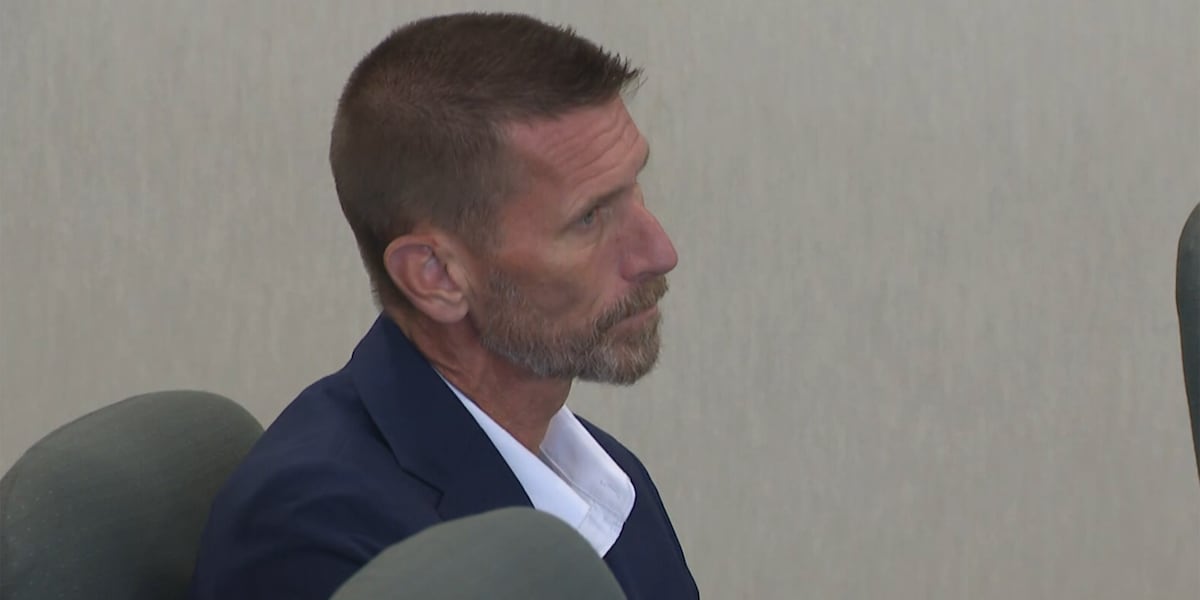
BURLINGTON, Vt. (WCAX) – Jason Eaton’s defense team called his sister and a forensic psychiatrist to the stand Wednesday, the third day of his attempted murder trial in Burlington. Both witnesses spoke to his mental state at the time of the 2023 shootings of three Palestinian American students.
Eaton has essentially admitted to shooting the victims, so the case does not hinge on whether he did it, but on whether he should be held criminally responsible.
The state rested its case Tuesday, and Wednesday, the defense began presenting witnesses to support an insanity defense.
On the stand Wednesday morning was Eaton’s younger sister, Amy Rubright.
“He talked about demons and they don’t necessarily come looking like angels or demons. They could look like a regular person, like they could be a friend of mine and I wouldn’t know,” Rubright said.
She described what she called a shocking phone call with her brother two years before the shooting, saying he was not acting like himself when he relayed messages he received from an unknown source.
“He had gotten a message that… the world was changing and that we are light bearers,” Rubright said.
In cross-examination, the state questioned the relationship between the siblings and a lack of communication leading up to the shooting, after Rubright kicked him out of her house following a disagreement in 2022.
“All of the remaining months of 2022 you had no contact with him?” Chittenden County Deputy State’s Attorney Sally Adams asked.
“No,” Rubright said.
“No phone calls?” Adams asked.
“No,” Rubright said.
“No in-person contact?” Adams asked.
“No,” Rubright said.
“And all of 2023 up until Nov. 25, 2023, no phone calls?” Adams asked.
“No,” Rubright said.
The defense’s main witness, Dr. Fabian Saleh, spent the rest of the day on the stand. The forensic psychiatrist testified about the messages Eaton claims he received from the CIA and the Israeli government on the day of the shooting and in the period leading up to it, telling him to take action.
Eaton also believed he was told to watch over a Jewish gathering space he could see from his apartment window.
“And he saw the three victims, and through the messages that he received, be it through the FM radio and the voice of God, he was instructed and urged to go and kill them,” Saleh said.
The defense’s expert backed up their claim that Eaton should not be held criminally responsible for the shooting, pointing to Eaton’s delusions that he felt he had to carry out a government operative.
“He is operating under the belief, the delusional belief, that this is an authorized, legalized undertaking. So he doesn’t think, ‘I’m doing something criminal or wrong,’” Saleh said.
The state pushed back on the defense’s expert, saying that even days before the shooting, doctors had no notes of any delusions, and none recently.
“In any conversations that you’ve had with Mr. Eaton, he hasn’t described any new delusions that are outside of what he is here for today,” Chittenden County State’s Attorney Sarah George said.
“But that’s what the delusional disorder is about,” Saleh said.
“About one delusion?” George asked.
“It’s not one delusion,” Saleh said.
The defense also played recordings of Eaton five days after the shooting.
“I don’t know how much of this is in my head, and how much of this is real,” Eaton said in the recording.
The state was still cross-examining the defense’s expert as of Wednesday afternoon, trying to poke holes in his testimony.
Proceedings are set to resume Thursday morning, with the state continuing its cross-examination of the defense’s expert.
At least one more witness or expert is expected from the defense, after which the state is expected to bring its own mental health expert to the stand.
Once both sides are satisfied with the testimony provided, the jury may begin deliberating.
Copyright 2026 WCAX. All rights reserved.