
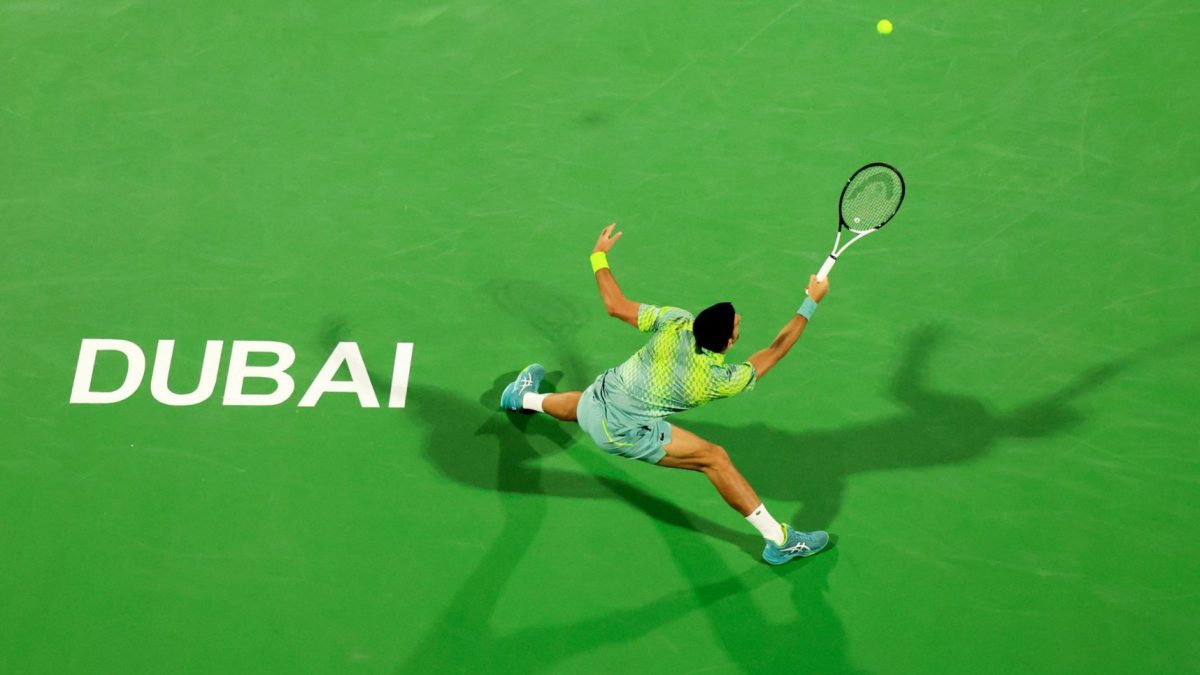
Tennis authorities are making plans to replace spring events in the Middle East over concerns security risks in the region will still be too high.
In February, a group of 40 players, staff and media were left stranded in Dubai after missile strikes on the United Arab Emirates in the last days of the tournament.
The attacks, aimed at US military assets in the area, closed the airspace in the UAE for days and explosions were heard during play. A subsequent event in the country was cancelled after one day.
Both Dubai and Doha are due to host both men’s and women’s events in February after the Australian Open, but tour chiefs are understood to have started discussing a viable “Plan B” because of worries about a repeat of last year.
What could happen next?
The i Paper has been told that Singapore and Australia have been mooted as possible replacement hosts, but neither is believed to have made a formal approach. Bosses would prefer to switch the tournaments to Europe but, on the ATP side at least, there are no immediately forthcoming options.
The WTA tournaments are an even bigger challenge because they are 1000-level, the highest level of tour event outside the grand slams, with more players in the draw and therefore a greater infrastructure footprint. Singapore is hosting a WTA 500 event next week but that only features 28 singles players, half the size of the Dubai or Doha event it would have to replace.
That extra size comes with significantly more cost for a last-minute host, with authorities in Dubai or Doha unlikely to foot the bill given they will be bullish on their ability to host.
Both cities’ significant international airports remain open, despite the breakdown of a summer ceasefire between the US and Iran.
However, Safe Airspace, an independent organisation with 7,000 members, made up of airlines, private charter operators, military and government, rates both Qatar and UAE’s airspace with a “Level 3 – Caution”. The European Union Aviation Safety Agency offers similar advice, telling airlines to “exercise caution and take potential risks into account when operating in the airspace of Bahrain, Kuwait, Israel, Jordan, Qatar, Oman, UAE and Saudi Arabia”.
Could tournaments still go ahead in Middle East?
 Carlos Alcaraz and Jannik Sinner are set to return to Riyadh for the ‘Six Kings Slam’ next month (Photo: Getty)
Riyadh, Saudi Arabia’s capital, is due to host a lucrative exhibition tournament next month featuring Novak Djokovic, Carlos Alcaraz, Jannik Sinner, Alexander Zverev, Taylor Fritz and Alex De Minaur. Last year, each participant received a $1.5m (£1.12m) appearance fee, with the overall winner receiving another $4.5m (£3.36m) in prize money.
It is seen as a dry run for the risk assessment of any event further east, and sources in the Middle East are hoping its success will strengthen their case not to have the licence for the 2027 tournaments in Dubai and Doha temporarily revoked.
However, fighting between Houthi rebels in Yemen and a Saudi-led coalition has intensified in recent weeks. The Houthis claimed to have downed a Saudi fighter jet over Yemen this week, and launched missiles at targets in Saudi Arabia itself, albeit predominantly at targets in the south west, hundreds of miles from Riyadh.
More on tennis
Special report: Emma Raducanu’s US Open triumph five years on, told by her opponents
Opinion: Serena Williams disrespected Wimbledon and paid the price
This all comes at a sensitive time internally for tennis, albeit political wrangling over prize-money and scheduling seems rather trite in the context of real war. However, the tours will not want to risk angering a player group already close to revolt over grand slam prize money and the relentless tennis calendar.