
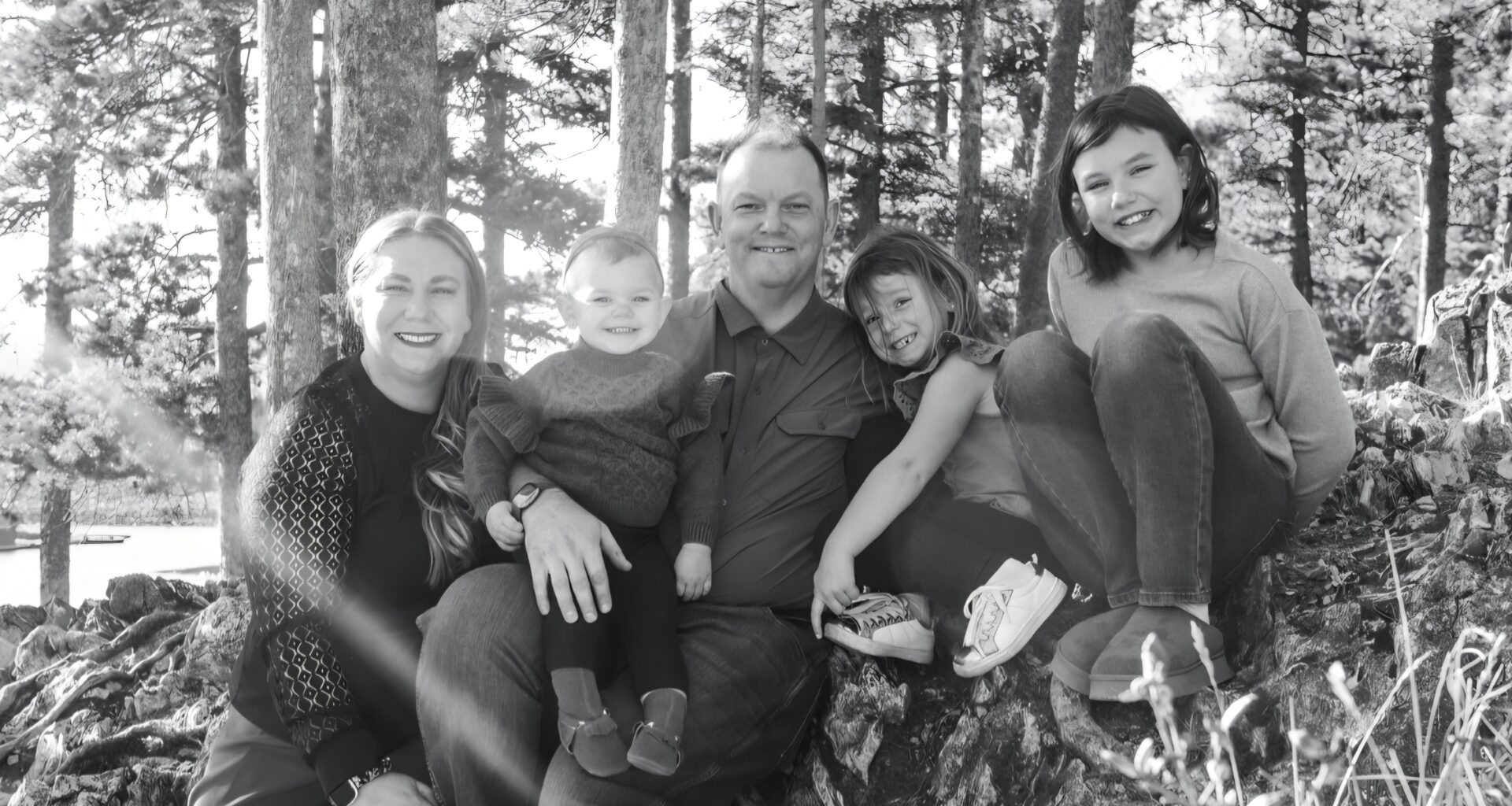
Bre Kaglar took her one-year-old daughter for a routine eye exam.
Kaglar called it a “happy visit” — a chance for Baby H to get used to doctors, lights and medical equipment while she was still young.
Related Stories:
Instead, Kaglar said optometrist Dr. Jared Long at Airdrie Eyecare Centre noticed something in her daughter’s eyes.
The appointment led to a diagnosis of bilateral retinoblastoma, chemotherapy and treatment in Toronto.
More than a year and a half later, Baby H is now two-and-a-half. Doctors are watching changes in her right eye, and trips to Toronto that her parents had not expected to continue into 2027 are still part of life.
Kaglar still points back to that first appointment.
“That eye exam literally saved her life.”
Still watching, still travelling
Kaglar said Baby H is doing well and has not had any major medical setbacks over the past year.
Doctors are monitoring three areas in her right eye, measuring them for growth and activity while watching changes in their colour. Kaglar said doctors have not determined whether the changes are a response to previous focal eye therapy, including laser and cryotherapy.
They are also watching for additional tumours.
“They want us to continue to travel to Toronto as the humps have been changing colour,” Kaglar said. “They’re not sure if it’s her body responding to the treatment.”
Because Baby H is still young and considered at risk for additional tumours, Kaglar said doctors want to keep her under close observation until she is five.
The eye treatment she receives in Toronto is not offered in Alberta, Kaglar said.
In a June 29 update to the family’s GoFundMe, Kaglar wrote that Baby H’s left eye remained stable with no new activity, while the right eye continued to require close observation.
At that time, the family was travelling to Toronto approximately every six weeks for focal eye treatments.
The visits can involve examinations under anesthesia, retinal imaging, fluorescent dye testing, RetCam imaging, tomography and other scans. Laser treatment and cryotherapy are performed when needed.
By June, Kaglar wrote, Baby H had undergone more than 21 sedations in roughly a year and a half. Waking from anesthesia had also become increasingly difficult.
“What should be a relatively quick recovery now takes nearly two and a half hours, and watching it happen has been heartbreaking.”
“For hours afterward, I spend my time simply trying to comfort H and encourage even a few sips of water or a bite of food into such a tiny body.”
Kaglar wrote that Baby H’s treatment schedule extended until at least January 2027 — nearly two years after it began — “with no certainty yet about what comes after.”
Speaking on Sept. 17, Kaglar confirmed the family had not expected the Toronto trips to continue into next year.
“We weren’t expecting to have to go next year.”
Care continues in Alberta as well.
The June update lists regular blood work, yearly MRIs, oncology appointments at Alberta Children’s Hospital, pediatric followups and annual hearing assessments. Kaglar wrote that Baby H’s hearing is monitored because hearing loss is a known side effect of chemotherapy.
Progress, Kaglar said, has come in smaller measures.
“As each appointment progresses, we are seeing positive and manageable successes.”
The exam Kaglar wants other parents to remember
Early dental and eye checkups were already part of how Kaglar and her husband approached their children’s health.
Now, she speaks about early eye exams with an urgency born from what happened to her own daughter.
Kaglar is clear about what she believes could have happened had Baby H’s cancer been found later.
“If it wasn’t for that, she may not have her eyes, or she may not be with us on this earth.”
“Something so small and seems so pointless can save a life.”
The Canadian Cancer Society says retinoblastoma is the most common type of eye cancer in children.
Retinoblastoma is included in broader eye-cancer statistics. In 2023, 20 children aged 0 to 14 in Canada, excluding Nova Scotia, were diagnosed with eye cancer, according to the society.
What Baby H may see
Exactly how Baby H’s vision will change as she grows remains uncertain.
In September, Kaglar said the family had been told Baby H would be partially blind in her right eye because of the tumour’s rapid growth early in her illness and its location close to the centre of her vision.
In her June GoFundMe update, Kaglar described it as a blind spot in the right eye.
In that update, she wrote that the hope is Baby H’s left eye and brain will compensate.
At home, her parents watch the small things.
They drop tiny objects to see whether Baby H can find and pick them up. They watch how she responds when she hears something and whether she can point toward it.
For now, Kaglar said her daughter’s eyesight seems to be doing well.
“So each day will be different for her and for us.”
The moment that changed the family
Asked which moment from the past year and a half she keeps returning to, Kaglar went back to the diagnosis.
“I’m gonna try to do this without crying.”
Her daughter’s age has also changed what Kaglar has had to take on as a parent.
“It’s a very hard journey, especially because she’s so young and can’t advocate for herself,” Kaglar said. “I’ve had to step up a lot to help her.”
Being told her daughter had cancer changed how the entire family approached life.
“It’s scary, right? And I have other children to have to consider in this too.”
There were also answers Kaglar did not immediately have. Some would only come after the family reached Toronto.
“Having somebody say something like that, and then having to wait a few days before you’ll get results was very challenging.”
Kaglar summed up the change more simply.
“You look at life differently.”
In her June update, Kaglar described what that has meant at home.
“The ordinary moments we once rushed through have become our greatest treasures. Every laugh, every cuddle, every milestone, every quiet moment together gets tucked away into our memory box.”
Rather than allowing fear to consume each day, she wrote, their role as parents has become to “love fiercely, make memories, and soak in every precious moment we are given.”
Learning to be her daughter’s voice
Kaglar did not enter Baby H’s diagnosis comfortable with the medical world.
“I could barely watch Grey’s Anatomy without getting a queasy stomach.”
She has had to learn to ask questions when she does not understand something, seek support for Baby H and the rest of the family, and make unfamiliar medical settings as comfortable as possible for her daughter.
“I had to kind of pull up my big girl pants and jump into it and dive into it,” Kaglar said.
It has also meant making decisions for a child who cannot yet make them for herself.
Kaglar said parents need to stand beside their children, help them develop their own voices and speak for them when they cannot.
The little girl beyond the diagnosis
Ask Kaglar about Baby H away from hospitals and treatment, and the medical language disappears.
“She is the funniest little thing ever.”
Baby H is chatty, social and polite, Kaglar said. She loves her sisters and meeting people, and her mother describes her as kind and compassionate.
The family has not been able to get out and meet as many new friends while Baby H has been a cancer patient, though Kaglar said they are beginning to open that bubble more.
“Even if she didn’t have cancer, she’s really strong and really resilient.”
The community that kept showing up
Airdrie residents and businesses began rallying around the Kaglar family after Baby H’s diagnosis in 2025, including a three-day Great Clips fundraiser last summer.
More than a year later, Kaglar said that support has continued.
“The support from the community and the city has made me speechless.”
Even as Airdrie has grown, Kaglar said, it still has the small-town quality of people coming together when someone needs help.
The family’s June GoFundMe update describes meals waiting after long travel days, restaurant gift cards, HelloFresh boxes, coffees, handwritten notes, messages and simple “thinking of you” texts.
Businesses and charities helped. So did neighbours and friends, relatives and complete strangers.
“Knowing that our community was standing beside us gave us strength, and we needed it the most.”
As of Sept. 17, the GoFundMe showed $44,383 raised toward its $50,000 goal from 280 donations.
Kaglar said money raised for Baby H goes toward travel to Toronto, which the family pays out of pocket.
She also provided HCancerjourney@outlook.com for anyone wishing to send an e-transfer directly to Baby H’s travel account.
But the help has gone beyond money.
“Their generosity made it possible for us to focus on what truly mattered: supporting our family, getting through each day, and finding hope during a time when it was sometimes difficult to see beyond the immediate challenges.”
The Toronto trips will continue next year, along with the monitoring and appointments that have become part of Baby H’s care.
Kaglar said the community that rallied around her family after the diagnosis remains part of their lives.
“Your kindness became part of our story.”
Have a news tip, story idea, photo or video? Send it to news@discoverairdrie.com. You can also follow and message us on Facebook and X at @AIR1061FM.