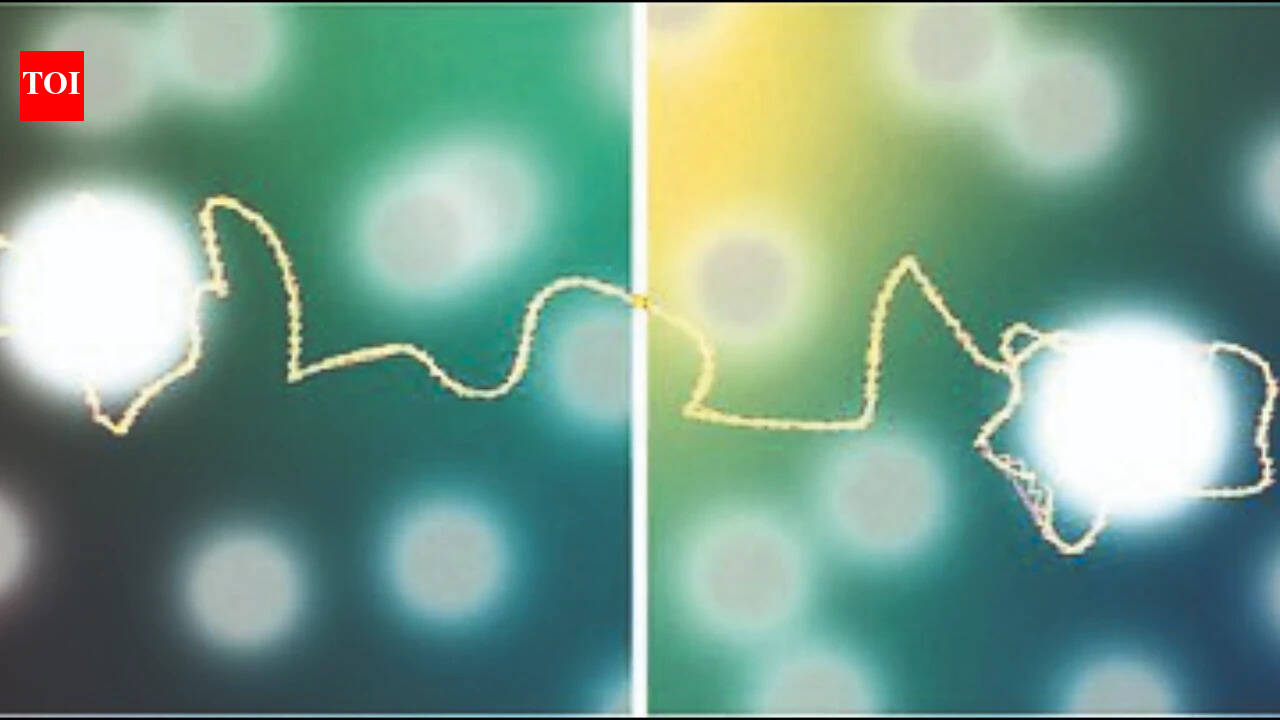
 Under the right conditions, theoretical calculations showed a flip could prevent sudden death — an outcome researchers call ‘avoidance’ BENGALURU: A single, precisely timed operation can delay – and potentially prevent – the sudden loss of a fragile quantum link, scientists at Raman Research Institute (RRI) have found, offering a possible way to protect information used by future quantum computers.The experiment showed that timing one “flip” of a photon’s quantum state can determine whether entanglement between two photons disappears quickly, survives longer or avoids sudden death altogether. Researchers also found that the same setup can mimic two established forms of quantum noise and the range between them, giving scientists a new way to study how quantum information breaks down.The study published in American Physical Society’s Physical Review A was led by scientists from RRI’s Quantum Information and Computing (QuIC) lab in collaboration with researchers at University of Calgary and Louisiana State University. It was partly funded by Department of Science and Technology’s National Quantum Mission.Quantum computers process information using quantum states, which can hold and manipulate information in ways that ordinary computers cannot. Their power depends partly on delicate effects such as entanglement – a link between particles that makes their properties correlated, even when separated. But these states are extremely sensitive to their surroundings and can lose their quantum properties through interaction with the environment.RRI researchers used pairs of photons, or particles of light, to study this problem. Each photon was assigned one of two possible states based on polarisation – the direction in which its light wave oscillates. Horizontal polarisation represented the lower-energy “ground” state and vertical polarisation the higher-energy “excited” state.As time passes, an excited state naturally tends to fall to the ground state. This decay also reduces entanglement between the photons. In some conditions, entanglement vanishes completely at a finite point, before the underlying decay process has finished. This is known as “entanglement sudden death”.Researchers found they could change that outcome by inserting a single flip during the decay. Using a waveplate, a device that changes the polarisation of light, they switched the populations of the two states.But timing was crucial. “A single flip operation will determine if you avoid or delay or hasten the sudden death,” said Saumya Ranjan Behera, quantum scientist at QuIC lab and lead author of the study.A flip at a suitable stage of decay could delay entanglement loss. Under the right conditions, theoretical calculations showed it could prevent sudden death altogether – an outcome researchers call “avoidance”. “Timing is not just an experimental detail. It can be a control resource,” said Urbasi Sinha, senior professor at RRI and group leader of QuIC lab.The experiment also yielded a broader insight into quantum noise. Scientists commonly use two standard models to describe how quantum information is lost to the environment. RRI’s setup initially appeared to fit neither.After nearly a year of theoretical work, researchers found that it traced a curve connecting the two models. By changing a single tuning parameter, the same experimental arrangement could therefore reproduce both established forms of quantum noise and intermediate cases. “What first looked like an experimental complication became one of the most interesting features of the work,” Sinha said.Researchers are now using the approach to model different kinds of environmental noise in quantum systems, both theoretically and experimentally. If such methods can be developed further, controlling when and how entanglement disappears could help address one of the central challenges in building practical quantum computers.