
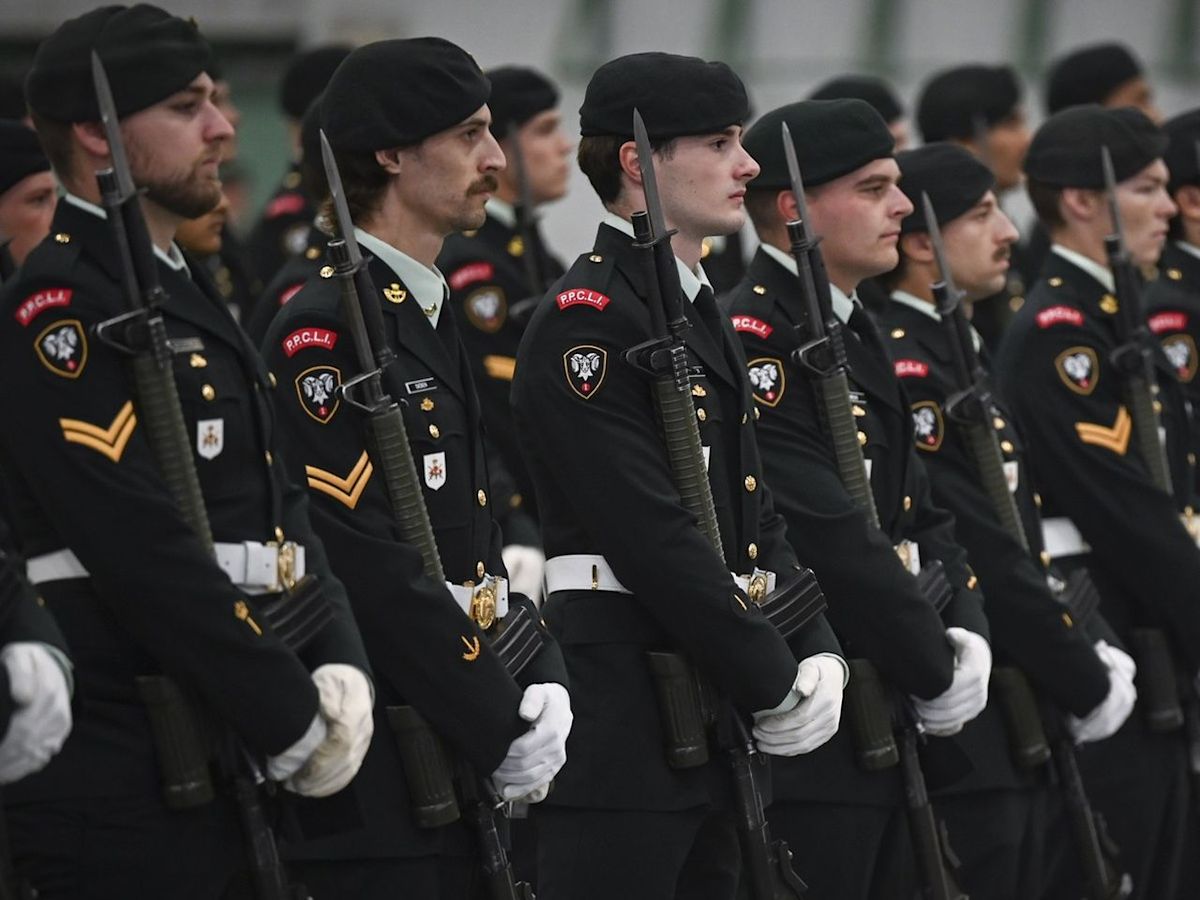
A new shoulder patch will come with new war-fighting preparedness levels not seen since the Second World War at Edmonton’s army base, set to grow by another 1,000 personnel over the next five years.
The newly reorganized 1st Canadian Division headquarters has coast-to-coast responsibility for regular-force units with an operational and expeditionary focus.
Previously, the 3rd Canadian Division headquartered in Edmonton, it was responsible for all of the army elements from Thunder Bay to the Pacific — reserve, regular force, training, institutional support all fell under one boss, said Col. Robert Tesselaar, commander of the Canadian Support Group West.
That division was officially stood down in a ceremony last week.
“Most simply, what the Army’s reorganization has done is it moved us from a geographical model, where across the country we had four separate divisions that were responsible for the province or provinces that they had troops in a functional model,” Tesselaar told Postmedia in a phone interview.
“Under the new 1st Canadian Division headquarters here in Edmonton, the commander is going to have coast-to-coast responsibilities, but it will only be the regular force units with an operational expeditionary focus,” Tesselaar said.
“It’s a functional alignment within the Army. The new 1st Canadian Division will be a warfighting division, and Canada has not actually operated in combat at a division level since the Second World War.”
In Afghanistan, Canada provided leadership and staff to what would be considered a divisional level headquarters, but it wasn’t truly a Canadian division, more of a contribution to an allied mission, a coalition formation, Tesselaar said.
“As we look at how the world has changed since the Russian invasion of Ukraine, and the threat that has posed to our NATO allies, how it has destabilized some of our security assumptions around the world, we’re also learning from our Ukrainian partners and recognizing that if Canada is going to operate at that level of of warfighting, there are capabilities that we don’t currently have, such as long-range precision strike, which is going to be addressed through buying some systems from the Americans.”
Those systems are bound for the Shilo, Man., base.
Shift from post-Cold War vibe
Equipment-wise, new capabilities will include long-range precision strike, drones, air defence, electronic warfare, new logistics vehicles, updated uniforms and protective equipment, and a new Canadian-made Colt rifle that will have a distinctly different, modern look.
With drone capabilities thrown in, the reinvigorated warfighting division in Edmonton will be able to reach a battlefield 100 km away. These combine with air defence capabilities and electronic warfare capabilities not seen since the peak of the Cold War, Tesselaar said.
Such measures weren’t deemed necessary in the more relaxed strategic environment of the 1990s and early 2000s.
“Understanding how the world was perceived at the end of the Cold War and the fall of the Berlin Wall, there was a bit of a search for a peace dividend,” he said.
Between the fiscal state of government and the realization that the military isn’t cheap, it was perhaps considered a discretionary spend.
“The leaders probably had to make some tough decisions, just as we’re making tough decisions now about where we continue to invest taxpayer dollars to be able to give the Government of Canada the military options that they may need in the current environment,” Tesselaar said.
“Now the threat picture has changed and we’ve got to redevelop some of those capabilities.”
Heightened preparedness
The new heightened preparedness comes with a price tag. Prime Minister Mark Carney’s June announcement of an $82-billion package for Canada’s defence was an infusion that sparked noticeable changes.
“The investment that we are seeing into the military right now is certainly something I haven’t seen before in my 30-plus years of service, including when we were fighting in Afghanistan,” Tesselaar said.
For starters, a recruiting push that will swell local ranks by 150 new positions next year, rising to 1,000 over the next decade.
“There’s some new units that are being established to help us develop the capabilities that we’re going to need to enable a division headquarters as a war-fighting headquarters. There’s some that are going to be based here in Edmonton,” Tesselaar said.
More could be based in Shilo, Wainwright or Suffield as well, he said.
While 150 people on a base of about 4,000 to 5,000 soldiers doesn’t seem like much, over the next decade that’s probably going to be 1,000 to 1,500 people, he said.
That aligns with earlier announcements on housing investment in the base, he said.
Under the reorganization, Tesselaar’s own responsibilities will shift a bit.
“I’ve just got a bit more opportunity to engage with provincial authorities to talk about things that affect all three of my bases regionally, or to continue to co-ordinate with other army or CAF elements in the West to ensure that the support they require is still being delivered, rather than having my higher headquarters do it on my behalf,” he said.
All army bases coast-to-coast will now report to a new commander in Kingston, whose focus will be entirely the institutional support of the army.
Related
Bookmark our website and support our journalism: Don’t miss the news you need to know — add EdmontonJournal.com and EdmontonSun.com to your bookmarks and sign up for our newsletters here.
You can also support our journalism by becoming a digital subscriber. Subscribers gain unlimited access to The Edmonton Journal, Edmonton Sun, National Post and 13 other Canadian news sites. Support us by subscribing today: The Edmonton Journal | The Edmonton Sun.