
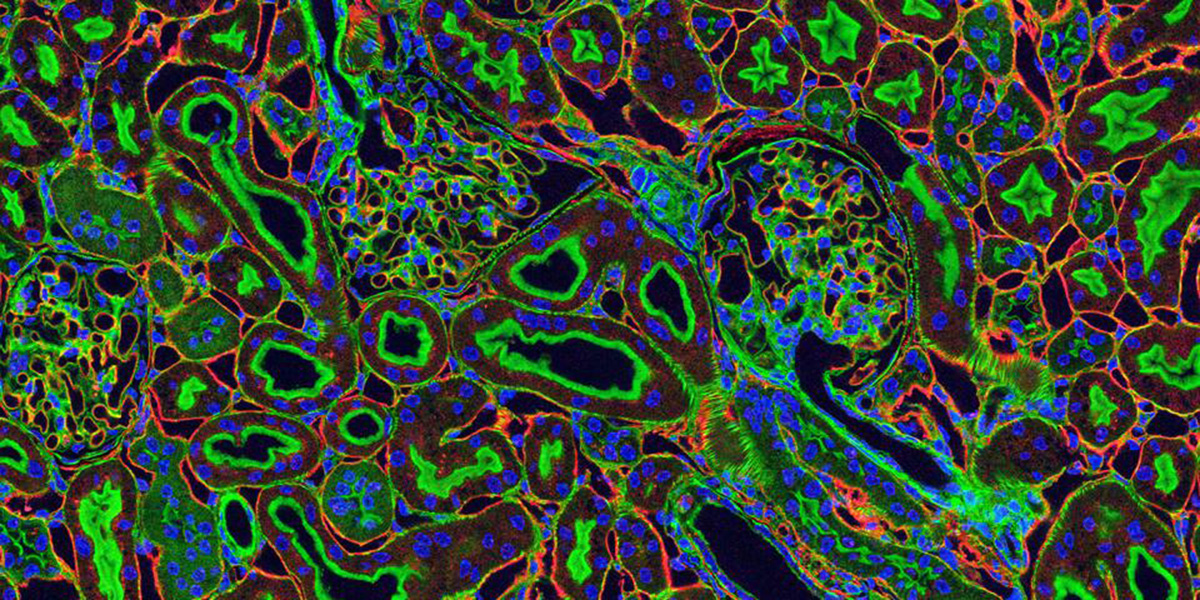
Kidney transplantation is considered the gold standard treatment for kidney failure. However, post-transplant complications in recipients are difficult to diagnose, and there is a current clinical challenge surrounding viable biomarkers that may indicate complications following transplantation. In a recent study published in Molecular & Cellular Proteomics, K. Johanna R. Hoyer–Allo, Patrick Affeldt and their colleagues at the University of Cologne proposed a minimally invasive, highly informative metric for determining transplant success. This metric uses urine-derived protein biomarkers to identify the success of transplantation up to one year post-procedure.
Tom Deerinck and Mark Ellisman, National Center for Microscopy and Imaging Research
Fluorescence microscopy image of stained kidney tissue.
The researchers were able to confirm distinct proteomic differences between kidney donors and recipients recruited to the study. Interestingly, when comparing the 20 most abundant proteins at each of the collection time points, there appeared to be a distinct transplant-related shift. At one-year post-transplantation, inflammatory pathways associated with tissue damage were still enhanced, as well as those related to cell adhesion molecules and extracellular matrix-receptor interactions.
Finally, the team aimed to draw a connection between this proteomic shift and transplantation outcome. They identified a correlation between proteomic profile and common clinical endpoints. The team found that estimated glomerular filtration rate, or eGFR, could be predicted as early as four weeks after transplantation to be linked to elevated levels of carbonic anhydrase, immunoglobulin lambda variable 2-11, and fatty acid binding protein 4. Prediction of eGFR levels one year post-transplant could be linked to proteins including Interleukin Receptor 1 Accessory Protein and Orosomucoid 2, which can potentially be associated with donor-derived immune activation.
This work increases efficiency and minimizes invasive procedures for transplant patients, and it has the potential to greatly improve monitoring of post-transplant patients following a diagnosis of chronic kidney disease.