
When Mayor Ken Sim and his ABC Vancouver colleagues launched their election campaign in 2022, they made a bold promise to hire 100 police officers and 100 nurses.
Three weeks after Sim and his ABC majority council were sworn in November 2022, they unlocked $16 million in the city’s 2023 operating budget to help fund the party’s campaign promise.
This is what ABC Coun. Sarah Kirby-Yung, whose partner is a retired Vancouver police officer, said at the time: “You cannot put a price on public safety, and you cannot put a price on mental health and wellness. And we cannot afford not to do this.”
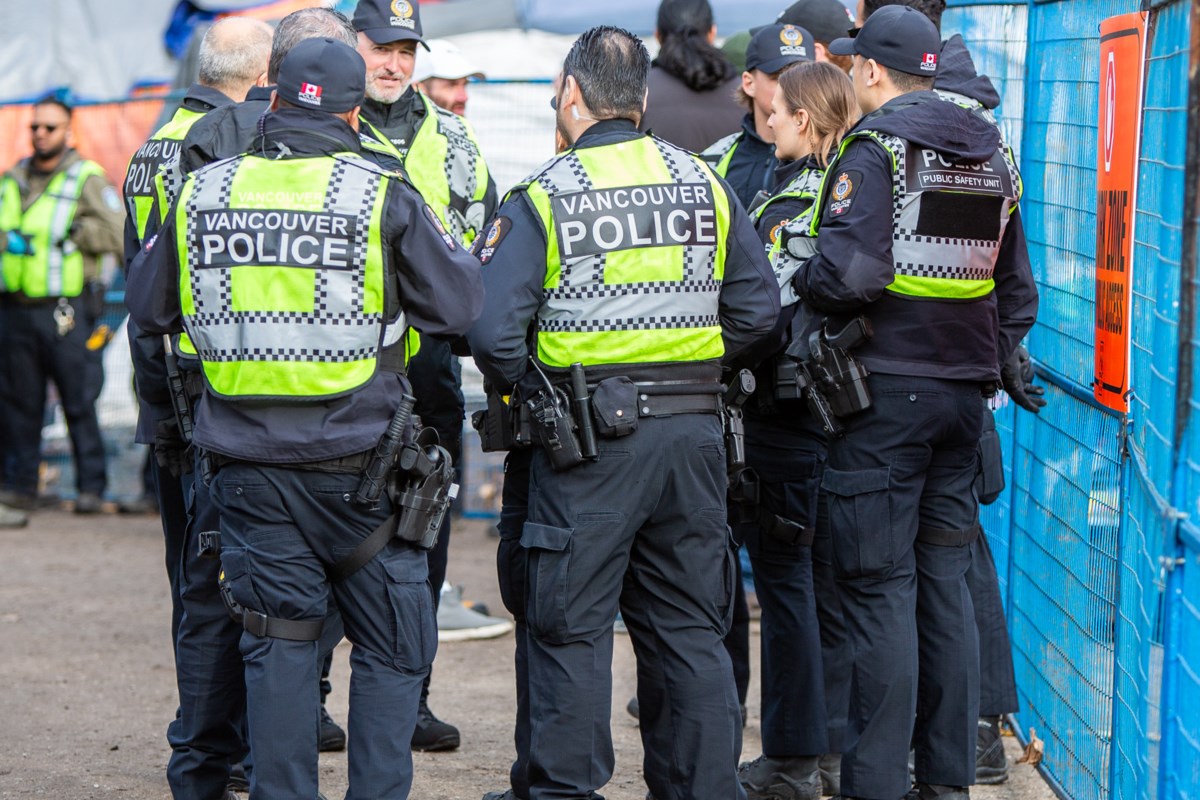
Since then, the Vancouver Police Department has hired a total of 408 officers between November 2022 and Sept. 15, 2026, according to data provided to Business in Vancouver.
During that period, an additional eight officers returned to the department from secondment to other agencies, said Sgt. Adam Donaldson, a VPD media liaison officer, in an email.
At the same time, 319 officers retired or left the department for other reasons.
Donaldson said that leaves the VPD with a net gain of 97 officers, which includes 40 recruits sworn in Sept. 11 at the department’s new training academy in the Woodward’s building.
“This number routinely fluctuates, depending on attrition and officers hired throughout the year,” Donaldson said.

Mayor Ken Sim during a tour Sept. 10 of the VPD’s new training academy in the Woodward’s building in the Downtown Eastside. | Photo Mike Howell
‘We absolutely love you’
The VPD officially opened the academy two weeks ago at an event where Sim spoke to more than 300 people, many of whom were police officers.
During his campaign-style speech, he said: “We hired 175 additional police officers.”
Donaldson explained the numbers.
“The 175-figure referenced refers to the number of officers [roughly] hired between the end of 2022 and beginning of 2024,” he said.
Sim’s office did not respond to a request for comment on why he cited that period.
VPD data shows its current authorized strength is 1,452 officers, an increase of 104 officers since 2022.
Some of the officers hired came from other departments. They received $10,000 signing bonuses through a program that remains active.
Near the close of his speech at the training academy, Sim praised the work of VPD officers.
“I’ve said this numerous times, but you do an incredible job, an incredibly difficult job that very few people can do, and even fewer are willing to do,” he said.
“You run into danger on a daily basis to keep us safe. And so from the bottom of our hearts, thank you for your service. Thank you for your sacrifice. We absolutely love you.”
VPD budget at $497.1 million
A report going before the Vancouver Police Board Sept. 17 says the VPD’s 2026 net operating budget is $497,111,673, representing an increase of $50,013,583 (11.19 per cent) over the 2025 adjusted budget.
“The increase was driven primarily by fixed and contractual wage obligations arising out of the Vancouver Police Union collective bargaining settlement, external agency levy increases, third-party contracts, year 2 implementation of the Body-Worn Camera (BWC) project, and funding to address the VPD’s ask to fund long-standing under budgeted items and inflationary pressures,” the report said.
The VPD operated in 2023 with a budget of $373.5 million.
‘Challenges with hiring capacity’
ABC’s promise to hire 100 nurses was not met, according to a City of Vancouver staff memo sent to council July 2.
The memo said that as of June 1, 41.5 out of 47.5 full-time equivalent positions funded by the city have been recruited for what is called the Urgent Mental Health and Substance Use Service Enhancements program.
Sim and other ABC members have attributed the nurse shortfall to jurisdiction and expertise during previous council debates and scrums with reporters.
The mayor has said that Vancouver Coastal Health (VCH) is the expert agency when it comes to setting up mental health teams. Council’s role was to unlock the money—an estimated $8 million per year—and allow VCH to build the program.
VCH reduced the number of staff required to 58, then to 55, then to 47.5—with the health authority emphasizing the need to have people with a variety of skills connected to the teams, not just nurses.
“VCH continues to recruit, implement the program and refine service delivery, as well as engage in ongoing program evaluation,” said the memo authored by Margaret Wittgens, the city’s general manager of arts, culture and community services.
“Reflecting the challenges with hiring capacity and labour market availability, the program was phased in over subsequent years.”

The Vancouver Police Department operates a command centre inside the Cambie Street precinct. | Photo Mike Howell
Psychiatric nurses diverting police calls
The program comprises psychiatric nurses working in the VPD’s command centre, mobile de-escalation teams, an Indigenous crisis response team and expansion of the police-nurse Car 87/88 teams.
Three physicians work with two of the teams.
Wittgens said the program supported 2,435 Vancouver residents in 2025, “creating safe diversion from police services to appropriate healthcare resources with expanded options for crisis response.”
In a presentation to city council in October 2025, VCH staff provided the following highlights of the program:
• A total of 546 visits by Indigenous crisis response team from April to June, supporting 57 active clients with what VCH staff described as “culturally grounded care.”
• The mobile de-escalation team expanded to seven days a week, improving outreach and follow-up care, with emergency visits reduced by 38 per cent post-intervention.
• Nurses in VPD command centre diverted 1,192 calls between January and July to health-care response.
• Car 87/88 teams served 6,701 people in 2024. The teams located 1,530 people who were assessed and left in their own care. Another 1,515 people were assessed and hospitalized.
X/@Howellings
BIV’s free newsletters cover daily business, real estate, B.C. politics and more. Sign up here for B.C.’s most important business news delivered directly to your inbox.