
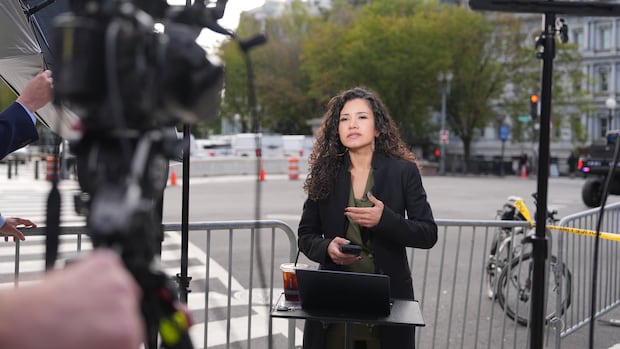
Reporters from three news outlets banned from the White House by U.S. President Donald Trump were back on its grounds on Thursday afternoon, hours after a federal judge ordered the administration to reinstate their access.
CNN, MS NOW and Politico journalists were allowed back after being shut out throughout the morning despite an overnight ruling from a U.S. district judge — the latest development in an extraordinary showdown between Trump and media outlets whose coverage he dislikes.
The news outlets had asked in a court filing Thursday for an immediate hearing to address their inability to access the White House grounds earlier in the day. The filing said a Secret Service agent had confiscated the journalists’ credentials.
In a statement, the White House later confirmed access had been restored and said that Secret Service had indicated the passes were available for pick up at the press gate around 9:45 a.m. ET.
But the delay caused speculation that the Trump administration was defying a court order, which it has been accused of doing in several cases.
WATCH | 3 U.S. media outlets sue Trump administration :
3 U.S. media outlets sue Trump administration
CNN, Politico and MS NOW are suing the Trump administration after being barred from the White House. Major U.S. networks are also suspending pooled coverage, escalating the fight over press access.
The news organizations are seeking to cover the state visit of China’s Xi Jinping, where press freedoms have been curtailed on the mainland and in Hong Kong.
Trump announced he was banning the outlets last week, assailing what he called “fake news,” and later arguing that their reporting was a risk to national security. The outlets argued they were singled out because of the content of their coverage, calling the ban a blatant First Amendment violation.
The ban prompted other media outlets to take action in solidarity. The U.S. network press pool — consisting of five major networks, including CNN — has suspended coverage of Trump pool events pending further notice.
In an order that was filed overnight, U.S. District Judge Timothy Kelly said the media outlets had met the legal thresholds to obtain a temporary restraining order, in effect for 14 days. He said they were likely to succeed in showing that their White House press passes were revoked without due process.
“This is a high bar, but plaintiffs have met it,” he wrote.
The ruling did not address that rotating pool. After Wednesday’s hearing, the networks continued to refuse to air footage of Trump without assurances that CNN would be permitted into the White House pool.
White House argues access ‘a privilege, not a right’
Kelly said the government must have clear standards for conduct that would lead to revoking a press pass. He called the standard of objectionable reporting outlined in letters that the White House sent the outlets “so vague it hardly does the trick.”
Kelly — nominated to the bench by Trump in 2017 — heard arguments on Wednesday from the opposing sides.
Temporary restraining orders are typically designed to preserve the status quo pending a closer review of the case by the court.
Kelly rejected the White House’s claim that revoking the press passes was necessary for national security.
“Nothing in the record… suggests that the revocation of plaintiffs’ hard passes was motivated by national security concerns,” he wrote.
“The court is skeptical … that defendants’ interest in safeguarding national security is the actual motivation for, or is even advanced by, the revocation of plaintiffs’ hard passes.”
WATCH | Did Trump just silence himself?
Did Trump just silence himself? | About That
After the U.S. president revoked White House media access for CNN, MS NOW and Politico, other major U.S. networks including Fox News pulled out of the TV pool coverage in solidarity. Andrew Chang breaks down what the coverage boycott could mean for Trump’s media reach.
(Photo credits: The Canadian Press, Reuters, Adobe Stock, De Nederlandsche Bank and Getty Images)
Ted Boutrous, the lawyer for the plaintiffs, argued in the hearing that there was an urgent need for renewed access, saying that the ban caused irreparable harm to the outlets at a time of momentous news events.
Justice Department attorney Michael Velchik, in his argument, had reiterated the administration’s point that the president had the right to choose who gets into the White House.
“Access to the White House is a privilege, not a right,” Velchik said.
Velchik added that the U.S. president had criticized other news organizations even more harshly — such as calling ABC “the worst” — but hadn’t banned them.
In response, Boutrous said, “Suddenly it’s a national security case,” arguing that the president brought up that point only after the lawsuit was filed.
Trump “keeps proving our point,” Boutrous said, describing how the president has consistently used negative coverage of him as justification for the ban.
Trump also loses Iowa case
Trump, who as a private businessman earned a reputation for being litigious, has sued a number of news outlets since becoming a political figure, making various claims of harm to his reputation.
On Wednesday, an Iowa judge dismissed Trump’s lawsuit accusing the Des Moines Register and its former pollster of misrepresenting the state of the 2024 presidential race, rejecting the president’s claim that the newspaper’s poll coverage violated Iowa’s consumer fraud law.
Calling the case extraordinary, Iowa District Judge Scott J. Beattie said that allowing the lawsuit and its “faulty” claims to proceed could have a chilling effect that “can discourage others from reporting on and debating public affairs.”
The White House said it would appeal the ruling to the Iowa Supreme Court.
Among the other press-related cases winding through the courts are a multibillion-dollar defamation suit Trump has filed against the BBC concerning a 2024 documentary, and a suit against the Wall Street Journal regarding an article connecting Trump to a 2003 birthday for his one-time friend Jeffrey Epstein, who was later indicted for child sex-trafficking offences.