
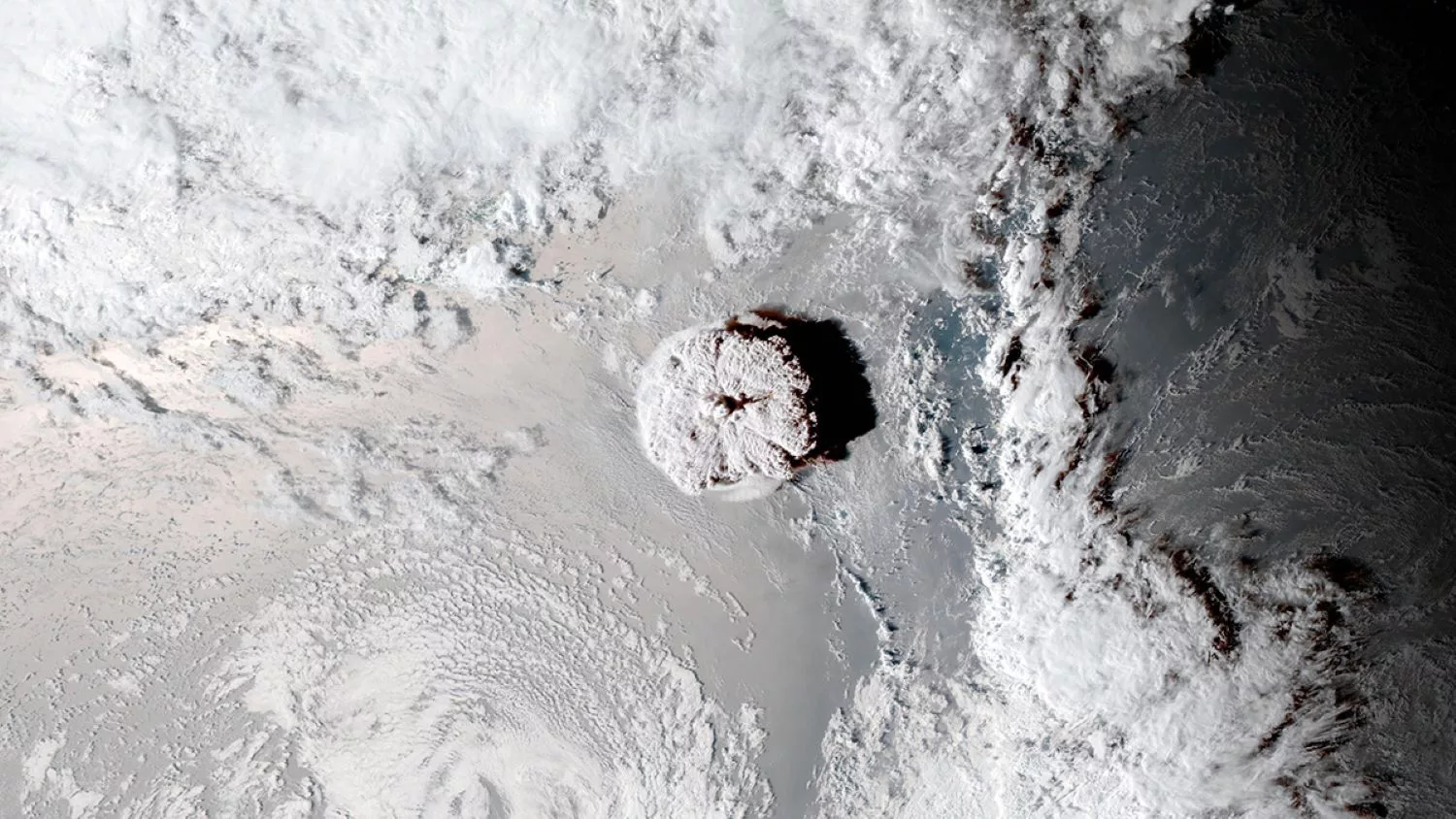
On January 15th, 2022, when the Hunga Volcano in Tonga erupted, the whole world was amazed by what they saw. The explosion of the volcano created such a huge amount of energy that it created shock waves throughout the entire planet, caused tidal waves (tsunamis) to form and move across all of the oceans of the Earth, and threw ash up into the upper layers of the atmosphere called the stratosphere. However, below the water level of the ocean, there were much greater things going on; i.e., the floor of the ocean was collapsing.
The new and repeated high-resolution seafloor mapping allowed scientists to reconstruct how the giant underwater volcano changed shape and what the collapse can tell us about potential dangers of volcanoes.
Authors noted, “These observations reveal previously unrecognized dynamics of submarine caldera formation and highlight the need to reassess hazard assessment associated with small caldera systems worldwide.”
Prior to the eruption, the caldera floor of Hunga was approximately 150 meters below sea level; following the eruption, the caldera floor dropped to almost 850 meters (a drop of 700 meters). The width of the caldera increased slightly from 4.5 to 4.8 kilometers. Overall, the volume of material displaced was estimated to be 8.9 ± 0.1 cubic kilometers.
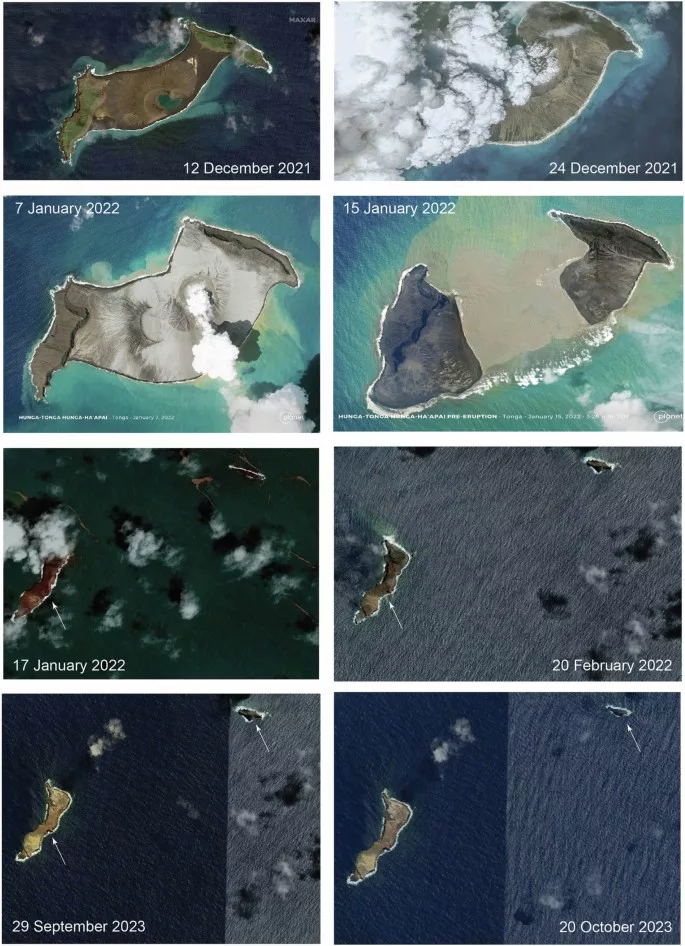 Satellite imagery revealing the evolution of submerged parts of Hunga volcano.
Satellite images showing the emergent parts of Hunga caldera, Hunga Ha’apai and Hunga Tonga islands undergoing continuous changes since December 2021 (upper panels) to October 2023 (lower right panel). White arrows in the lower panels indicate the erosion of Hunga Ha’apai and Hunga Tonga. Satellite imagery sources: Maxar Technologies and Google Earth.
Of this, about 6.85 cubic kilometers came from the caldera collapse itself, while the rest was carved away by eruption-fed density currents scouring the seafloor.
The post-eruption bathymetry revealed more than just a hole in the ocean floor. Scientists found landslide deposits interlayered with pyroclastic infill, evidence that the collapse occurred during the eruption itself. Inward-stepping terraces suggested surface fault splays forming as the caldera floor subsided like a piston.
The geometry of the caldera and its magmatic system indicates that about 8 cubic kilometers of Dense Rock Equivalent magma erupted to trigger the collapse, less than 30% of the total reservoir.
The eruption’s tsunami was one of its most devastating consequences, racing across the Pacific and causing destruction as far away as Peru. The new findings suggest the tsunami’s magnitude was amplified by the speed and style of the caldera collapse.
Even though some of these submarine volcano collapses may seem relatively small in comparison to the largest ones, the authors caution that they can produce disproportionately dangerous tsunamis. Therefore, despite being much smaller than others, these relatively minor eruptions could present significantly greater dangers to coastal communities.
Submarine caldera-forming eruptions are one of the greatest dangers of volcanic activity; however, we know very little about them. It is very hard to study these types of events because we cannot access them easily and therefore cannot understand what happens during a collapse or what kind of materials are produced by an eruption. The Hunga eruption offered a unique opportunity to obtain a map of the seafloor prior to and post-eruption, giving us insight into how these events occur, which typically occur out of sight.
The 2022 Hunga eruption was an example of how the Earth changes dramatically (violently) and frequently as a result of activity occurring beneath the ocean’s surface. Scientists are using their knowledge of the collapse to understand a long-standing geologic puzzle; however, they are also developing models based upon this understanding which will allow them to make better predictions about potential threats.
Although submarine volcanoes appear to be inactive on top, when they collapse underwater, they can cause such large waves that they travel around the world.
Journal Reference:
Ribó, M., Cronin, S.J., Park, SH. et al. Rapid submarine caldera collapse during the 2022 climactic eruption of Hunga volcano (Tonga). Nat. Geosci. (2026). DOI: 10.1038/s41561-026-02099-7