
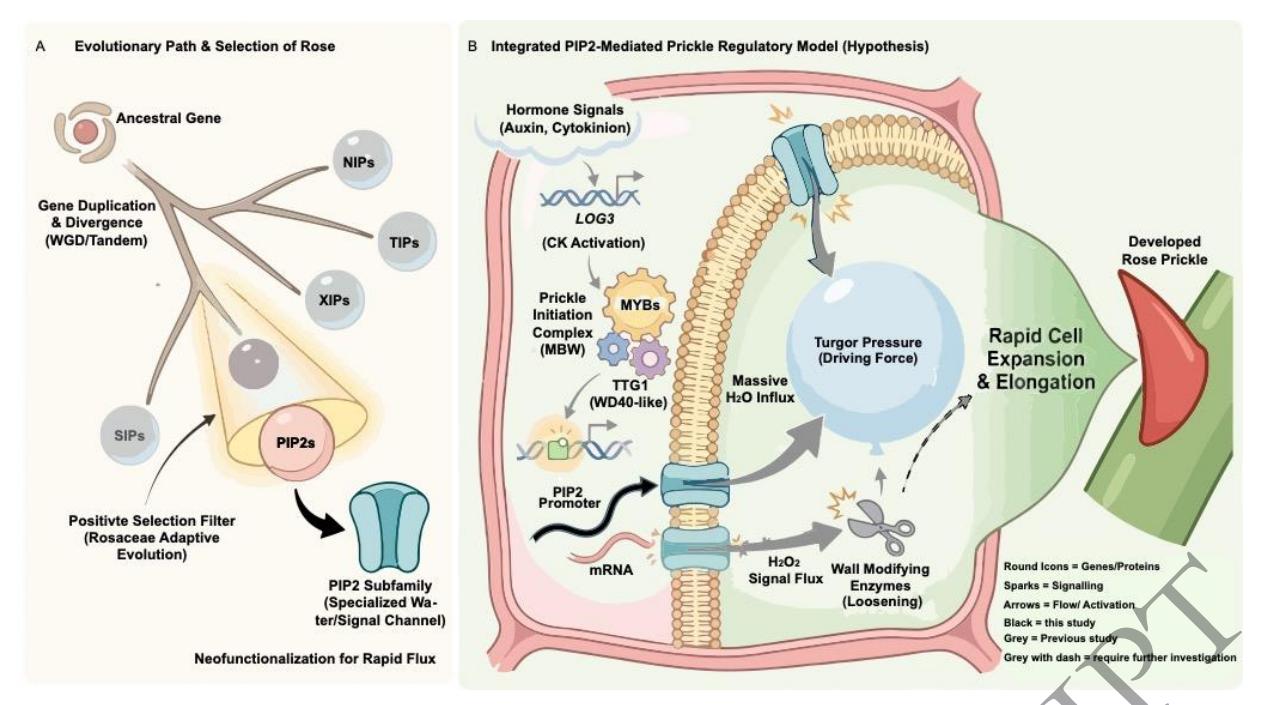
Despite the economic and ornamental importance of roses, the molecular basis of prickle formation has remained largely mysterious. Unlike trichomes (plant hairs), which arise from epidermal cells, prickles originate from cortical cells beneath the surface and are controlled by distinct gene regulatory networks. Previous work identified a genomic region—a quantitative trait locus (QTL)—associated with prickle density that contains two aquaporin genes, but their actual role in prickle development was unknown. Due to these unresolved questions, the functional contribution of aquaporins to prickle morphogenesis needed to be systematically investigated.
Now, researchers from the Kunming Institute of Botany, Chinese Academy of Sciences, and Shandong Agricultural University have published (DOI: 10.1093/hr/uhag143) their findings in Horticulture Research on 14 April 2026. In this open-access study, the team combined evolutionary genomics, spatiotemporal expression profiling, and virus-induced gene silencing to uncover how a specific aquaporin, PIP2;1, regulates prickle development in roses.
The researchers first surveyed aquaporin genes across 26 plant species representing all major lineages—from red algae to flowering plants—and identified 524 aquaporin sequences. While the protein structures of these water channels remained remarkably conserved over hundreds of millions of years of evolution, their regulatory sequences diverged substantially. In the Rosaceae family, which includes roses, the PIP2 and SIP subfamilies showed strong signs of positive selection, suggesting they have acquired new functions. Expression profiling in the prickly rose Rosa gigantea revealed that several aquaporins, including the QTL-associated PIP2;1, were specifically upregulated in developing prickles compared to the underlying cortical tissue. To test whether PIP2;1 actually drives prickle formation, the team silenced its expression using virus-induced gene silencing in the prickly rose variety ‘Samantha’. The results were striking: silenced plants produced significantly fewer prickles on newly formed stems, confirming that PIP2;1 is essential for normal prickle development.
“We were surprised to find that a classical water channel protein has been co-opted for a completely different job—shaping prickles,” said Jin-Yong Hu, corresponding author from the Kunming Institute of Botany. “Aquaporins are incredibly ancient and conserved, yet their regulatory regions have evolved in lineage-specific ways that allow them to respond to developmental signals like hormones. This flexibility may explain how the same protein family can perform such diverse functions across plants.” Mi-Cai Zhong, co-corresponding author from Shandong Agricultural University, added: “Our findings suggest that PIP2;1 doesn’t just move water—it helps generate the turgor pressure needed for cortical cells to protrude and form prickles. It’s a beautiful example of how basic cellular machinery can be repurposed for morphological innovation.”
The discovery that PIP2;1 regulates prickle development has immediate implications for rose breeding. Prickles are a major nuisance for cut-flower production and handling, and current prickle-free varieties are limited. This study provides a precise genetic target—PIP2;1—for developing new cultivars with reduced or eliminated prickles while maintaining the plant’s water-use efficiency and stress tolerance. Given that convergent mutations in a cytokinin biosynthesis gene (LOG3) have been associated with prickle loss across diverse species including eggplant, barley, and jujube, the role of aquaporins may extend beyond roses to other prickly plants. The findings also raise intriguing questions about how developmental signals like auxin and cytokinin coordinate with PIP2;1 expression to control prickle initiation, pointing toward a broader regulatory network that integrates water transport with organ morphogenesis.
###
References
DOI
Original Source URL
https://doi.org/10.1093/hr/uhag143
Funding information
This work was supported by the Organization Department of Yunnan Province (grant no. E43F311261), the Yunnan Province Science and Technology Department (grant no. 202302AE090209), the 811 Project of Shandong Agricultural University (grant no. 539/539528), and the Special Research Assistant Program at the Chinese Academy of Sciences (grant no. E2221141).
About Horticulture Research
Horticulture Research is an open access journal of Nanjing Agricultural University and ranked number one in the Horticulture category of the Journal Citation Reports ™ from Clarivate, 2023. The journal is committed to publishing original research articles, reviews, perspectives, comments, correspondence articles and letters to the editor related to all major horticultural plants and disciplines, including biotechnology, breeding, cellular and molecular biology, evolution, genetics, inter-species interactions, physiology, and the origination and domestication of crops.