
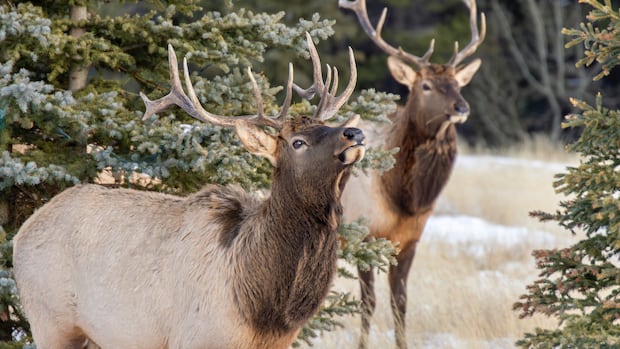
Amid brilliant orange larches, a piercing call echoes through the Bow Valley.
With the fall rut underway, male ungulates across North America are competing for breeding rights.
That includes elk, a common sight across much of Alberta. It’s not uncommon to see — and hear — bull elk trying to assert their dominance in the Canadian Rockies at this time of year.
But while that iconic bugle call might sound just as chilling to human ears across the continent, research from the States suggests elk in different areas could actually be communicating with different dialects.
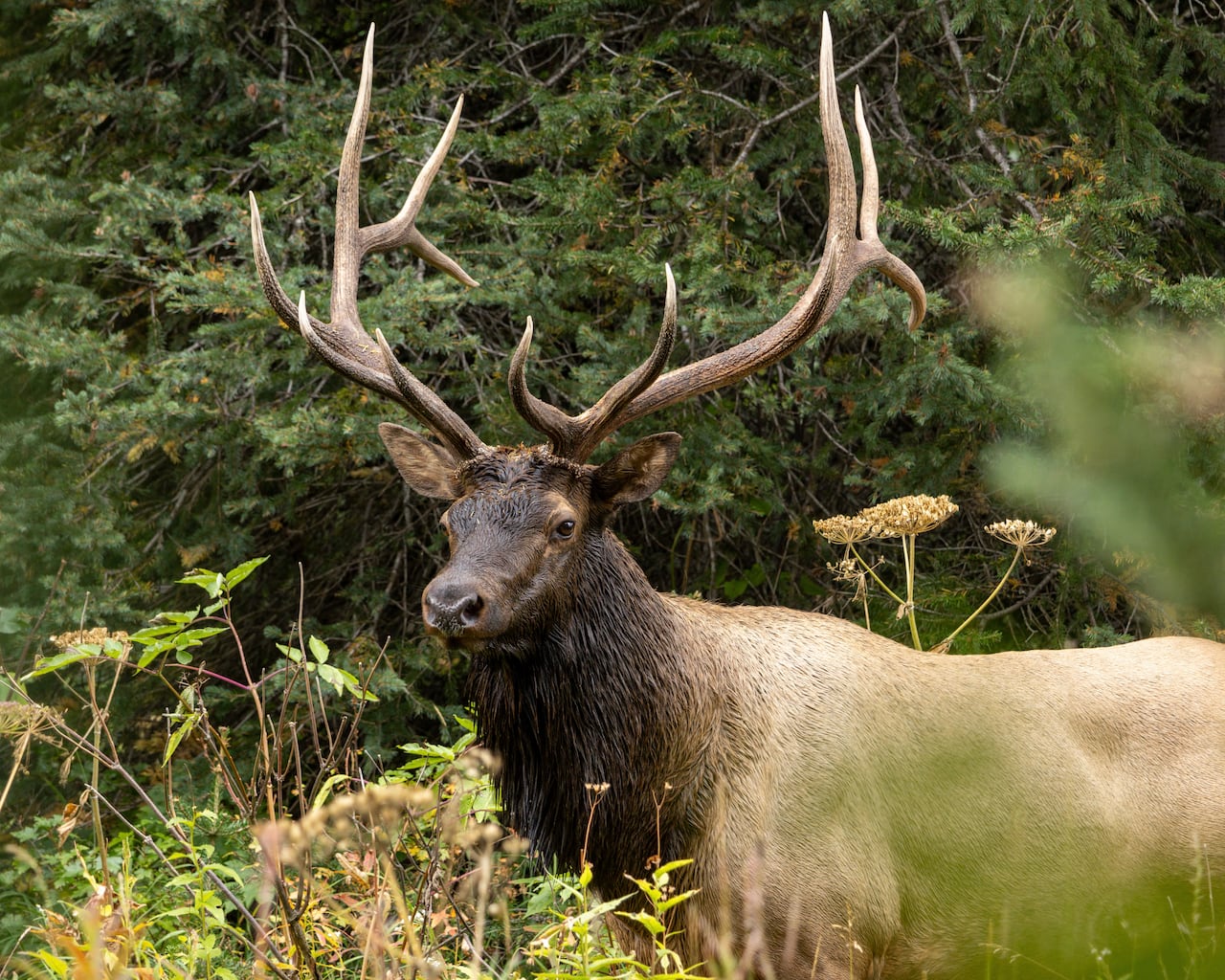 A bull elk in British Columbia’s Yoho National Park. (Amir Said/CBC)
Study author Jennifer Clarke, a biology professor at the University of La Verne in California, published her findings after studying elk populations in Colorado, Pennsylvania and Wyoming.
“These three populations have been separated for long periods of time,” Clark told CBC’s Calgary Eyeopener.
“And like human populations that don’t have contact with one another for a long period of time, the communication takes on its own aspects, unique aspects. And that’s what’s happened with the elk.”
LISTEN | Jennifer Clarke discusses different elk dialects:
Calgary Eyeopener8:30Elk bugle dialects
Why elk in Colorado, Wyoming and maybe Alberta speak their own regional dialects during mating season.
Bull elk bugle to let other males know they are there. Clarke says the bugling is a clear sign of aggression, and are the animal’s way of advertising that they are ready to take on any other male who thinks they can challenge them.
Clarke says bugles can also indicate the age and size of an elk, with younger bulls often sounding “squeaky” compared to the distinctive call of dominant mature males.
But the exact reason behind the different regional dialects remains unclear.
Clarke says the team had initially thought it was due to the elk populations’ different habitats across the states she studied.
“Different sounds travel differently through different habitats,” she said. “If there’s a lot of vegetation, they won’t propagate as well unless there are certain aspects that are altered. If it’s an open habitat, different aspects, different sounds will travel better. “
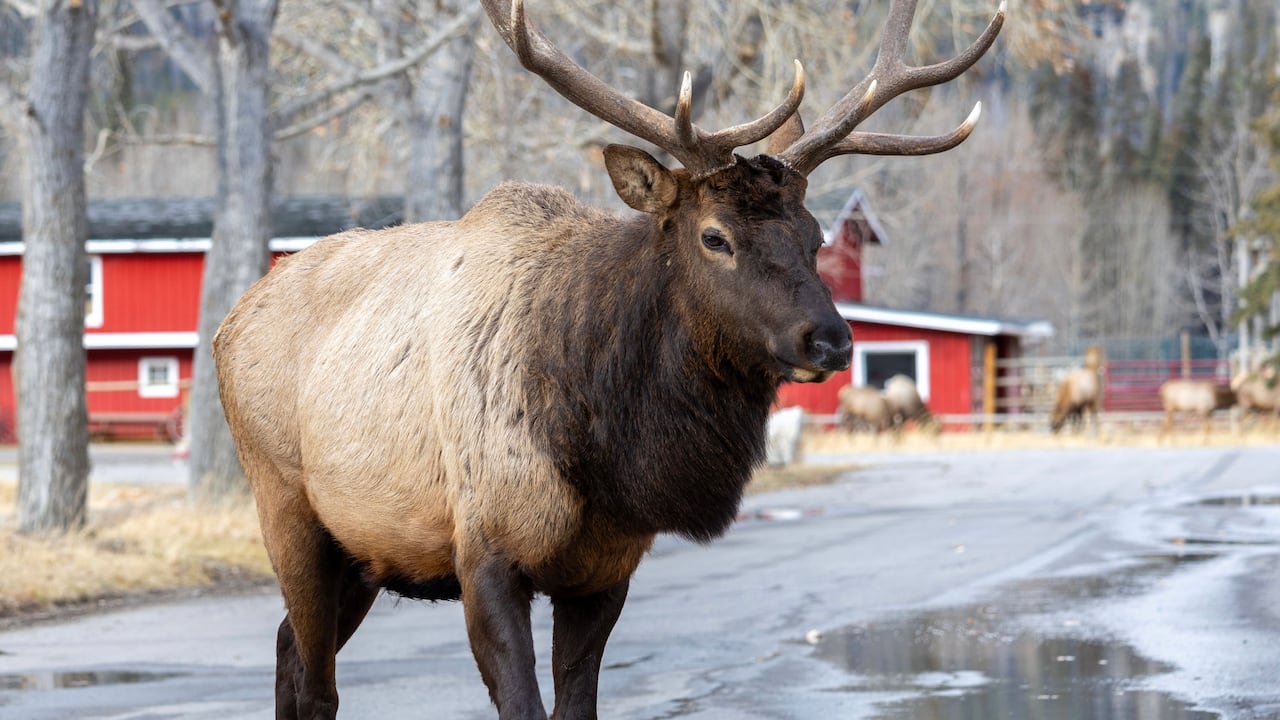 A bull elk crosses the road. Elk made up 138 of the 7,449 roadkill carcasses reported by the provincial government’s Alberta Wildlife Watch in 2025. (Amir Said/CBC)
They expected the Pennsylvania population — which lives in a dense, leafy deciduous forest — to use lower-pitched and longer tonal calls to help the sound carry. Meanwhile, Wyoming and Colorado have more open, dry, and scattered coniferous forests and meadows.
With that in mind, they expected the Wyoming and Colorado populations to sound more similar to each other than to the elk in Pennsylvania.
But the data didn’t support that hypothesis.
The Pennsylvania population’s bugle call was not more different from its source population in Wyoming than Wyoming was from Colorado. All three populations were highly unique, meaning habitat did not drive the dialect differences.
“So that leaves genetics or learning,” Clarke said. “Those are different studies on their own.”
She said research suggests that genetics might play a part, but that there’s still much to learn.
“What we know is that the population in Pennsylvania is it has very low heterozygosity, which means all the animals [are] more genetically similar to one another than the Wyoming population or the Colorado population,” Clarke said.
She said that because of this low genetic diversity, the calls of Pennsylvania elk sound much more similar to one another.
In contrast, Colorado and Wyoming elk calls sound more different from one another within those populations.
As for whether Canadian elk sound any different?
“I could not answer that,” Clarke said. “We were thinking it had something to do with habitat, and it doesn’t. So I could not even make a guess.”
Caution advised as rut underway in Alberta
With the elk rut underway in the Canadian Rockies, caution is being advised due to bull elk being aggressive and unpredictable at this time of year.
A study looking at more than two dozen Canadian national parks found that elk were involved in nearly two-thirds of aggressive wildlife encounters.
WATCH | Study shows majority of risky wildlife encounters do not involve predators:
Study shows majority of risky wildlife encounters do not involve predators
A recent study is shedding light on some of the factors behind aggressive wildlife encounters in Canada’s national parks. As CBC’s Michelle McCann reports, the research shows conflicts rarely include thrill-seeking or risky human behaviour, and a common animal poses the highest risk.
Nick de Ruyter, program director of the BioSphere Institute’s WildSmart program, says elk are frequently seen on fields, playgrounds, trails and other public spaces in Banff and Canmore.
Because these are the exact locations where residents and tourists spend time, the likelihood of close encounters with elk goes up.
“This time of year, the male elk are very aggressive towards anything that gets too close,” de Ruyter said. “That could be a car, or a truck, or a person on a bike, or a dog on- or off-leash, or people, so we just need to give them lots of space.”
He said people sometimes trigger aggressive reactions or attacks by getting too close to elk to take photos or selfies..
“The best thing people can do is give them space,” de Ruyter said. “Normally we say 30 metres or three school bus lengths for elk, but during the elk rut and times like the elk calving season, I like to increase that to 100 metres or 10 school bus lengths, because you just never know how they’re going to react.”
He said people on Bow Valley trails should always be mindful of their surroundings, keep dogs on-leash, and carry bear spray, which also works on elk.