
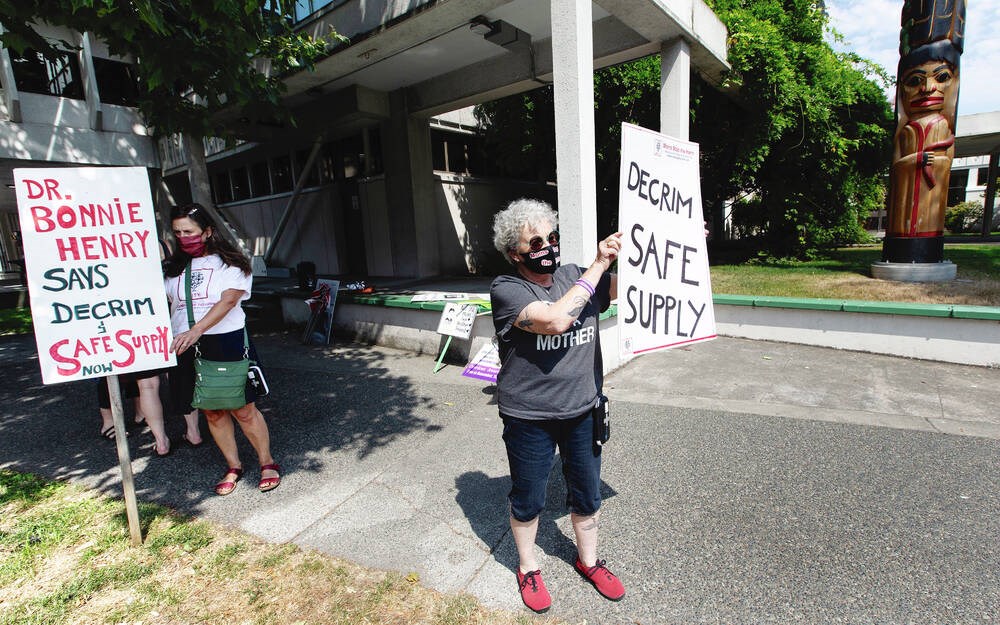
When a drop in overdose deaths failed to materialize, the public lost confidence, which could hurt future efforts to try interventions, says researcher Daniel Myran.
“Overselling” the potential benefits of a pilot project to decriminalize possession of small amounts of hard drugs likely undermined public support, which may have lasting implications, says the co-author of a new study.
When the pilot project didn’t lead to a drastic drop in overdose deaths and injuries as expected, public trust was eroded, said Daniel Myran, a researcher, public health physician, and family doctor with an interest in addiction medicine.
“I think that we’re in an unfortunate circumstance where some of the social benefits that you might see through a reform in drug policy might be missed out on because public support has been eroded for policies of this kind,” Myran said in an interview.
Myran is the co-author of a study published this month in the Canadian Medical Journal on the impact of drug decriminalization and recriminalization on drug-related crime and health outcomes in B.C.
The study found decriminalization had no large or meaningful effect on overdose deaths or hospitalizations for opioids or stimulants.
In January 2023, B.C. introduced the three-year pilot to decriminalize possession of up to 2.5 grams of hard drugs, including opioids, cocaine, methamphetamine, MDMA or ecstasy.
People carrying a personal amount of drugs were no longer arrested or had their drugs seized, but drug trafficking remained a crime.
The goal was to reduce overdose deaths of people using illegal drugs alone in their homes, to improve access to health and harm-reduction services, to reduce stigma, and to open more opportunities for treatment. It was an intervention long advocated for by health officials as well as B.C.’s chief coroner at the time.
But by May 2024, the government had partially recriminalized possession after public backlash about rampant use of hard drugs in public places, including parks, and accompanying street disorder. Possession of small amounts of drugs would only be allowed in homes and shelters, addiction clinics and overdose prevention sites.
By January of this year, the B.C. government had shut the pilot project down entirely, opting not to renew an expiring exemption to the federal Controlled Drugs and Substances Act granted by Health Canada.
Premier David Eby, then Health Minister Josie Osborne and Victoria Police Chief Fiona Wilson said the experiment hadn’t delivered expected results.
Myran said he and his co-authors looked at a five-year period, from August 2020 to March 2025, before and after decriminalization, and found that when decriminalization came in, there was “a very clear and large immediate decline in drug arrests.
After the policy was partially reversed, “the arrests come right back up to the level that they would have been if decriminalization had not occurred,” he said.
But drug deaths and hospitalizations did not follow that same dramatic pattern, according to the study.
The absence of changes in overdose outcomes highlights that there are no simple solutions to the overdose crisis in Canada, and that other interventions are needed, said Myran.
Adding to the public’s discontent was that once the federal and provincial governments were convinced to try decriminalization amid escalating toxic drug poisonings, it was hyped as something that could “deliver meaningful change,” rather than being just one tool in the toolbox.
“The government set very high public expectations,” said Myran.
The premise of “we’re going to see these very large health benefits related to acute overdoses has not been borne out by the data we’re presenting here.”
Myran said addiction and the toxic drug supply is a “wickedly hard problem to solve,” and everyone involved was “rightfully concerned” about the enormous toll the opioid and overdose crisis was taking and was desperately looking for solutions.
Toxic drug poisonings in B.C. were declared a public health emergency in the spring of 2016 and have since resulted in more than 18,000 deaths in B.C. This year, however, the death rate has dropped to an average of about four a day from a peak of seven a day in 2023.
That experience is similar to that in the rest of Canada as well as the U.S., where drug policy was not largely changed, said Myran.
Recent studies suggest declining opioid-related deaths in Canada and the U.S partly reflect Chinese restrictions on the export of fentanyl precursors, which disrupted fentanyl production in North America.
Myran acknowledged decriminalization remains a highly contentious issue to study.
Those who advocated to the federal and provincial government to implement decriminalization maintain it’s an important tool in harm reduction, while others say it was a failure and opened the floodgates to expanded public drug use and street crime.
A related study last week co-authored by Alexis Crabtree, a public health physician and medical lead of harm reduction and substance use services at the B.C. Centre for Disease Control, said “multiple factors” likely affected the decriminalization outcomes.
The study found the clearest benefit of B.C.’s decriminalization policy was that it reduced arrests for drug possession, saying changes made midway through the decriminalization pilot made studying the health impacts harder.
Any renewed attempt at drug liberalization policies would require broad community support, acceptable and accessible health services, and mechanisms to encourage treatment and discourage problematic public consumption, the study said, adding that right now, “few jurisdictions meet those criteria.”
Both supporters and opponents of decriminalization might be wise to focus on areas broadly agreed to be beneficial, such as school-based prevention programs, treatment programs and the provision of naloxone to reverse overdoses, the study suggests.
“The lesson from B.C. is not that decriminalization is irrelevant, but that such policies must be supported within prepared, trusted, and adequately resourced systems.”
Myran said it’s important to understand that decriminalization in isolation does not have a major impact on overdose deaths.
“I’m saying this because I really want us to pursue other things that do work on reducing overdose deaths because I would like there to be less deaths,” he said.