
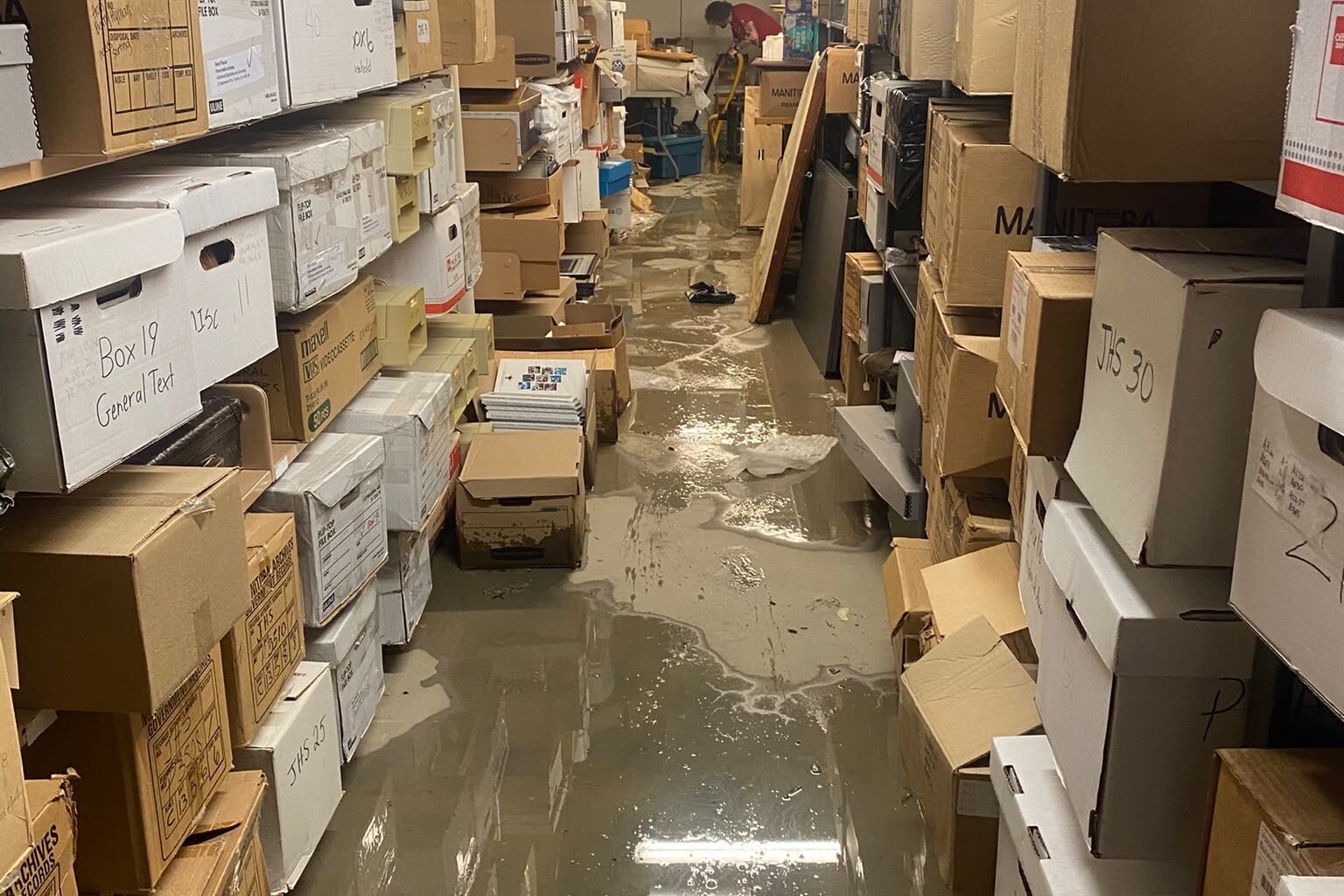
It’s been more than three months since a massive rainstorm hit Winnipeg on June 9, flooding the basement of the Asper Jewish Community Campus, where half the archival collection of the Jewish Heritage Centre of Western Canada was being stored.
The collection includes some 70,000 photographs, old Jewish newspapers, Torah covers, records of Jewish farm colonies and textiles donated by generations of Jewish families from Western Canada and Northwestern Ontario.
If not for the quick response of archivist Ava Garfinkel and a group of volunteers, the collection could have suffered serious damage from mould and been ruined within a day or two. Racing against time, they worked through the night to move sodden boxes upstairs, then called in an Ottawa restoration company that specializes in saving water-damaged paper and archival materials through deep freezing.
Garfinkel believes they managed to save everything except one photograph. But major challenges remain before the collection can return to Winnipeg, including raising $100,000 to build a safer, drier storage space in the same building to protect 130 years of Jewish history.
On today’s episode of The CJN’s North Star podcast, host Ellin Bessner takes Garfinkel back to that frantic, stormy night to recount what happened, get an update on the frozen archives and learn what needs to be done to prevent another disaster.
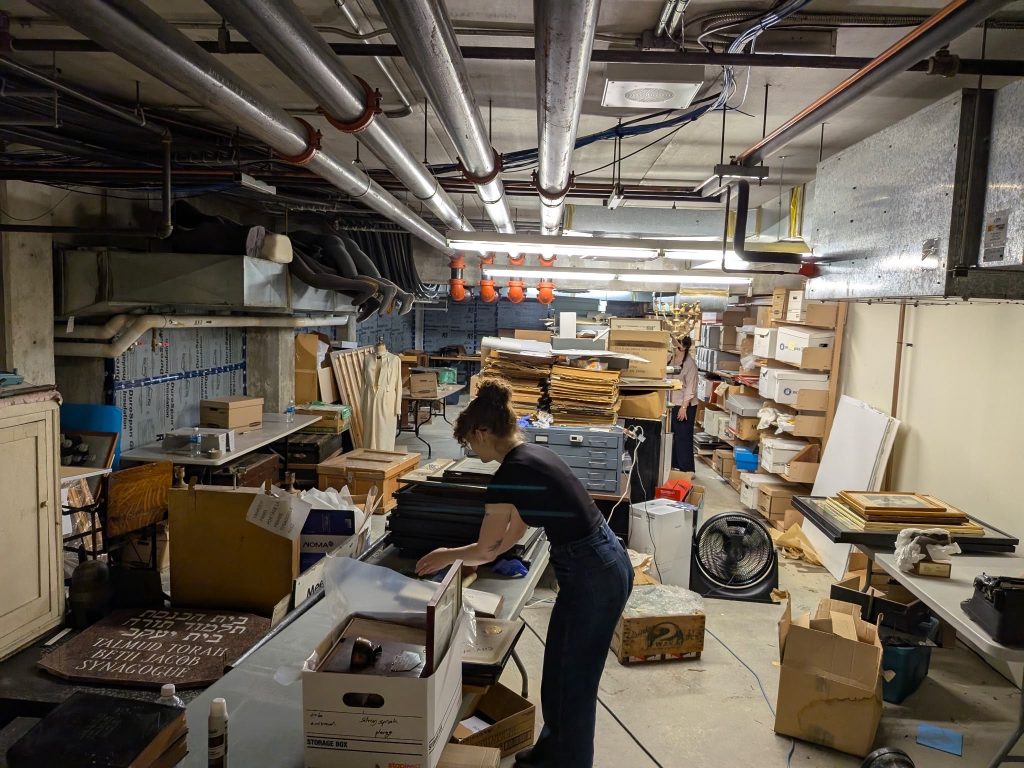 Archivist Ava Garfinkel spent the night moving damaged boxes from the June 9, 2026 rainstorm that flooded the basement of Winnipeg’s Asper Jewish community centre, where despite existing humidity and space challenges, half the collection had been stored. (Submitted photo)
Related links
Read about some of the significant artifacts that the Jewish Heritage Centre of Western Canada holds, including a donated 235-year-old European Torah scroll, once used by communities in Montreal and Saskatchewan, in The CJN, from 2024. Charitable donations to restore and rebuild the archives can be made through the Jewish Heritage Centre of Western Canada’s website.The JHCWC is holding a trivia night Oct. 22 with all proceeds going to the emergency restoration fund for the archives.Watch the full interview and see the damage and restoration efforts on The CJN’s YouTube Channel
Transcript
Ava Garfinkel
Jewish history is so at risk to begin with. I think there’s a lot that has been destroyed and lost, and all that we can keep is just as important as everything else.
Ellin Bessner
Nearly four months ago a torrential rainstorm hit parts of Manitoba and the water caused a flood in the Asper Jewish Community Campus in Winnipeg, which is home to the archives of the Jewish Heritage Centre of Western Canada.
The center holds some seventy thousand photographs plus thousands of other pieces of Western Canadian Jewish history, like Torah covers, linens, old Jewish newspapers, oral history recordings, Jewish farm colony records. Holocaust survivor artifacts, and even some personal documents from notable Manitobans, including Hollywood actress Frances Bay, lawyer and politician Maitland Steinkopf, novelist Adele Wiseman, and nuclear bomb builder doctor Louis Slotin.
Some of the archival documents date back one hundred and thirty years.
Half the collection was being stored in the center’s basement in boxes, for reasons you’ll hear about shortly.
When building staff contacted archivist Ava Garfinkel the night of the rainstorm, her heart sunk, and then she swung into action, braving the dangerous driving conditions to get to work. She knew she had only a few hours to save the collection before it would become mouldy and be ruined. What she did that night with her team of volunteers saved the soggy archives, all but one picture.
The collection’s now in Ottawa with a company specializing in the In deep freeze restoration of damaged museum collections. And although insurance can pay for some of the damage in the archives, bringing it all back to Winnipeg isn’t so easy. The space wasn’t the safest place to store the archives before the flood, and now officials say they need $100,000 in immediate funding to get the right climate-controlled boxes and containers to ensure the threat from humidity and even pests doesn’t put more than a century of Jewish history at risk in the future
I’m Ellin Bessner, and this is what Jewish Canada sounds like for Monday, September 28th, 2026. Welcome to North Star, the flagship podcast of The Canadian Jewish News, made possible thanks to Ira Gluskin and Maxine Granofsky Gluskin’s Charitable Foundation.
The Irma and Marvin Penn Archives, where Ava Garfinkel works, is named after the center’s first archivist, who was also one of the world’s first female Torah scribes. It’s still closed to researchers, so is the Holocaust Education Centre, and there’s only limited donations being accepted.
Even before this natural disaster, they needed a million-dollar endowment fund, long term, to preserve the records and the space, but now they’re looking for emergency donations just to reopen.
Joining us now from Winnipeg is Ava Garfinkel to share what that awful night was like and what was nearly lost.
It’s great to meet you. Thanks for joining us on The Canadian Jewish News North Star Podcast.
Ava Garfinkel
Thanks for having me.
Ellin Bessner
First of all, I want to ask what is the latest today as we’re speaking and then we’ll go back to what happened when that night.
Ava Garfinkel
Everything is a bit mixed up right now. We have our archive in several different places around the Asper Jewish Community Campus. And right now we’re trying to, I guess, put everything in new boxes, give it more effective protective storage, prepare the basement so that everything can go back down to it. And as far as the documents and just archives in general that were affected by by the flood and by the water. those have been in Ontario at a vacuum freeze drying facility. And we’ve actually just been in contact in the last couple of weeks with them there and everything has been going smoothly. It’s really great news coming out of that whole process, which has been a massive relief. because that’s been a bit of an unknown with everything so far away from us.
Ellin Bessner
So you’re talking to me from the archives office. Are you also in the basement or not?
Ava Garfinkel
No, so our office is split. We’ve got our main office is upstairs and then we have an archive that just holds textual records up here as well. And then textual record overflow and the majority of our artifacts are kept downstairs in the basement and then we have a hallway museum as well as the Holocaust Education Centre Museum. So, you know.
Ellin Bessner
Okay. I want to hear about the night of. I want to take you back to the night of.
Ava Garfinkel
Okay.
Ellin Bessner
And it’s June and you’re at home and it’s pouring rain and you get a phone call.
Ava Garfinkel
Yeah, so I think we got actually it was an email, it was sent to everybody, and I got an email notification. I was watching the storm with my sister, and the second the email came through, I pretty much knew immediately. I went, “I know exactly what this is gonna be.”
Ellin Bessner
Who sent the email.
Ava Garfinkel
It was from the campus, from the head of the campus here. He said, “I think the archive is experiencing some flooding”. And there were photos and a few board members had started to have a conversation over the email and they said,” Well, okay, we’ll come in first thing tomorrow.”
And I just knew that I wouldn’t be able to sleep. So I got in the car and I don’t think I’ve ever driven in conditions like that in my entire life.[my sister drove]
The storm was just absolutely insane and we got there around the time we started to get alerts to go to a basement, so it was almost convenient actually, that we should be sheltering in a basement. And yeah, we ended up spending most of the night into the early hours of the morning lifting boxes out of the water, setting them up on tables, just trying to get as much out of the water as we possibly could as quickly as we could.
Ellin Bessner
What did you actually see? Like how many inches or feet of water are up to your knees, up to your thighs, where?
Ava Garfinkel
So in some places the floor there is a bit uneven. So in certain places it was higher than others. I think overall it was the lowest point was about three inches and then some places went a bit higher than that. which doesn’t seem like a lot, but we had a lot of material that was quite low to the ground.
Ellin Bessner
And you say boxes, are you talking about the special protective boxes or just, like, cardboard boxes? Banker’s boxes?
Ava Garfinkel
So we have a mix. You know, our institution’s been in operation since the seventies. So, you know, archival standards have changed over the years. Some of the things that we have are literally cardboard boxes from the seventies and some things are, you know, bankers’ boxes, and then some things are very specialized Hollinger gray archival boxes, and those were like magic. We were so amazed by those when we saw them because they just they held their shape, they protected the material so well. but the other boxes were just completely falling apart, kind of disintegrating in our hands. and we didn’t have enough space to put things on. I think we had tables out into the hallway. and then at the same time, you know, there’s flooding in the hallway. It was quite an intense situation.
Ellin Bessner
You guys have seventy thousand photographs and artifacts, four thousand dolls, clothing, trophies, paper things. I mean, what was in those boxes? And also, did you even know what was in there?
Ava Garfinkel
So initially it was really hard to know what was in there. There were a few points of the process where I started to realize what had become wet and what hadn’t.
And there were some boxes that I wasn’t even entirely sure what was in there, because we just had to get them shipped away to restoration so fast. We were working on an extremely tight timeline. Everything had to be frozen within forty-eight hours to prevent mould growth. So we just didn’t have the time to look at everything. But there were some things that I was feeling quite anxious about. We had a few artifacts here and there. We had thankfully none of our textiles were really affected. We had very old vintage mechanical adding machine. It got quite soaked. There were a few reel-to-reel audio tapes. That was quite upsetting. Thankfully those are things we do have digital copies of, but we always like to retain the original more than we like to retain any digital copies. And the Oral histories, Holocaust histories, histories of people in the community who are no longer around.
Ellin Bessner
How did you know what even to do? Had you ever practiced this before?
Ava Garfinkel
So we’d never run a practice, but we’d had a project that we were implementing before. We were about about two weeks away from starting a project to overhaul the basement and bring it up to a higher archival standard. And we’d had previous dampness in the basement that we’d troubleshooted and handled in a very small, isolated way.
So we did know the broad strokes of it and we did know how to begin, but through the process we’ve learned a lot. there’s also conservation hotlines that museums and archives have access to and are able to call in emergencies. Those have been absolutely so important to us.
Ellin Bessner
You mentioned too that like just two weeks before, you were worrying about maybe fixing the basement. Why were they in the basement in the first place?
Ava Garfinkel
I think in any other context we would be very delighted that our community is so vibrant and growing so much. But in the context of our archive, what it’s meant is that unfortunately we’ve had to give up a lot of our space over the years in the Asper campus to other things like daycares and seniors programming and other community groups that just need that space. So what it’s meant is that, you know, there’s been reshuffling for everybody and what’s happened is that we’ve ended up landing in the basement.
And we’ve tried to do the best with what we’ve got. And there’s just not enough space in this community is the reality.
Ellin Bessner
You knew that you were gonna do the freezing right when you were schlepping boxes? Or that came later?
Ava Garfinkel
I knew immediately that well, the second I saw exactly how much had been affected, I knew that we’re a very small team here. We’re about, you know, three or four people. We cannot in the time that we had dry everything. we needed to freeze it somehow. Because what happens is after 48 hours, mould starts to grow and the fight against mould once it develops is a harrowing fight that you can’t really win. It becomes nearly impossible, especially with masses of material at that size and in a room with so much humidity and it just would have been an absolute nightmare.
Ellin Bessner
Anybody that’s had a flood knows that from their own personal experiences. It smells, It’s dangerous police. The fire department, the insurance, they tell you “You gotta throw it out,”
Ava Garfinkel
It destroys everything too. It just it eats right through things. And, you know, you can send things to conservation, to sort of remediate against mould but it’s not a guarantee that it’s gonna come back or that it’s ever going to be fully gone. So it’s just better never to get it. In an archive it’s kind of your worst nightmare.
Ellin Bessner
So why does I mean we talked a little bit before that you digitized some things. Why do you think it’s important that these physical records matter when so many things are already digitized?
Ava Garfinkel
When you digitize something, you lose some of the material. you lose some of the information. And it might not be necessarily the data, the words that are written on a piece of paper, but it can be the paper itself, or it can be things written on like the back or the way it’s deteriorating or the way it’s folded. You know, you get information that you wouldn’t expect from a physical artifact that you wouldn’t necessarily get in a digital scan. My background is in archaeology, so I’m used to working with very, very tiny fragments of material and we can glean an enormous amount of information from these very tiny fragments.
Jewish history is so at risk to begin with. I think there’s a lot that has been destroyed and lost and all that we can keep is just as important as everything else, right? So even if it’s just a you know, a piece of paper that you don’t think is gonna be very important, it could actually end up being more important to you know, a researcher or a genealogist or even just somebody looking for personal interest years later, right?
Ellin Bessner
And so what could have been lost from Canadian Western and Northwestern Ontario Jewish history had you not gone there that night?
Ava Garfinkel
Yeah, we had many, many, many photographs were in those boxes. We had a lot of records from we hold the records of the Western Canadian division of the Canadian Jewish Congress. Some of those were involved in the flood. They’ve all been vacuum freeze dried; they’re all coming back to us. They seem to be in fairly good condition from what we’ve heard. We’re feeling quite optimistic about that.
There’s a lot of photos. We hold a lot of records of Jewish farm colonies in Western Canada, a lot of which those communities no longer exist. And we’re solely responsible for their history so those records are something that’s very important to us and something that we really try hard to preserve. And you know, the material that got wet wasn’t all that was at risk. If we hadn’t been able to remove everything in time, mould would have developed and started to affect everything else in the space, and the air, the space. Afterwards we had to remove everything from the basement. It is now completely empty because it was too humid and there was a continued flood risk after the structural damage happened. You know, there’s a lot that could have ended up being lost. We have so many records. We have, my gosh, we have like a massive amount of material. we’ve got manuscripts, photographs, audiovisual media, and newspapers, I think artifacts. We’ve got a massive textile collection as well.
Ellin Bessner
Tell me about that. I know that’s your background. Textiles. You mean clothing? Do you mean tallis bags, tallitot, things like that?
Ava Garfinkel
Yeah, so we have Torah covers, ark curtains, we have tallitot, we have cantorial robes, we have people’s clothing from way back. We have a lot of wedding dresses. we have tefillin, we have shoes, we have all sorts of personal artifacts, we’ve got all sorts of trousseaux, that women had made for them way back and their families have preserved,
Ellin Bessner
For our audience, you’ve got to tell them ’cause nobody knows what that is now. It’s
Ava Garfinkel
It’s
Ellin Bessner
It like their dowry thing, yeah.
Ava Garfinkel
Clothing and household textiles that would go to a woman sort of as a dowry when she married into a new family.
Ellin Bessner
So the Torah covers? That was not wet and none of that stuff? The Judaica was not wet? Thank God.
Ava Garfinkel
No, no, none of the none of the textiles got wet. It was a lot of photographs, paper documents, a lot of audio. Audio, digital material. We had a collection of floppy discs. They weren’t even working anymore. we’d actually were preparing to get rid of those. They had been transferred to
Ellin Bessner
A bit of a silver lining no?
Ava Garfinkel
Yeah, so it saved us a bit of time.
Ellin Bessner
If you’re listening to North Star, you can also watch our interviews on The Canadian Jewish News’ YouTube channel.
Let’s talk a bit about what isn’t happening at the archives now because of this incident that happened. How are researchers impacted? And also maybe your Holocaust Museum and other things you were planning to do.
Ava Garfinkel
So, our Holocaust Museum is closed right now and our offices are closed to regular visits. There’s some acquisitions that we’ve been taking, that are a bit more pressing. So we have been making exceptions here and there now that things have calmed down a little bit in the last three months.
We’ve also been hit really hard by Bill C-3 and the effects of that Canadian citizenship bill: the new Canadian citizenship bill relies heavily on archival documentation. So we’ve had a lot of people contacting us looking for records of their family. and we’ve just had to push a lot of that back.
Ellin Bessner
Wha tell me about that. I’m not familiar with the what does that mean?
Ava Garfinkel
Bill C-3, it basically says that if you had a Canadian relative in the past, as long as you can track your history and track your family connection reliably, through documentation, you can apply for Canadian citizenship.
Ellin Bessner
And these are Jewish people whose family came here or lived here years ago and where are they do they not live in Canada? I mean, I don’t know about
Ava Garfinkel
a lot of them are American. We’ve had a lot of American requests. so there’s been there’s things have been very busy, not just for our archive, but archives all over Canada have been
Ellin Bessner
It’s actually interesting. The Americans are trying to come home so that they can escape whatever Trump business or whatever for whatever reasons?
Ava Garfinkel
We’ve been trying to get to as much of it as we can, but even regularly we have usually a backlog of research. So now we have an even bigger backlog because of the flooding and the Bill C-3 stuff because, you know, when it rains it pours.
Ellin Bessner
No pun intended. Yeah. Yeah. And you said you’re gonna have to close the center. This is back to school time and a lot of school groups, I assume, would be coming in as they learn towards November and Kristallnacht and Holocaust Education Week. Is that gonna be able to be, you think, reopened in time for that?
Ava Garfinkel
We’re trying to get things moved as fast as we possibly can. the work that we need to do to prepare the basement to return the archives to it goes the way that any sort of construction or any sort of project like this goes where every once in a while there it starts to be a series of roadblocks. But things are starting to look really good right now. We’re about to seal the floors there and do some work to reduce the humidity. overall and set up new shelving and a few other protective measures so that we can start moving stuff.
Ellin Bessner
So are we talking timeline a month?
Ava Garfinkel
So I’m thinking at this point it’s gonna be two, two to three.
Ellin Bessner
How do you expect your space will be renovated in order can it be renovated now with this limited scope to mitigate preserving the heritage materials from climate change?
Ava Garfinkel
Well we’re doing right now is we’re setting up the basement in a way that there are several layers of protection so that if something like this or another sort of disaster happens again, that there’ll be several lines of defense for all of the material that’s in there. And that goes down to the what’s going on directly inside the box that the material is in, but also on the shelf and outside the shelf and in the general vicinity of the room around it. We’re also creating a climate that’s better situated. That’s a project we’ve wanted to for quite a while as we’ve wanted to stabilize the humidity in that room. So, you know, we are finding opportunities in all of the, you know, tragedy.
Ellin Bessner
Are you going to come to to Ontario and and have a look at this stuff or how how do you even get to see what they’re doing?
Ava Garfinkel
So thankfully, modern technology has allowed us to have a lot of Yeah.
Ellin Bessner
You on their Zoom and they show you?
Ava Garfinkel
There’s a lot of material that we’ve looked at individually. There’s a few things that needed specialized care. so
Ellin Bessner
Tell me about that, yeah.
Ava Garfinkel
So we have a collection of half-tone photo engravings, which are like photo blocks that were used by the Israelite press. Every time somebody was in the newspaper, they would print a block with their face engraved in metals so that they could Use it on the printing press. We have a lot of those photo blocks and one of the boxes did get damp and the bottom of those are wood and the top are engraved metal and they cannot be put into vacuum freeze drying chamber like everything else can. The facility there is handling a few specialized materials that are being looked at there. ‘s if I believe it’s in Ottawa.
Ellin Bessner
It’s in Toronto? Where is this place?
Ava Garfinkel
I believe it’s in Ottawa.
Ellin Bessner
And there’s no insurance for this? Why do you need to raise a hundred thousand dollars?
Ava Garfinkel
There is insurance, but insurance only goes so far. There’s insurance will cover what the restoration work that we’ve gotten done, but the project that we need to do now is to set up the space for the future so that if th this does happen again, it won’t affect anything that’s in our archive. That is an expensive project. And we also have a an emergency fundraiser coming up, which is gonna be a trivia night, to try to I guess drum up a bit of support for the project and bring people’s attention to, you know, the history that we are preserving.
Ellin Bessner
Well give you the last word. The general public may not understand what is at stake. Why is it important?
Ava Garfinkel
That we preserve the memory of this community. And I think we talk about memory a lot in Jewish kind of culture. And I think that so much of this memory is at risk and has in the past been eroded by time and by external factors. And we’re doing what we can to preserve it and make sure that it remains. And it’s not just our own community here, it’s other communities that no longer exist that we’re trying to preserve and we’re trying to create access to these things for researchers and genealogists and students and, you know, members of the public whose own families are preserved here.
I think a lot of people don’t realize how thorough our records are. There are a lot of people in this community I think that don’t actually know that their family are preserved here because their family aren’t necessarily preserved because they donated a document. Oftentimes an organization like a synagogue will donate a document or newspapers or different organizations that people have been part of throughout the years. You know, people’s lives are really recorded and kept here.
And it’s just very, very important to preserve as much as we can of our history and culture. I think all history is sort of at risk from technology and time, but I think Jewish history in particular were, you know, people of diasporas We move around a lot and not always by choice and not always in good conditions. and the result of the Holocaust and the massive amounts of information and history that was lost in that period of time makes it all the more dire, I think, to protect what we do have, what little still remains of certain times and places that no longer exist.
Ellin Bessner
It’s really been an eye-opener to hear from you and we wish you only good news as we get closer to the big restoration repatriation. Speak to you again and check in with you when we have news.
And that’s what Jewish Canada sounded like for this episode of North Star. Made possible thanks to the Ira Gluskin and Maxine Granofsky Gluskin Charitable Foundation.
On a personal note, I spent many hours at those archives in Winnipeg a decade ago to research my book on Western Jewish soldiers who served in the Second World War. Those records were beyond crucial, so this story is personal for me too.
To learn more and to donate to restore the Jewish Heritage Centre of Western Canada’s archives, you can go to the links in our show notes.
North Star is produced by Zachary Judah Kauffman and Izzy Hellenchilde. Michael Fraiman is the executive producer and Alicia Richler is The CJN’s editorial director. Thanks for listening.
Show Notes
Credits
Host and writer: Ellin Bessner (@ebessner )Production team: Zachary Kauffman (senior producer), Izzie Helenchilde (producer and video editor),l Michael Fraiman (executive producer), Alicia Richler (editorial director)Music: Bret Higgins
Support our show